Pang Yunguo, Zhao Jinmin, Fowdur Mitra, Liu Yun, Wu Hao, He Maolin
Division of Spinal Surgery, The First Affiliated Hospital of Guangxi Medical University, Nanning, Guangxi, China (mainland).
Guangxi Key Laboratory of Regenerative Medicine, Guangxi Medical University, Nanning, Guangxi, China (mainland).
Med Sci Monit Basic Res. 2018 Jan 17;24:16-25. doi: 10.12659/msmbr.908107.
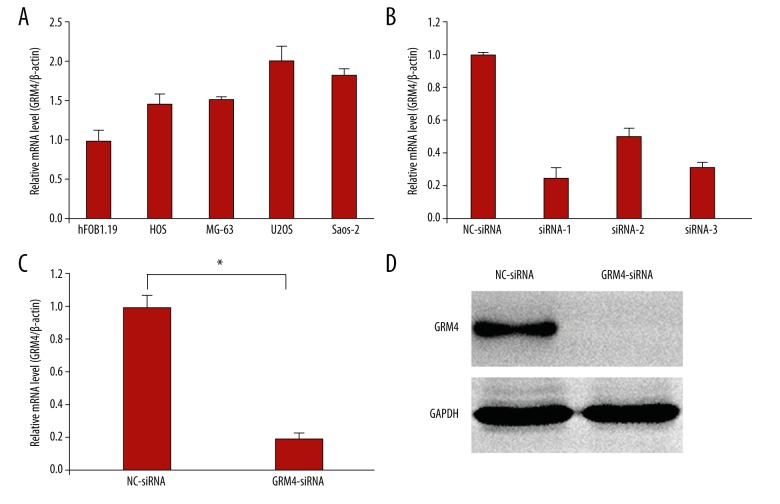
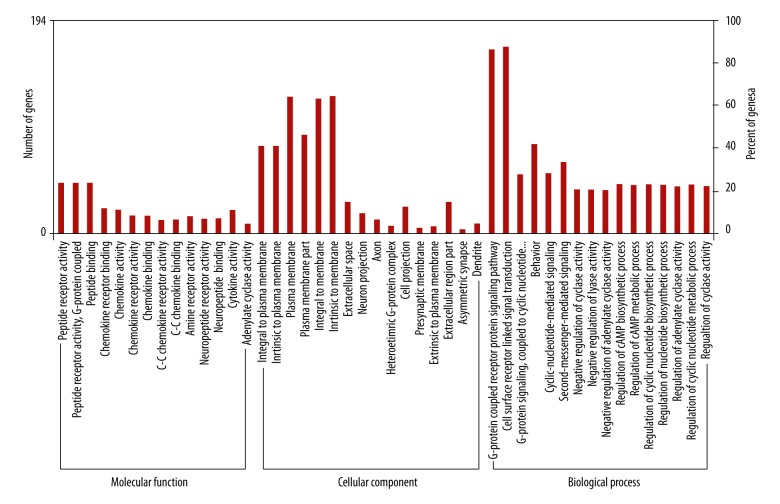
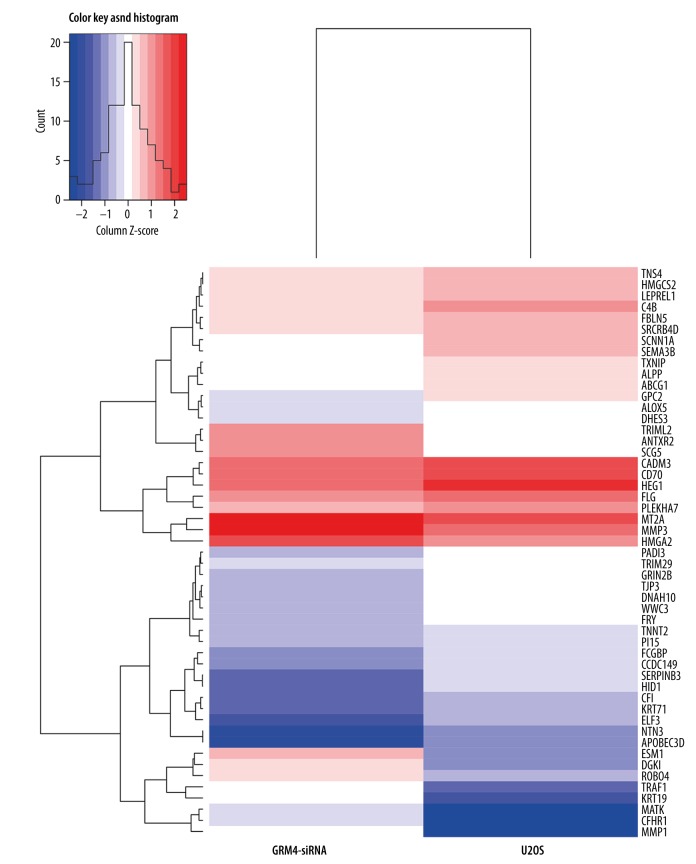
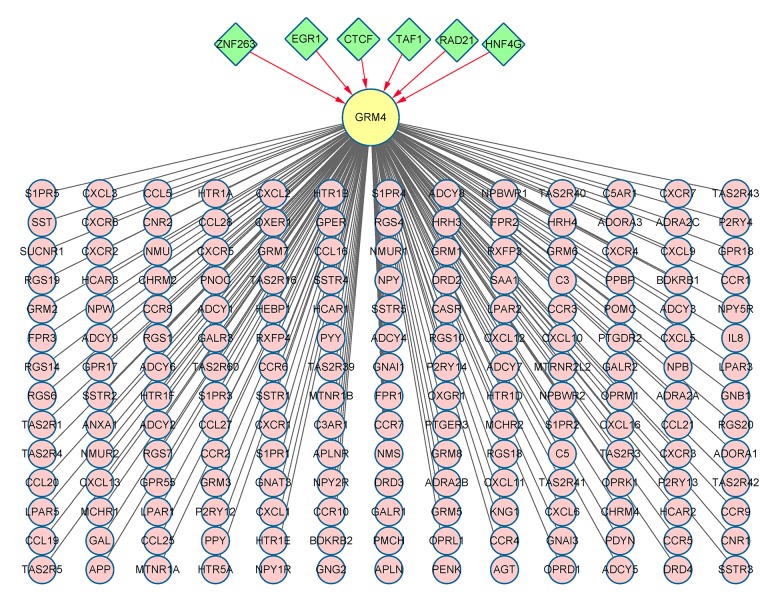
BACKGROUND Glutamate metabotropic receptor 4 (GRM4) has been correlated with the pathogenesis of osteosarcoma. The objective of this study was to explore the underlying molecular mechanism of GRM4 in osteosarcoma. MATERIAL AND METHODS The expression levels of GRM4 in four human osteosarcoma cell lines and hFOB1.19 cells were examined by real-time quantitative PCR (RT-qPCR). The U2OS cells of the highest GRM4 expression were transfected with lentivirus-mediated small interfering RNA (siRNA). The differentially expressed genes (DEGs) after GRM4 gene silencing were screened through RNA sequencing, and analyzed by bioinformatics. Additionally, the transcription factors (TFs) targeting GRM4 were predicted and the downstream protein-protein interaction (PPI) network was constructed using the bioinformatics approach. RESULTS A total of 51 significant DEGs were obtained, including 14 upregulated and 37 downregulated DEGs. The Kyoto Encyclopedia of Genes and Genomes (KEGG) pathway enrichment analysis of the DEGs indicated that four significant enrichment pathways were obtained. A total of six TFs that could be involved in the transcriptional regulation of GRM4 were detected. The results showed that 182 genes in the PPI network were significantly enriched in 14 pathways. The chemokines and chemokine receptors were found to be significantly enriched in three pathways. CONCLUSIONS The DEGs in the four significant enrichment pathways might participate in the development and progression of osteosarcoma through GRM4. The results revealed that EGR1 and CTCF are probably involved in the transcriptional regulation of GRM4, which participates in the progress of osteosarcoma by interacting with chemokines and their receptors.
背景 代谢型谷氨酸受体4(GRM4)与骨肉瘤的发病机制相关。本研究的目的是探讨GRM4在骨肉瘤中的潜在分子机制。
材料与方法 通过实时定量PCR(RT-qPCR)检测GRM4在四种人骨肉瘤细胞系和hFOB1.19细胞中的表达水平。用慢病毒介导的小干扰RNA(siRNA)转染GRM4表达最高的U2OS细胞。通过RNA测序筛选GRM4基因沉默后差异表达的基因(DEG),并进行生物信息学分析。此外,预测靶向GRM4的转录因子(TF),并使用生物信息学方法构建下游蛋白质-蛋白质相互作用(PPI)网络。
结果 共获得51个显著的DEG,包括14个上调的DEG和37个下调的DEG。对DEG进行京都基因与基因组百科全书(KEGG)通路富集分析,得到四条显著富集的通路。共检测到六个可能参与GRM4转录调控的TF。结果显示,PPI网络中的182个基因在14条通路中显著富集。发现趋化因子和趋化因子受体在三条通路中显著富集。
结论 四条显著富集通路中的DEG可能通过GRM4参与骨肉瘤的发生和发展。结果表明,EGR1和CTCF可能参与GRM4的转录调控,GRM4通过与趋化因子及其受体相互作用参与骨肉瘤的进展。