Jardim Thiago Veiga, Inuzuka Sayuri, Galvão Luan, Negretto Leandra Anália Freitas, de Oliveira Rogério Orlow, Sá Wanessa Faria, de Souza Haroldo Silva, Sousa Andrea Crisitina, Carneiro Patricia Silva, Barroso Weimar Kunz Sebba, Sousa Ana Luiza Lima, Jardim Paulo César Veiga
Hypertension League, Federal University of Goias, 1ª Avenida, S/N.-Setor Universitário, Goiânia, GO CEP 74085-300 Brazil.
Division of Cardiovascular Medicine, Brigham & Women's Hospital, 75 Francis Street, Boston, MA 02115 USA.
Diabetol Metab Syndr. 2018 Jan 8;10:3. doi: 10.1186/s13098-017-0305-2. eCollection 2018.
Although multidisciplinary treatment is recommended for type 2 diabetes mellitus and hypertension (HTN), there is a lack of scientific literature supporting the hypothesis of extending this treatment strategy to patients with both diabetes and HTN. Aiming to report results of long-term multidisciplinary treatment for these patients and identify strategies to improve their management, we conducted this study.
Data of patients with diabetes and HTN with regular follow-up visits in a multidisciplinary HTN treatment center from Brazil's Midwest were retrospectively assessed. Patients ≥ 18 years enrolled in the service by June 2017 with a minimum of three visits were included. Anthropometric, blood pressure (BP), laboratory, pharmacological treatment, lifestyle, and cardiovascular events data were collected from first (V1), intermediate (V2) and most recent (V3) visits to the service. BP < 130 × 80 mmHg, LDL-cholesterol (LDL-C) < 70 mg/dL and HbA1C < 7.0% were defined as treatment targets. Wilcoxon signed-rank test was used to compare variables along study visits. A linear regression model was built to identify variables associated with better overall patient control.
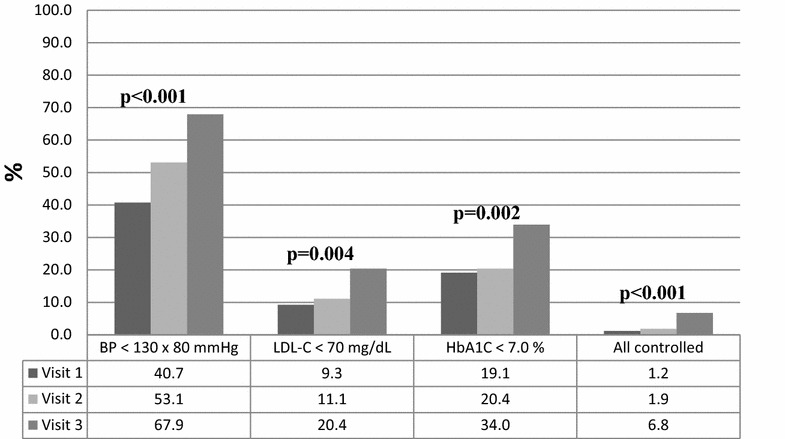
A total of 162 patients were included (mean age of 56.5 ± 10.8 years). Median follow-up time was 60 (IQR 40-109) months, 80.2% of the sample was female and 83.3% had no cardiovascular event history. BP, total cholesterol, LDL-C, triglycerides and HbA1C values showed a significant trend to improve along the study visits (p < 0.001). Growing trend in aspirin (p = 0.045) and statins (p < 0.001) use was found, in addition to treatment compliance increase (p < 0.001). Significant improvement trends in BP (p < 0.001), LDL-C (p = 0.004) and HbA1C (p = 0.002) control were also found across visits. Control rates of BP, LDL-C and HbA1C in combination were low in V1, V2 and V3 (1.2, 1.9 and 6.8%, respectively), but showed significant improvement trend (p < 0.001). Treatment compliance (β-coefficient = 1.20; 95% CI 1.07-1.34; p < 0.001) was positively associated with better overall patients control.
Multidisciplinary treatment of patients with diabetes and HTN significantly improved clinical and laboratory parameters, despite ageing of population evaluated. Although combined control of HbA1C, BP and LDL-cholesterol increased along follow-up, management of all these three conditions needs to improve, and focus on treatment compliance should be given to attain this goal.
尽管推荐对2型糖尿病和高血压(HTN)进行多学科治疗,但缺乏科学文献支持将这种治疗策略扩展至糖尿病合并HTN患者的假设。为了报告这些患者长期多学科治疗的结果并确定改善其管理的策略,我们开展了本研究。
对巴西中西部一个多学科HTN治疗中心定期随访的糖尿病合并HTN患者的数据进行回顾性评估。纳入2017年6月前登记入组该服务且至少就诊3次的≥18岁患者。收集从首次(V1)、中间(V2)和最近一次(V3)就诊时的人体测量学、血压(BP)、实验室检查、药物治疗、生活方式及心血管事件数据。将血压<130×80 mmHg、低密度脂蛋白胆固醇(LDL-C)<70 mg/dL和糖化血红蛋白(HbA1C)<7.0%定义为治疗目标。采用Wilcoxon符号秩检验比较各研究就诊时的变量。建立线性回归模型以确定与患者总体控制更佳相关的变量。
共纳入162例患者(平均年龄56.5±10.8岁)。中位随访时间为60(四分位间距40 - 109)个月,样本中80.2%为女性,83.3%无心血管事件病史。BP、总胆固醇、LDL-C、甘油三酯和HbA1C值在各研究就诊时呈显著改善趋势(p<0.001)。除治疗依从性增加(p<0.001)外,还发现阿司匹林(p = 0.045)和他汀类药物(p<0.001)使用呈上升趋势。各次就诊时BP(p<0.001)、LDL-C(p = 0.004)和HbA1C(p = 0.002)控制也有显著改善趋势。V1、V2和V3时BP、LDL-C和HbA1C联合控制率较低(分别为1.2%、1.9%和6.8%),但呈显著改善趋势(p<0.001)。治疗依从性(β系数 = 1.20;95%置信区间1.07 - 1.34;p<0.001)与患者总体控制更佳呈正相关。
糖尿病合并HTN患者的多学科治疗显著改善了临床和实验室参数,尽管所评估人群老龄化。尽管随访期间HbA1C、BP和LDL胆固醇的联合控制有所增加,但这三种情况的管理仍需改善,应注重治疗依从性以实现这一目标。