Park Jihong, Seeley Matthew K, Francom Devin, Reese C Shane, Hopkins J Ty
Department of Sports Medicine, Kyung Hee University, Yongin, Gyeonggi, Korea.
Department of Exercise Sciences, Brigham Young University, Provo, UT, USA.
J Hum Kinet. 2017 Dec 28;60:39-49. doi: 10.1515/hukin-2017-0114. eCollection 2017 Dec.
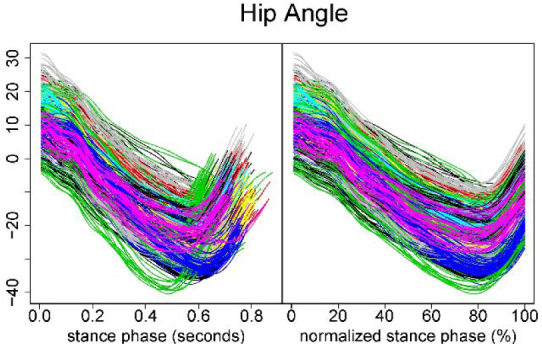
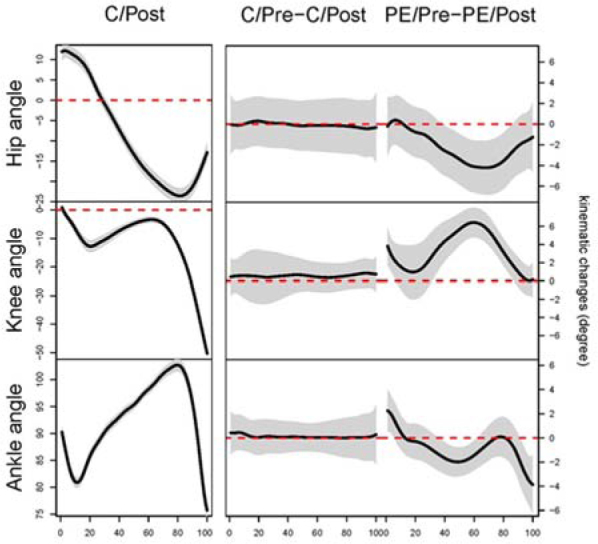
In human motion studies, discrete points such as peak or average kinematic values are commonly selected to test hypotheses. The purpose of this study was to describe a functional data analysis and describe the advantages of using functional data analyses when compared with a traditional analysis of variance (ANOVA) approach. Nineteen healthy participants (age: 22 ± 2 yrs, body height: 1.7 ± 0.1 m, body mass: 73 ± 16 kg) walked under two different conditions: control and pain+effusion. Pain+effusion was induced by injection of sterile saline into the joint capsule and hypertonic saline into the infrapatellar fat pad. Sagittal-plane ankle, knee, and hip joint kinematics were recorded and compared following injections using 2×2 mixed model ANOVAs and FANOVAs. The results of ANOVAs detected a condition × time interaction for the peak ankle (F1,18 = 8.56, p = 0.01) and hip joint angle (F1,18 = 5.77, p = 0.03), but did not for the knee joint angle (F1,18 = 0.36, p = 0.56). The functional data analysis, however, found several differences at initial contact (ankle and knee joint), in the mid-stance (each joint) and at toe off (ankle). Although a traditional ANOVA is often appropriate for discrete or summary data, in biomechanical applications, the functional data analysis could be a beneficial alternative. When using the functional data analysis approach, a researcher can (1) evaluate the entire data as a function, and (2) detect the location and magnitude of differences within the evaluated function.
在人体运动研究中,通常会选择诸如峰值或平均运动学值等离散点来检验假设。本研究的目的是描述一种功能数据分析方法,并阐述与传统方差分析(ANOVA)方法相比,使用功能数据分析的优势。19名健康参与者(年龄:22±2岁,身高:1.7±0.1米,体重:73±16千克)在两种不同条件下行走:对照和疼痛+积液。通过向关节囊内注射无菌盐水和向髌下脂肪垫内注射高渗盐水来诱发疼痛+积液。在注射后,使用2×2混合模型方差分析和功能方差分析记录并比较矢状面踝关节、膝关节和髋关节的运动学数据。方差分析结果检测到踝关节峰值(F1,18 = 8.56,p = 0.01)和髋关节角度(F1,18 = 5.77,p = 0.03)存在条件×时间交互作用,但膝关节角度未检测到(F1,18 = 0.36,p = 0.56)。然而,功能数据分析发现在初始接触(踝关节和膝关节)、支撑中期(每个关节)和离地时(踝关节)存在一些差异。尽管传统方差分析通常适用于离散或汇总数据,但在生物力学应用中,功能数据分析可能是一种有益的替代方法。当使用功能数据分析方法时,研究人员可以(1)将整个数据作为一个函数进行评估,以及(2)检测评估函数内差异的位置和大小。