Department of Ophthalmology, First Affiliated Hospital, Zhengzhou University, Zhengzhou, China.
Department of Pathology, Johns Hopkins University, Baltimore, Maryland, United States.
Invest Ophthalmol Vis Sci. 2018 Jan 1;59(1):280-288. doi: 10.1167/iovs.17-21617.
We test the ability of next-generation sequencing, combined with computational analysis, to identify a range of organisms causing infectious keratitis.
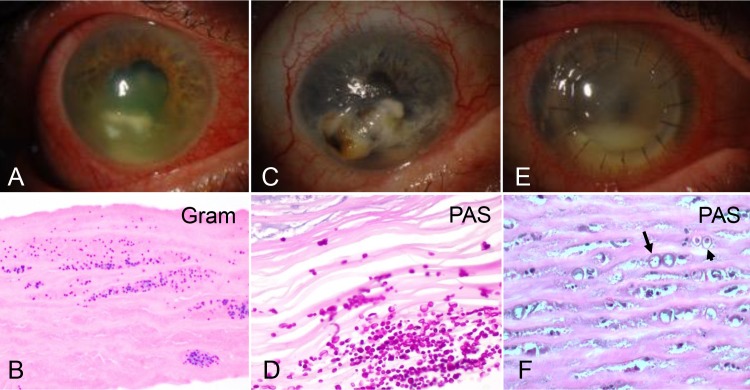
This retrospective study evaluated 16 cases of infectious keratitis and four control corneas in formalin-fixed tissues from the pathology laboratory. Infectious cases also were analyzed in the microbiology laboratory using culture, polymerase chain reaction, and direct staining. Classified sequence reads were analyzed with two different metagenomics classification engines, Kraken and Centrifuge, and visualized using the Pavian software tool.
Sequencing generated 20 to 46 million reads per sample. On average, 96% of the reads were classified as human, 0.3% corresponded to known vectors or contaminant sequences, 1.7% represented microbial sequences, and 2.4% could not be classified. The two computational strategies successfully identified the fungal, bacterial, and amoebal pathogens in most patients, including all four bacterial and mycobacterial cases, five of six fungal cases, three of three Acanthamoeba cases, and one of three herpetic keratitis cases. In several cases, additional potential pathogens also were identified. In one case with cytomegalovirus identified by Kraken and Centrifuge, the virus was confirmed by direct testing, while two where Staphylococcus aureus or cytomegalovirus were identified by Centrifuge but not Kraken could not be confirmed. Confirmation was not attempted for an additional three potential pathogens identified by Kraken and 11 identified by Centrifuge.
Next generation sequencing combined with computational analysis can identify a wide range of pathogens in formalin-fixed corneal specimens, with potential applications in clinical diagnostics and research.
我们测试了下一代测序技术与计算分析相结合的方法,以鉴定引起感染性角膜炎的一系列病原体。
本回顾性研究评估了来自病理实验室福尔马林固定组织的 16 例感染性角膜炎病例和 4 例对照眼角膜。感染性病例也在微生物学实验室中使用培养、聚合酶链反应和直接染色进行了分析。分类序列读取使用两种不同的宏基因组分类引擎(Kraken 和 Centrifuge)进行分析,并使用 Pavian 软件工具进行可视化。
每个样本的测序生成了 2000 万到 4600 万条reads。平均而言,96%的reads 被分类为人源,0.3%对应于已知的载体或污染序列,1.7%代表微生物序列,2.4%无法分类。这两种计算策略成功地鉴定了大多数患者的真菌、细菌和阿米巴病原体,包括所有 4 例细菌和分枝杆菌病例、5 例真菌病例、3 例棘阿米巴病例和 1 例单纯疱疹性角膜炎病例。在一些病例中,还鉴定出了其他潜在的病原体。在 Kraken 和 Centrifuge 鉴定出巨细胞病毒的一例病例中,该病毒通过直接检测得到了确认,而 Centrifuge 鉴定出金黄色葡萄球菌或巨细胞病毒但 Kraken 未鉴定出的两例病例无法得到确认。Kraken 鉴定出的另外三个潜在病原体和 Centrifuge 鉴定出的 11 个潜在病原体没有进行确认。
下一代测序技术与计算分析相结合可以鉴定福尔马林固定角膜标本中的广泛病原体,具有在临床诊断和研究中的潜在应用。