Center for Neurobiology and Behavior, Department of Psychiatry, Perelman School of Medicine at the University of Pennsylvania, Philadelphia, Pennsylvania.
Neuropsychiatry Section, Department of Psychiatry, Perelman School of Medicine at the University of Pennsylvania, Philadelphia, Pennsylvania.
Autism Res. 2018 Mar;11(3):488-502. doi: 10.1002/aur.1910. Epub 2018 Jan 17.
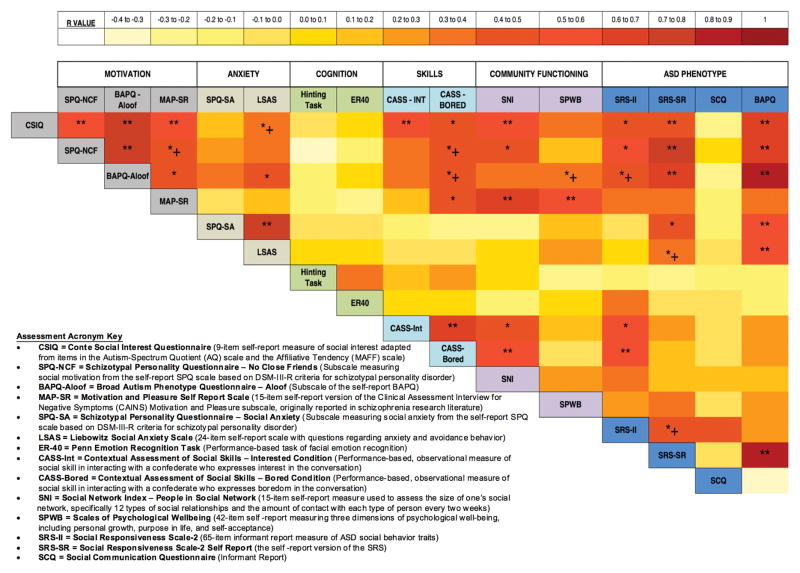
There is increasing recognition that adults with autism spectrum disorder (ASD) would benefit from treatment to improve social functioning, a key factor in adults' overall quality of life. However, the various behavioral components of social functioning (i.e., categories of behaviors underlying social functioning), including social motivation, social anxiety, social cognition, and social skills, have not all been assessed together in any sample of adults with ASD, making it difficult to know the relative levels of impairment in these various categories, the relationships among these categories, or promising targets for treatments. We hypothesized there would be significant correlations among measures within the same category, but fewer correlations of measures between categories, indicating the heterogeneity of impairments in adults with ASD. Twenty-nine adults with ASD without co-occurring intellectual disability completed multiple assessments measuring social motivation, social anxiety, social cognition, and social skills, as well as measures of overall ASD symptom levels and community functioning. Results revealed significant positive correlations among measures within most categories; positive correlations between measures of social motivation and all other categories, except for social cognition; as well as positive cross-domain correlations between measures of anxiety and ASD phenotype; measures of social skills and community functioning; and measures of social skills and ASD phenotype. Further studies are warranted to determine causal relationships among these behavioral categories, across developmental stages. However, the lack of correlations between many categories suggests the potential importance of multidimensional treatments that target the particular components of social functioning most in need of improvement in individuals. Autism Res 2018, 11: 488-502. © 2017 International Society for Autism Research, Wiley Periodicals, Inc.
The goal of this study was to measure behaviors that contribute to social functioning difficulties in adults with ASD, with the ultimate goal of guiding treatment development. We found that motivation to interact with others was significantly related to social anxiety and social skill. Our results suggest that motivation may be important to target in treatment, and that treatments should be tailored to the areas most in need of improvement in each individual.
越来越多的人认识到,自闭症谱系障碍(ASD)的成年人将受益于改善社交功能的治疗,社交功能是成年人整体生活质量的关键因素。然而,社交功能的各种行为成分(即社交功能的行为类别),包括社交动机、社交焦虑、社会认知和社交技能,在任何 ASD 成年人样本中都没有一起评估,这使得难以了解这些不同类别中的相对损伤程度、这些类别之间的关系,或有希望的治疗目标。我们假设在同一类别内的测量值之间会有显著的相关性,但在类别之间的测量值之间相关性较小,这表明 ASD 成年人的损伤具有异质性。29 名没有智力障碍共病的 ASD 成年人完成了多项评估,评估内容包括社交动机、社交焦虑、社会认知和社交技能,以及 ASD 症状水平和社区功能的总体评估。结果显示,大多数类别内的测量值之间存在显著的正相关;社交动机测量值与除社会认知以外的所有其他类别之间存在正相关;焦虑和 ASD 表型之间存在正的跨域相关性;社交技能和社区功能之间的测量值;以及社交技能和 ASD 表型之间的测量值。需要进一步的研究来确定这些行为类别之间的因果关系,跨越发展阶段。然而,许多类别的测量值之间缺乏相关性表明,针对个体最需要改善的社交功能特定成分的多维治疗可能具有重要意义。自闭症研究 2018,11:488-502。 © 2017 自闭症国际研究协会,威利期刊,公司。
本研究的目的是测量自闭症谱系障碍(ASD)成年人社交功能障碍的相关行为,最终目的是指导治疗的发展。我们发现与他人互动的动机与社交焦虑和社交技能显著相关。我们的研究结果表明,动机可能是治疗的重要目标,并且治疗应该针对每个个体最需要改善的领域进行定制。