Autism and Neurodevelopmental Disorders Institute, The George Washington University and Children's National Health System, Washington, DC.
Child Study Center, Yale University School of Medicine, New Haven, Connecticut.
Autism Res. 2018 May;11(5):713-725. doi: 10.1002/aur.1941. Epub 2018 Mar 8.
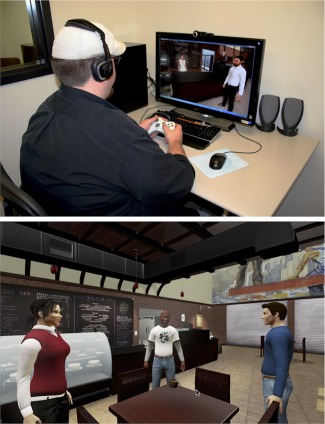
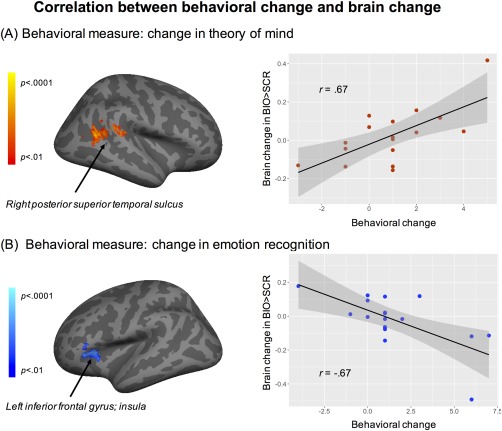
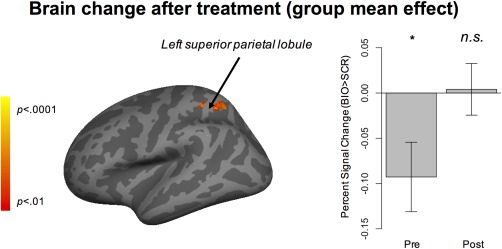
Measuring treatment efficacy in individuals with Autism Spectrum Disorder (ASD) relies primarily on behaviors, with limited evidence as to the neural mechanisms underlying these behavioral gains. This pilot study addresses this void by investigating neural and behavioral changes in a Phase I trial in young adults with high-functioning ASD who received an evidence-based behavioral intervention, Virtual Reality-Social Cognition Training over 5 weeks for a total of 10 hr. The participants were tested pre- and post-training with a validated biological/social versus scrambled/nonsocial motion neuroimaging task, previously shown to activate regions within the social brain networks. Three significant brain-behavior changes were identified. First, the right posterior superior temporal sulcus, a hub for socio-cognitive processing, showed increased brain activation to social versus nonsocial stimuli in individuals with greater gains on a theory-of-mind measure. Second, the left inferior frontal gyrus, a region for socio-emotional processing, tracked individual gains in emotion recognition with decreased activation to social versus nonsocial stimuli. Finally, the left superior parietal lobule, a region for visual attention, showed significantly decreased activation to nonsocial versus social stimuli across all participants, where heightened attention to nonsocial contingencies has been considered a disabling aspect of ASD. This study provides, albeit preliminary, some of the first evidence of the harnessable neuroplasticity in adults with ASD through an age-appropriate intervention in brain regions tightly linked to social abilities. This pilot trial motivates future efforts to develop and test social interventions to improve behaviors and supporting brain networks in adults with ASD. Autism Res 2018, 11: 713-725. © 2018 The Authors Autism Research published by International Society for Autism Research and Wiley Periodicals, Inc.
This study addresses how the behavioral changes after treatment for ASD reflect underlying brain changes. Before and after receiving VR-SCT, young adults with high-functioning ASD passively viewed biological motion stimuli in a MRI scanner, tapping changes in the social brain network. The results reveal neuroplasticity in this age population, extending the window of opportunity for interventions to impact social competency in adults with ASD.
在自闭症谱系障碍(ASD)个体中测量治疗效果主要依赖于行为,而对于这些行为改善的神经机制的证据有限。这项初步研究通过调查在接受基于证据的行为干预(虚拟现实-社会认知训练)的高功能 ASD 年轻成人的 I 期试验中的神经和行为变化来解决这一空白,该干预在 5 周内进行,总共进行 10 小时。参与者在接受训练前和训练后都接受了一项经过验证的生物/社会与随机/非社会运动神经影像学任务的测试,该任务以前被证明可以激活社会大脑网络内的区域。确定了三个重要的大脑行为变化。首先,后上颞叶的右侧,一个社会认知处理的枢纽,在心理理论测量中表现出更大收益的个体中,对社会刺激的大脑激活增加。其次,左额下回,一个社会情感处理区域,与社会刺激相比,个体的情绪识别收益跟踪到社会刺激的激活减少。最后,左顶叶上叶,一个用于视觉注意力的区域,在所有参与者中都显示出对非社会刺激的显著减少激活,而非社会刺激的注意力增加被认为是 ASD 的一个致残方面。这项研究提供了一些初步证据,证明了通过适合年龄的干预措施,可以使 ASD 成人的大脑区域具有可利用的神经可塑性,这些区域与社会能力紧密相连。这项初步试验激发了未来的努力,以开发和测试社交干预措施,以改善 ASD 成人的行为和支持性大脑网络。自闭症研究 2018 年,11:713-725。 © 2018 自闭症研究协会和威利在线期刊出版国际学会。
这项研究探讨了 ASD 治疗后的行为变化如何反映潜在的大脑变化。在接受 VR-SCT 之前和之后,高功能 ASD 的年轻成年人在 MRI 扫描仪中被动观看生物运动刺激,以测量社会大脑网络的变化。结果揭示了这个年龄段人群的神经可塑性,为干预措施提供了机会,以影响 ASD 成人的社交能力。