Mallegni Norma, Phuong Thanh Vu, Coltelli Maria-Beatrice, Cinelli Patrizia, Lazzeri Andrea
Department of Civil and Industrial Engineering, University of Pisa, Via Diotisalvi 2, 56122 Pisa, Italy.
Department of Chemical Engineering, Can Tho University, 3/2 Street, Can Tho 90000, Vietnam.
Materials (Basel). 2018 Jan 17;11(1):148. doi: 10.3390/ma11010148.
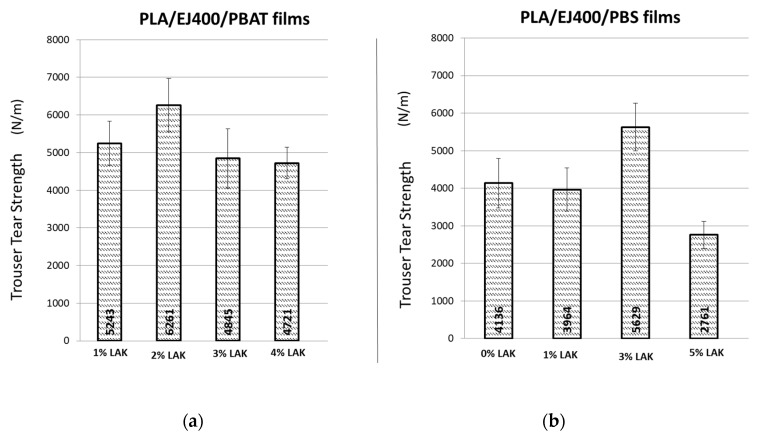
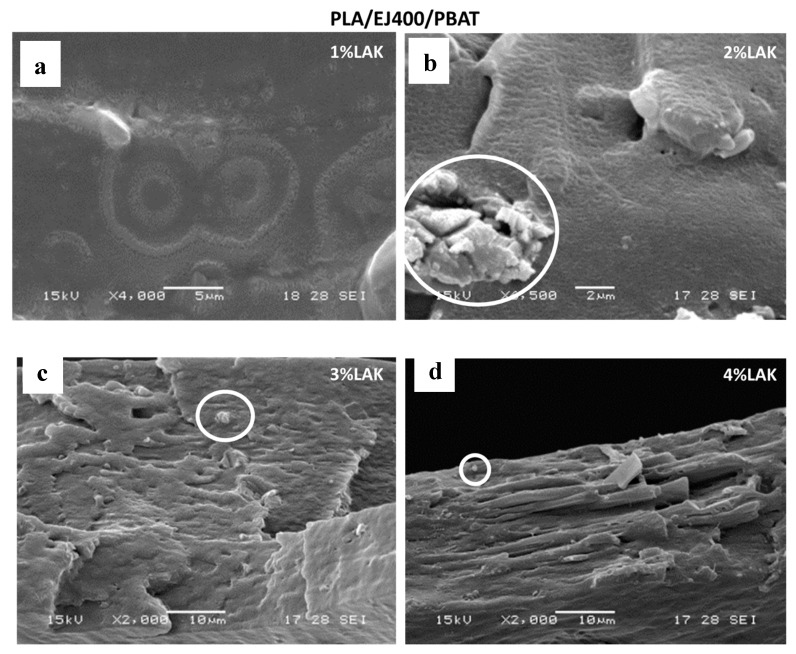
Poly(lactic acid) (PLA) was melt mixed in a laboratory extruder with poly(butylene adipate--terephthalate) (PBAT) and poly(butylene succinate) (PBS) in the presence of polypropylene glycol di glycidyl ether (EJ400) that acted as both plasticizer and compatibilizer. The process was then scaled up in a semi-industrial extruder preparing pellets having different content of a nucleating agent (LAK). All of the formulations could be processed by blowing extrusion and the obtained films showed mechanical properties dependent on the LAK content. In particular the tearing strength showed a maximum like trend in the investigated composition range. The films prepared with both kinds of blends showed a tensile strength in the range 12-24 MPa, an elongation at break in the range 150-260% and a significant crystallinity.
聚乳酸(PLA)在实验室挤出机中与聚己二酸丁二醇酯 - 对苯二甲酸丁二醇酯(PBAT)和聚丁二酸丁二醇酯(PBS)在作为增塑剂和相容剂的聚丙二醇二缩水甘油醚(EJ400)存在下进行熔融共混。然后在半工业挤出机中扩大该工艺规模,制备具有不同成核剂(LAK)含量的粒料。所有配方都可以通过吹塑挤出进行加工,并且所得到的薄膜的机械性能取决于LAK的含量。特别是撕裂强度在研究的组成范围内呈现出类似最大值的趋势。用两种共混物制备的薄膜的拉伸强度在12 - 24MPa范围内,断裂伸长率在150 - 260%范围内,并且具有显著的结晶度。