Orioli Riccardo, Cremona Giuseppe, Ciancarella Luisella, Solimini Angelo G
Department of Public Health and Infectious Diseases, Sapienza University of Rome, Rome, Italy.
Sustainable Territorial and Production Systems Department, National Agency for New Technologies, Energy and Sustainable Economic Development (ENEA), Bologna, Italy.
PLoS One. 2018 Jan 17;13(1):e0191112. doi: 10.1371/journal.pone.0191112. eCollection 2018.
Air pollution represents a serious threat to health on a global scale, being responsible for a large portion of the global burden of disease from environmental factors. Current evidence about the association between air pollution exposure and Diabetes Mellitus (DM) is still controversial. We aimed to evaluate the association between area-level ambient air pollution and self-reported DM in a large population sample in Italy.
We extracted information about self-reported and physician diagnosed DM, risk factors and socio-economic status from 12 surveys conducted nationwide between 1999 and 2013. We obtained annual averaged air pollution levels for the years 2003, 2005, 2007 and 2010 from the AMS-MINNI national integrated model, which simulates the dispersion and transformation of pollutants. The original maps, with a resolution of 4 x 4 km2, were normalized and aggregated at the municipality class of each Italian region, in order to match the survey data. We fit logistic regression models with a hierarchical structure to estimate the relationship between PM10, PM2.5, NO2 and O3 four-years mean levels and the risk of being affected by DM.
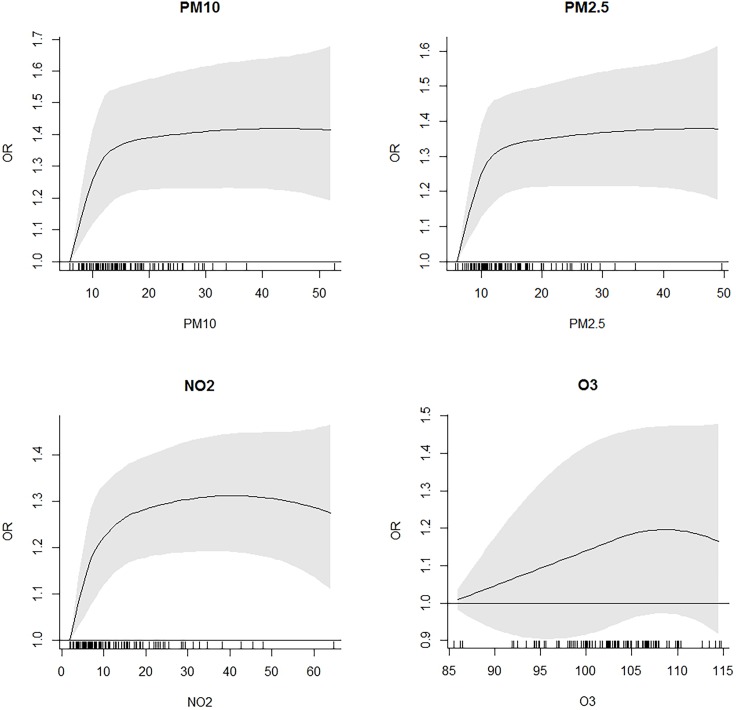
We included 376,157 individuals aged more than 45 years. There were 39,969 cases of DM, with an average regional prevalence of 9.8% and a positive geographical North-to-South gradient, opposite to that of pollutants' concentrations. For each 10 μg/m3 increase, the resulting ORs were 1.04 (95% CI 1.01-1.07) for PM10, 1.04 (95% CI 1.02-1.07) for PM2.5, 1.03 (95% CI 1.01-1.05) for NO2 and 1.06 (95% CI 1.01-1.11) for O3, after accounting for relevant individual risk factors. The associations were robust to adjustment for other pollutants in two-pollutant models tested (ozone plus each other pollutant).
We observed a significant positive association between each examined pollutant and prevalent DM. Risk estimates were consistent with current evidence, and robust to sensitivity analysis. Our study adds evidence about the effects of air pollution on diabetes and suggests a possible role of ozone as an independent factor associated with the development of DM. Such relationship is of great interest for public health and deserves further investigation.
空气污染在全球范围内对健康构成严重威胁,是环境因素导致的全球疾病负担的很大一部分原因。目前关于空气污染暴露与糖尿病(DM)之间关联的证据仍存在争议。我们旨在评估意大利大量人群样本中区域层面的环境空气污染与自我报告的糖尿病之间的关联。
我们从1999年至2013年在全国范围内进行的12次调查中提取了关于自我报告和医生诊断的糖尿病、风险因素及社会经济状况的信息。我们从AMS - MINNI国家综合模型获取了2003年、2005年、2007年和2010年的年平均空气污染水平,该模型模拟污染物的扩散和转化。原始地图分辨率为4×4平方公里,经过归一化处理并在意大利各地区的市镇类别进行汇总,以匹配调查数据。我们拟合了具有层次结构的逻辑回归模型,以估计PM10、PM2.5、NO2和O3四年平均水平与患糖尿病风险之间的关系。
我们纳入了376,157名年龄超过45岁的个体。有39,969例糖尿病病例,平均区域患病率为9.8%,且存在从北到南的正向地理梯度,与污染物浓度梯度相反。在考虑相关个体风险因素后,每增加10μg/m³,PM10的OR值为1.04(95%CI 1.01 - 1.07),PM2.5为1.04(95%CI 1.02 - 1.07),NO2为1.03(95%CI 1.01 - 1.05),O3为1.06(95%CI 1.01 - 1.11)。在测试的双污染物模型(臭氧加其他每种污染物)中,对其他污染物进行调整后,这些关联仍然稳健。
我们观察到每种检测到的污染物与糖尿病患病率之间存在显著的正相关。风险估计与当前证据一致,且对敏感性分析具有稳健性。我们的研究增加了关于空气污染对糖尿病影响的证据,并表明臭氧可能作为与糖尿病发展相关的独立因素发挥作用。这种关系对公共卫生具有重要意义,值得进一步研究。