Wedell-Neergaard Anne-Sophie, Eriksen Louise, Grønbæk Morten, Pedersen Bente Klarlund, Krogh-Madsen Rikke, Tolstrup Janne
The Centre of Inflammation and Metabolism and the Centre for Physical Activity Research, Rigshospitalet, University of Copenhagen, Copenhagen, Denmark.
The National Institute of Public Health, University of Southern Denmark, Copenhagen, Denmark.
PLoS One. 2018 Jan 17;13(1):e0190645. doi: 10.1371/journal.pone.0190645. eCollection 2018.
Up to 30% of obese individuals are metabolically healthy. Metabolically healthy obese (MHO) individuals are characterized by having low abdominal adiposity, low inflammation level and low risk of developing metabolic comorbidity. In this study, we hypothesize that cardiorespiratory fitness (fitness) is a determinant factor for the MHO individuals and aim to investigate the associations between fitness, abdominal adiposity and low-grade inflammation within different BMI categories.
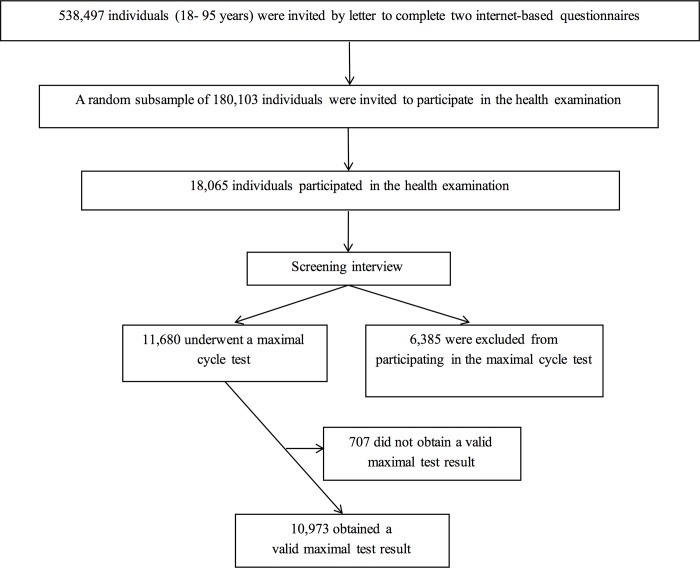
Data from 10,976 individuals from the general population, DANHES 2007-2008, on waist circumference, fitness and C-reactive protein (hsCRP) were analysed using multiple linear and median quantile regressions.
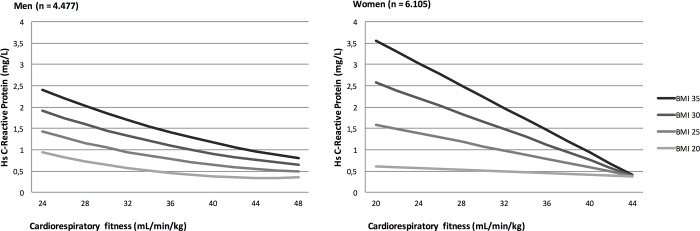
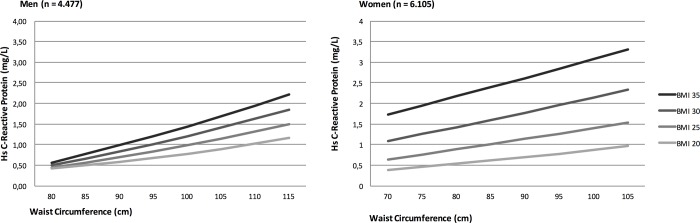
In men, an inverse association between fitness (+5 mL min-1 kg-1) and waist circumference (-1.45 cm; 95% CI: -1.55 to -1.35 cm; p<0.001), and an inverse association between fitness (+5 mL min-1 kg-1) and hsCRP (-0.22 mg/L; 95% CI: -0.255 to -0.185 mg/L; p<0.001) was found, all independent of BMI. Similarly in women, an inverse association between fitness (+5 mL min-1 kg-1) and waist circumference (-1.15 cm; 95% CI: -1.25 to -1.0 cm; p<0.001), and an inverse association between fitness (+5 mL min-1 kg-1) and hsCRP (-0.26 mg/L; 95% CI: -0.3 to -0.22 mg/L; p<0.001) was found, all independent of BMI. Additionally, significant positive associations between waist circumference and hsCRP were found for both men and women, independently of BMI.
Fitness was found to be inversely associated with both abdominal adiposity and low-grade inflammation independent of BMI. These data suggest that, in spite of BMI, high fitness levels lead to a reduction in abdominal fat mass and low-grade inflammation.
高达30%的肥胖个体代谢健康。代谢健康的肥胖(MHO)个体的特征是腹部脂肪少、炎症水平低以及发生代谢合并症的风险低。在本研究中,我们假设心肺适能是MHO个体的一个决定性因素,并旨在研究不同BMI类别中心肺适能、腹部肥胖与低度炎症之间的关联。
使用多元线性回归和中位数分位数回归分析了来自一般人群(DANHES 2007 - 2008)的10976名个体的腰围、心肺适能和C反应蛋白(hsCRP)数据。
在男性中,发现心肺适能每增加5 mL·min⁻¹·kg⁻¹,腰围减少1.45 cm(95%置信区间:-1.55至-1.35 cm;p<0.001),且心肺适能每增加5 mL·min⁻¹·kg⁻¹,hsCRP降低0.22 mg/L(95%置信区间:-0.255至-0.185 mg/L;p<0.001),所有这些均独立于BMI。同样在女性中,发现心肺适能每增加5 mL·min⁻¹·kg⁻¹,腰围减少1.15 cm(95%置信区间:-1.25至-1.0 cm;p<0.001),且心肺适能每增加5 mL·min⁻¹·kg⁻¹,hsCRP降低0.26 mg/L(95%置信区间:-0.3至-0.22 mg/L;p<0.001),所有这些也均独立于BMI。此外,在男性和女性中均发现腰围与hsCRP之间存在显著的正相关,且独立于BMI。
发现心肺适能与腹部肥胖和低度炎症均呈负相关,且独立于BMI。这些数据表明,尽管有BMI的影响,但高心肺适能水平会导致腹部脂肪量减少和低度炎症减轻。