Department of Public Health and Clinical Medicine, Epidemiology and Global Health, Umeå University , Umeå, Sweden.
KEMRI Centre for Global Health Research , Kisumu, Kenya.
Environ Health Perspect. 2018 Jan 12;126(1):017004. doi: 10.1289/EHP1745.
Numerous studies have reported a strong association between temperature and mortality. Additional insights can be gained from investigating the effects of temperature on years of life lost (YLL), considering the life expectancy at the time of death.
The goal of this work was to assess the association between temperature and YLL at seven low-, middle-, and high-income sites.
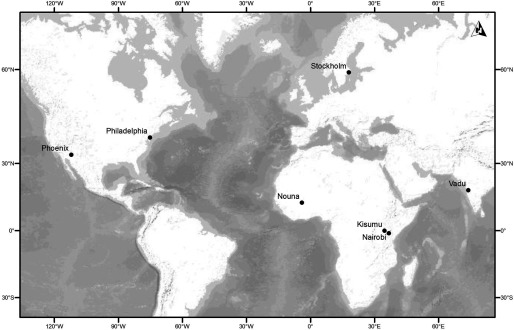
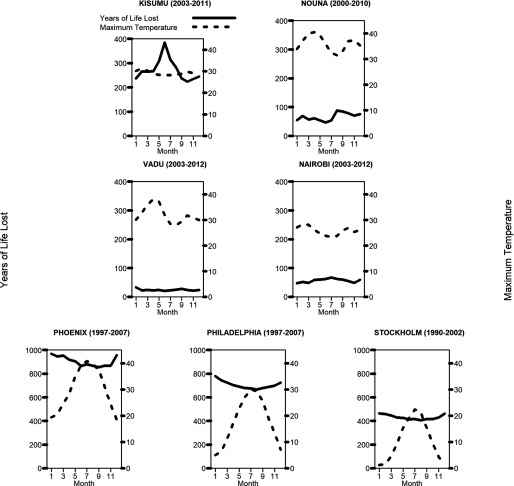
We obtained meteorological and population data for at least nine years from four Health and Demographic Surveillance Sites in Kenya (western Kenya, Nairobi), Burkina Faso (Nouna), and India (Vadu), as well as data from cities in the United States (Philadelphia, Phoenix) and Sweden (Stockholm). A distributed lag nonlinear model was used to estimate the association of daily maximum temperature and daily YLL, lagged 0-14 d. The reference value was set for each site at the temperature with the lowest YLL.
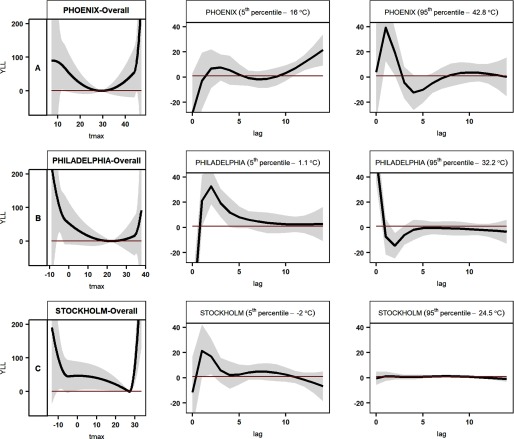
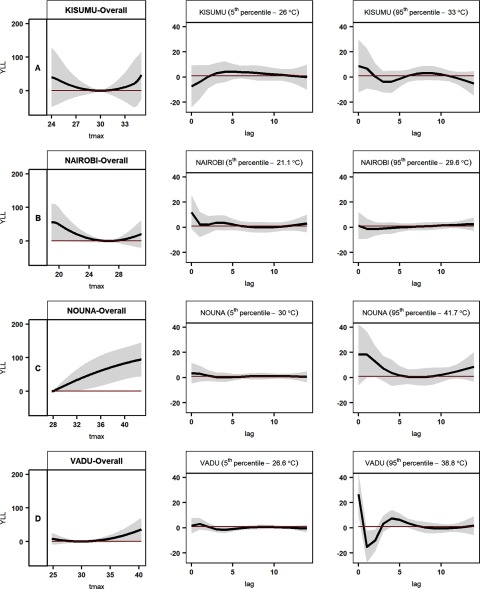
Generally, YLL increased with higher temperature, starting day 0. In Nouna, the hottest location, with a minimum YLL temperature at the first percentile, YLL increased consistently with higher temperatures. In Vadu, YLL increased in association with heat, whereas in Nairobi, YLL increased in association with both low and high temperatures. Associations with cold and heat were evident for Phoenix (stronger for heat), Stockholm, and Philadelphia (both stronger for cold). Patterns of associations with mortality were generally similar to those with YLL.
Both high and low temperatures are associated with YLL in high-, middle-, and low-income countries. Policy guidance and health adaptation measures might be improved with more comprehensive indicators of the health burden of high and low temperatures such as YLL. https://doi.org/10.1289/EHP1745.
许多研究报告指出,温度与死亡率之间存在很强的关联。通过研究温度对死亡时预期寿命的损失年数(YLL)的影响,可以获得更多的见解。
本研究旨在评估七个中低收入国家和地区的温度与 YLL 之间的关联。
我们从肯尼亚(西部肯尼亚、内罗毕)、布基纳法索(诺努)和印度(瓦都)的四个健康和人口监测点获得了至少九年的气象和人口数据,以及美国(费城、凤凰城)和瑞典(斯德哥尔摩)城市的数据。使用分布式滞后非线性模型来估计每日最高温度与每日 YLL 之间的关联,滞后 0-14 天。每个地点的参考值都设定在 YLL 最低的温度。
一般来说,YLL 随着温度的升高而增加,从第 0 天开始。在布基纳法索最热的地区,YLL 最低温度处于第一百分位,YLL 随着温度的升高而持续增加。在瓦都,YLL 与热有关,而在内罗毕,YLL 与低温和高温都有关。与冷和热相关的关联在凤凰城(与热的关联更强)、斯德哥尔摩和费城(与冷的关联都更强)中均可见。与死亡率相关的模式与 YLL 相似。
高收入、中等收入和低收入国家的高温和低温都与 YLL 有关。通过更全面的高温和低温对健康负担的指标(如 YLL),可以改善政策指导和健康适应措施。https://doi.org/10.1289/EHP1745.