Department of Human Nutrition, Foods, and Exercise, Virginia Tech, 295 West Campus Drive, Blacksburg, VA 24061, USA.
Department of Public Health Sciences, School of Public Health, University of Virginia, Cancer Center without Walls at the UVA Cancer Center, 16 East Main St, Christiansburg, VA 24073, USA.
Nutrients. 2018 Jan 13;10(1):83. doi: 10.3390/nu10010083.
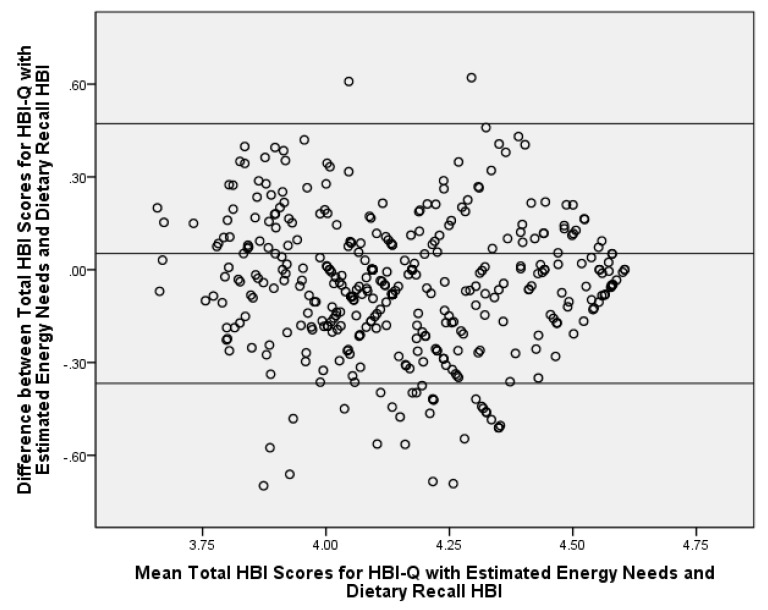
The Healthy Beverage Index (HBI) is an emerging approach to assess beverage pattern quality. HBI total scores range from 0 to 100, with higher scores indicating greater adherence to proposed beverage recommendations. However, assessing patterns is resource-intensive due to the need for extensive dietary data, typically 24-h dietary records or recalls. The BEVQ-15, a beverage intake questionnaire, may be used as an alternative method to rapidly measure HBI scores. The objective of this cross-sectional investigation is to assess the comparative validity of the HBI-Q, a method to rapidly assess HBI scores via the BEVQ-15, as compared to the traditional method of deriving HBI scores via dietary recalls/records. Between 2012 and 2016, a cross-sectional sample of adults in southwest Virginia completed three 24-h dietary recalls (30-60 min administration and analysis time per recall) and the BEVQ-15 (3-4 min administration time). HBI scores were generated by both methods, and compared via paired-samples -tests, correlations, and Bland-Altman analysis. Among 404 adults (mean age = 40 years), total mean HBI scores were 63.7 from the HBI-Q and 67.3 from the recalls (mean difference = 3.6 out of 100; = 0.63; both ≤ 0.001). Agreement between the two methods for total HBI scores via Bland-Altman plots was 92%. Using the HBI-Q to rapidly assess HBI scores in adults will increase the utility of the HBI by decreasing the time and resources required, thus allowing researchers and practitioners to provide targeted feedback for improvement.
健康饮料指数(HBI)是一种评估饮料模式质量的新兴方法。HBI 总分为 0 到 100 分,得分越高表示越符合建议的饮料推荐。然而,由于需要广泛的饮食数据(通常是 24 小时饮食记录或回忆),评估模式的资源密集度很高。BEVQ-15 是一种饮料摄入量问卷,可以作为一种替代方法,快速测量 HBI 得分。本横断面研究的目的是评估 HBI-Q 的相对有效性,这是一种通过 BEVQ-15 快速评估 HBI 得分的方法,与通过饮食回忆/记录推导 HBI 得分的传统方法相比。在 2012 年至 2016 年期间,弗吉尼亚州西南部的成年人进行了横断面样本调查,他们完成了三次 24 小时饮食回忆(每次回忆的管理和分析时间为 30-60 分钟)和 BEVQ-15(管理时间为 3-4 分钟)。通过两种方法生成 HBI 得分,并通过配对样本检验、相关性和 Bland-Altman 分析进行比较。在 404 名成年人(平均年龄为 40 岁)中,HBI-Q 的总平均 HBI 得分为 63.7,回忆的 HBI 得分为 67.3(平均差异为 100 分中的 3.6 分; = 0.63;均 ≤ 0.001)。通过 Bland-Altman 图比较两种方法的总 HBI 得分的一致性为 92%。在成年人中使用 HBI-Q 快速评估 HBI 得分将通过减少所需的时间和资源来提高 HBI 的实用性,从而使研究人员和从业者能够提供有针对性的改进反馈。