Section for Hematology, Department of Medicine, Haukeland University Hospital, N-5021 Bergen, Norway.
Section for Hematology, Institute of Clinical Science, University of Bergen, 5007 Bergen, Norway.
Int J Mol Sci. 2018 Jan 15;19(1):251. doi: 10.3390/ijms19010251.
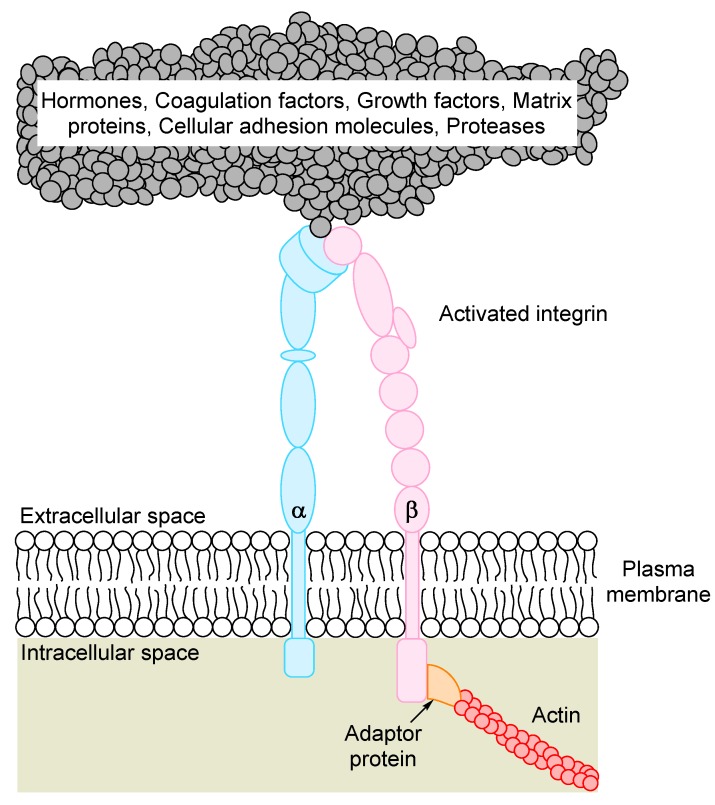
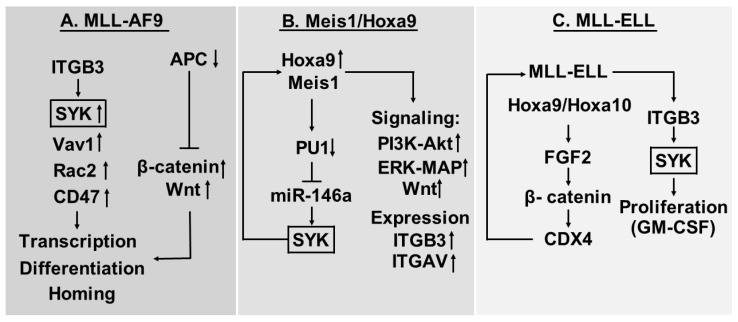
Acute myeloid leukemia (AML) is an aggressive bone marrow malignancy where the immature leukemia cells communicate with neighboring cells through constitutive cytokine release and through their cell surface adhesion molecules. The primary AML cells express various integrins. These heterodimeric molecules containing an α and a β chain are cell surface molecules that bind extracellular matrix molecules, cell surface molecules and soluble mediators. The β3 integrin (ITGB3) chain can form heterodimers only with the two α chains αIIb and αV. These integrins are among the most promiscuous and bind to a large number of ligands, including extracellular matrix molecules, cell surface molecules and soluble mediators. Recent studies suggest that the two β3 integrins are important for leukemogenesis and chemosensitivity in human AML. Firstly, αIIb and β3 are both important for adhesion of AML cells to vitronectin and fibronectin. Secondly, β3 is important for the development of murine AML and also for the homing and maintenance of the proliferation for xenografted primary human AML cells, and for maintaining a stem cell transcriptional program. These last effects seem to be mediated through Syk kinase. The β3 expression seems to be regulated by HomeboxA9 (HoxA9) and HoxA10, and the increased β3 expression then activates spleen tyrosine kinase (Syk) and thereby contributes to cytokine hypersensitivity and activation of β2 integrins. Finally, high integrin αV/β3 expression is associated with an adverse prognosis in AML and decreased sensitivity to the kinase inhibitor sorafenib; this integrin can also be essential for osteopontin-induced sorafenib resistance in AML. In the present article, we review the experimental and clinical evidence for a role of β3 integrins for leukemogenesis and chemosensitivity in AML.
急性髓系白血病 (AML) 是一种侵袭性骨髓恶性肿瘤,不成熟的白血病细胞通过组成性细胞因子释放以及通过其细胞表面粘附分子与邻近细胞相互作用。主要的 AML 细胞表达各种整合素。这些含有 α 和 β 链的异二聚体分子是结合细胞外基质分子、细胞表面分子和可溶性介质的细胞表面分子。β3 整合素 (ITGB3) 链只能与两个 α 链 αIIb 和 αV 形成异二聚体。这些整合素是最混杂的整合素之一,与大量配体结合,包括细胞外基质分子、细胞表面分子和可溶性介质。最近的研究表明,两种β3 整合素在人类 AML 的白血病发生和化疗敏感性中很重要。首先,αIIb 和β3 对于 AML 细胞与 vitronectin 和 fibronectin 的粘附都很重要。其次,β3 对于小鼠 AML 的发展以及异种移植的原发性人类 AML 细胞的归巢和维持增殖以及维持干细胞转录程序很重要。这些最后效应似乎是通过 Syk 激酶介导的。β3 的表达似乎受 HomeboxA9 (HoxA9) 和 HoxA10 调节,增加的β3 表达然后激活脾酪氨酸激酶 (Syk),从而导致细胞因子超敏性和β2 整合素的激活。最后,高整合素αV/β3 表达与 AML 的不良预后相关,并且对激酶抑制剂 sorafenib 的敏感性降低;这种整合素对于 AML 中骨桥蛋白诱导的 sorafenib 耐药也可能是必需的。在本文中,我们综述了β3 整合素在 AML 白血病发生和化疗敏感性中的作用的实验和临床证据。