Seam Md Omar Reza, Bhatta Rita, Saha Bijoy Laxmi, Das Abhijit, Hossain Md Monir, Uddin S M Naim, Karmakar Palash, Choudhuri M Shahabuddin Kabir, Sattar Mohammad Mafruhi
Department of Pharmacy, Noakhali Science and Technology University, Sonapur, Noakhali 3814, Bangladesh.
Department of Pharmacy, University of Chittagong, Chittagong 4331, Bangladesh.
Pharmacy (Basel). 2018 Jan 15;6(1):6. doi: 10.3390/pharmacy6010006.
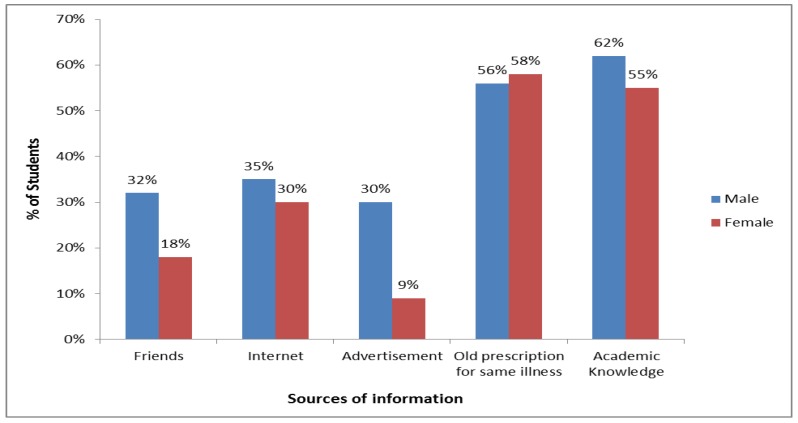
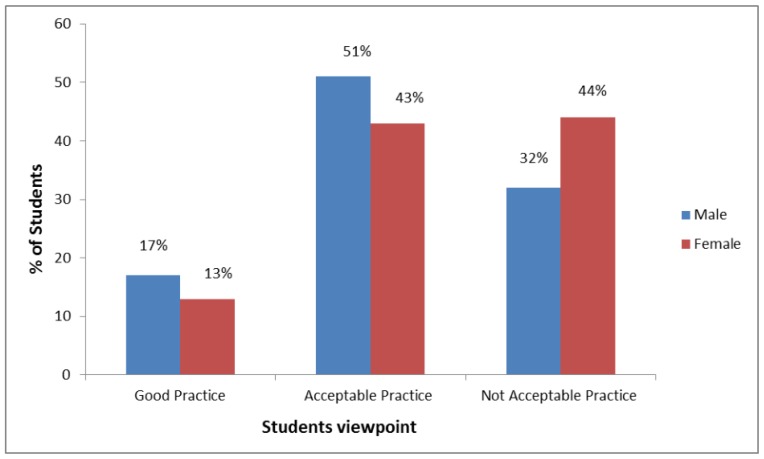
To evaluate the perceptions and extent of practicing self-medication among undergraduate pharmacy students. This cross-sectional, questionnaire-based study was conducted over a six month period (January to June 2016) among undergraduate pharmacy students in five reputable public universities of Bangladesh. It involved face-to-face interviews regarding self-medication of 250 respondents selected by simple random sampling. Self-medication was reported by 88.0% of students. Antipyretics (58.40%) were mostly preferred for the treatment of fever and headaches. The major cause for self-medication was minor illness (59.60%, = 0.73) while previous prescriptions were the main source of knowledge as well as the major factor (52.80%, = 0.94) dominating the self-medication practice. The results also demonstrated 88.80% of students had previous knowledge on self-medication and 83.60% of students always checked the information on the label; mainly the expiry date before use (85.60%). A significant ( < 0.05) portion of the students (51% male and 43% female) perceived it was an acceptable practice as they considered self-medication to be a segment of self-care. Furthermore, students demonstrated differences in their response level towards the adverse effect of drugs, the health hazard by a higher dose of drug, a physician's help in case of side effects, taking medicine without proper knowledge, and stopping selling medicine without prescription. Self-medication was commonly used among pharmacy students primarily for minor illnesses using over-the-counter medications. Although it is an inevitable practice for them it should be considered an important public health problem as this practice may increase the misuse or irrational use of medicines.
评估本科药学专业学生自我药疗的认知情况及实践程度。这项基于问卷调查的横断面研究在六个月期间(2016年1月至6月)对孟加拉国五所著名公立大学的本科药学专业学生开展。研究涉及通过简单随机抽样选取的250名受访者关于自我药疗的面对面访谈。88.0%的学生报告有自我药疗行为。退烧药(58.40%)最常用于治疗发热和头痛。自我药疗的主要原因是小病(59.60%, = 0.73),而既往处方是知识的主要来源以及主导自我药疗行为的主要因素(52.80%, = 0.94)。结果还显示,88.80%的学生以前了解过自我药疗,83.60%的学生总是会查看药品标签上的信息;主要是使用前查看有效期(85.60%)。相当一部分学生(51%的男生和43%的女生)认为这是一种可接受的做法,因为他们将自我药疗视为自我保健的一部分( < 0.05)。此外,学生们在对药物不良反应、高剂量药物对健康的危害、出现副作用时医生的帮助、在没有适当知识的情况下用药以及停止无处方售药等方面的反应水平存在差异。自我药疗在药学专业学生中普遍用于治疗小病,主要使用非处方药。尽管这对他们来说是一种不可避免的行为,但应将其视为一个重要的公共卫生问题,因为这种行为可能会增加药物的滥用或不合理使用。