Hou Nan, Ma Jie, Li Wei, Zhao Lingdi, Gao Quanli, Mai Ling
Department of Biological Immunotherapy, The Affiliated Cancer Hospital of Zhengzhou University, Henan Cancer Hospital, Zhengzhou, Henan 450003, P.R. China.
Department of Molecular Pathology, The Affiliated Cancer Hospital of Zhengzhou University, Henan Cancer Hospital, Zhengzhou, Henan 450003, P.R. China.
Oncol Lett. 2017 Dec;14(6):8007-8013. doi: 10.3892/ol.2017.7188. Epub 2017 Oct 16.
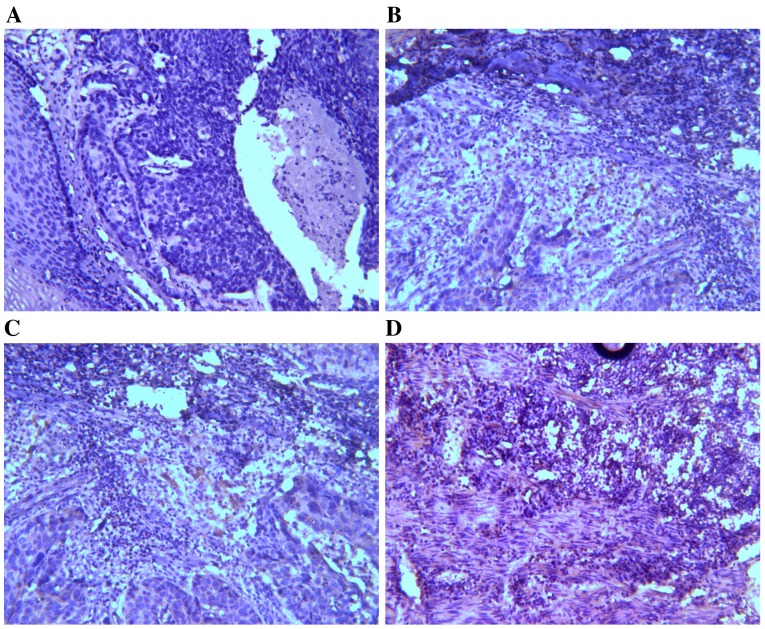
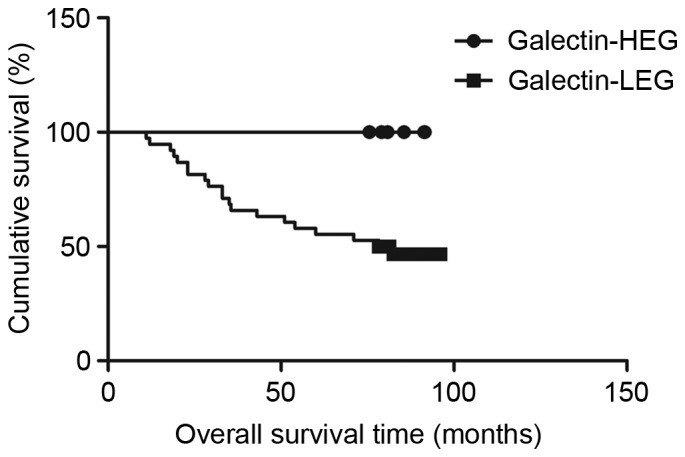
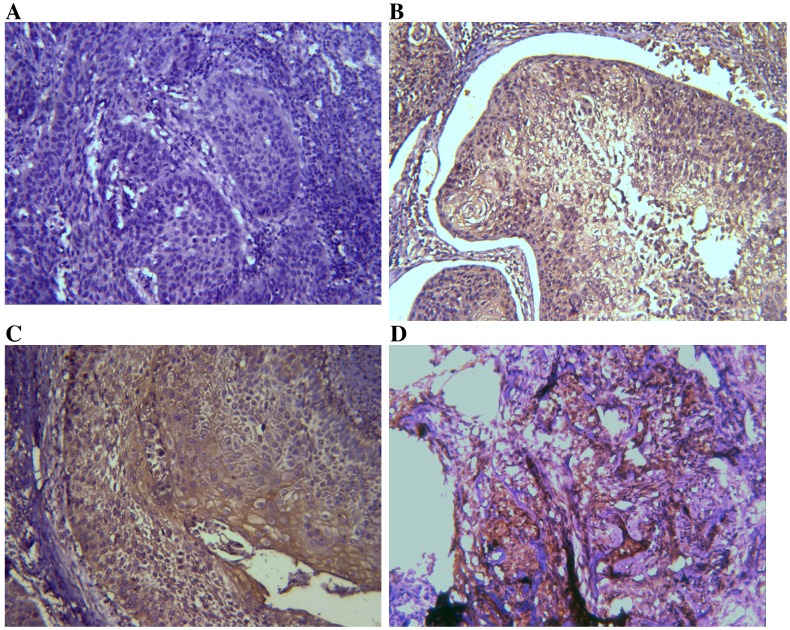
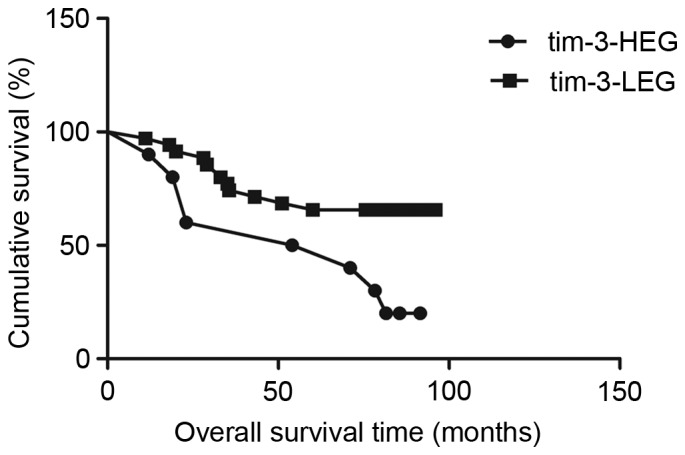
The aim of the present study was to investigate the expression levels of the T-cell immunoglobulin and mucin domain-containing protein-3 (TIM-3) and galectin-9 proteins and their clinical value in esophageal squamous cell carcinoma (ESCC) in Chinese patients. The expression profiles of TIM-3 and galectin-9 in ESCC were determined by the immunohistochemical analysis of the postoperative pathological specimens of 45 patients with ESCC; a χ test was used to evaluate the association of TIM-3 and galectin-9 expression with clinicopathological parameters, in addition to univariate and multivariate Cox's proportional hazards model to analyze the prognostic value of the expression of TIM-3 and galectin-9 proteins. The proportion of samples exhibiting a high staining intensity for TIM-3 and galectin-9 were 22.22 and 15.56%, respectively: these samples were termed the TIM-3 high-expression group (HEG) and galectin-9-HEG. There was a negative correlation between the expression of TIM-3 and galectin-9 (R=-0.71, P<0.001). The results of Kaplan-Meier survival analysis led to the conclusion that, compared with the TIM-3 low expression group (LEG), patients in the TIM-3-HEG exhibited a poorer overall survival rate (χ=6.049, P=0.0139). By contrast, patients in the galectin-9-HEG exhibited a significantly better overall survival rate than those in the galectin-9-LEG (χ=4.915, P=0.0266). However, the levels of TIM-3 and galectin-9 expression were not identified as independent indicators for the prognosis of patients with ESCC. As high TIM-3 and low galectin-9 expression levels were associated with a poor prognosis for patients with ESCC in the present study, these proteins may be potential prognostic indicators for ESCC.
本研究旨在探讨中国食管癌患者中T细胞免疫球蛋白黏蛋白结构域3(TIM-3)和半乳糖凝集素-9蛋白的表达水平及其临床价值。通过对45例食管癌患者术后病理标本进行免疫组织化学分析,确定TIM-3和半乳糖凝集素-9在食管癌中的表达谱;采用χ检验评估TIM-3和半乳糖凝集素-9表达与临床病理参数的相关性,此外还采用单因素和多因素Cox比例风险模型分析TIM-3和半乳糖凝集素-9蛋白表达的预后价值。TIM-3和半乳糖凝集素-9染色强度高的样本比例分别为22.22%和15.56%:这些样本分别称为TIM-3高表达组(HEG)和半乳糖凝集素-9-HEG。TIM-3和半乳糖凝集素-9的表达呈负相关(R=-0.71,P<0.001)。Kaplan-Meier生存分析结果得出结论,与TIM-3低表达组(LEG)相比,TIM-3-HEG患者的总生存率较差(χ=6.049,P=0.0139)。相比之下,半乳糖凝集素-9-HEG患者的总生存率明显高于半乳糖凝集素-9-LEG患者(χ=4.915,P=0.0266)。然而,TIM-3和半乳糖凝集素-9的表达水平未被确定为食管癌患者预后的独立指标。由于本研究中高TIM-3和低半乳糖凝集素-9表达水平与食管癌患者预后不良相关,这些蛋白可能是食管癌潜在的预后指标。