Zhejiang Province Key Laboratory of Anti-Cancer Drug Research, College of Pharmaceutical Sciences, Zhejiang University, Hangzhou China.
Theranostics. 2018 Jan 1;8(3):676-692. doi: 10.7150/thno.21463. eCollection 2018.
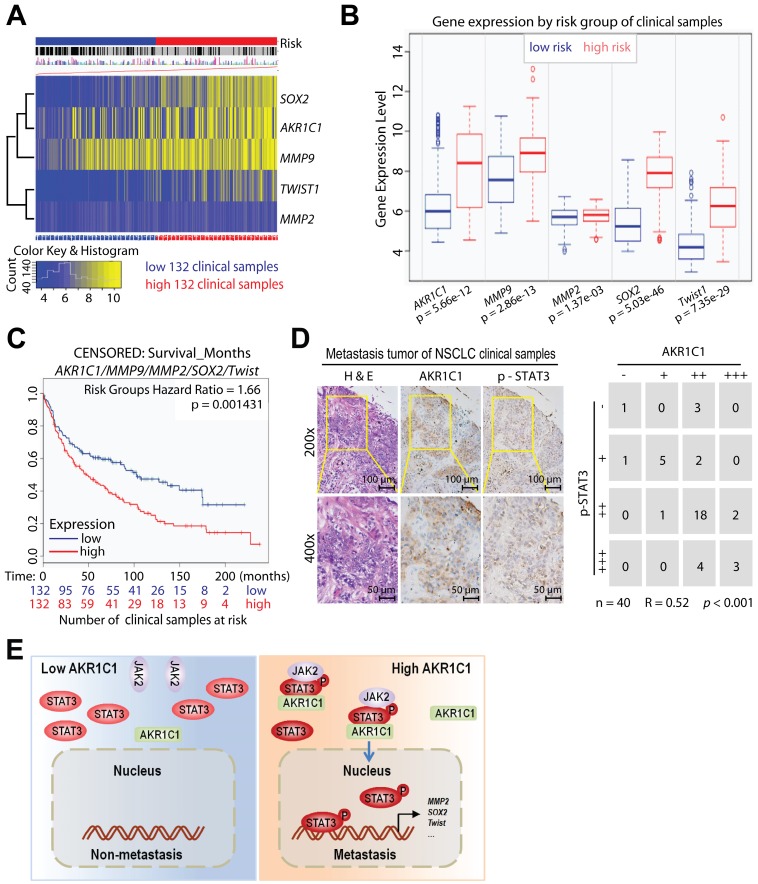
Metastasis is the leading cause of mortality for human non-small cell lung cancer (NSCLC). However, it is difficult to target tumor metastasis because the molecular mechanisms underlying NSCLC invasion and migration remain unclear. GEO data analyses and IHC analyses were performed to identify that the expression level of AKR1C1, a member of human aldo-keto reductase family, was highly elevated in patients with metastasis or metastatic foci of NSCLC patients. Functional analyses (in vitro and in vivo) and quantitative genomic analyses were preformed to confirm the pro-metastatic effects of AKR1C1 and the underlying mechanisms. The correlation of AKR1C1 with the prognosis of NSCLC patients was evaluated using Kaplan-Meier analyses. in NSCLC patients, AKR1C1 expression was closely correlated with the metastatic potential of tumors. AKR1C1 overexpression in nonmetastatic cancer cells significantly promoted metastasis both in vitro and in vivo, whereas depletion of AKR1C1 in highly metastatic tumors potently alleviated these effects. Quantitative genomic and functional analyses revealed that AKR1C1 directly interacted with STAT3 and facilitated its phosphorylation-thus reinforcing the binding of STAT3 to the promoter regions of target genes-and then transactivated these genes, which ultimately promoted tumor metastasis. Further studies showed that AKR1C1 might facilitate the interaction of STAT3 with its upstream kinase JAK2. Intriguingly, AKR1C1 exerted these pro-metastatic effects in a catalytic-independent manner. In addition, a significant correlation between AKR1C1 and STAT3 pathway was observed in the metastatic foci of NSCLC patients, and the AKR1C1-STAT3 levels were highly correlated with a poor prognosis in NSCLC patients. taken together, we show that AKR1C1 is a potent inducer of NSCLC metastasis. Our study uncovers the active function of AKR1C1 as a key component of the STAT3 pathway, which promotes lung cancer metastasis, and highlights a candidate therapeutic target to potentially improve the survival of NSCLC patients with metastatic disease.
转移是导致人类非小细胞肺癌(NSCLC)患者死亡的主要原因。然而,由于 NSCLC 侵袭和迁移的分子机制尚不清楚,因此很难针对肿瘤转移进行治疗。通过 GEO 数据分析和免疫组化分析,我们发现醛酮还原酶家族 1C1(AKR1C1)在转移或转移性 NSCLC 患者的肿瘤中高度表达。我们进行了功能分析(体外和体内)和定量基因组分析,以证实 AKR1C1 的促转移作用及其潜在机制。通过 Kaplan-Meier 分析评估 AKR1C1 与 NSCLC 患者预后的相关性。在 NSCLC 患者中,AKR1C1 的表达与肿瘤的转移潜能密切相关。在非转移性癌细胞中过表达 AKR1C1 显著促进了体外和体内的转移,而在高度转移性肿瘤中耗尽 AKR1C1 则显著减弱了这些作用。定量基因组和功能分析表明,AKR1C1 直接与 STAT3 相互作用,并促进其磷酸化,从而增强 STAT3 与靶基因启动子区域的结合,然后激活这些基因,最终促进肿瘤转移。进一步的研究表明,AKR1C1 可能促进 STAT3 与其上游激酶 JAK2 的相互作用。有趣的是,AKR1C1 以非催化依赖的方式发挥这些促转移作用。此外,在 NSCLC 患者的转移灶中观察到 AKR1C1 与 STAT3 通路之间存在显著相关性,AKR1C1-STAT3 水平与 NSCLC 患者的预后不良高度相关。综上所述,我们发现 AKR1C1 是 NSCLC 转移的有效诱导剂。我们的研究揭示了 AKR1C1 作为 STAT3 通路的关键组成部分的积极作用,促进了肺癌转移,并强调了一个潜在的治疗靶点,以提高转移性 NSCLC 患者的生存率。