Pallari Elena, Fox Anthony W, Lewison Grant
Health Service and Population Research Department, Centre for Implementation Science, Institute of Psychiatry, Psychology & Neuroscience, King's College London, London, UK.
Institute of Pharmaceutical Sciences, Academic Centre, King's College London, London, UK.
ESMO Open. 2018 Jan 6;3(1):e000258. doi: 10.1136/esmoopen-2017-000258. eCollection 2018.
This is an appraisal of the impact of cited research evidence underpinning the development of cancer clinical practice guidelines (CPGs) by the professional bodies of the European Society for Medical Oncology (ESMO), the National Institute for Health and Care Excellence (NICE) and the Scottish Intercollegiate Guidelines Network (SIGN).
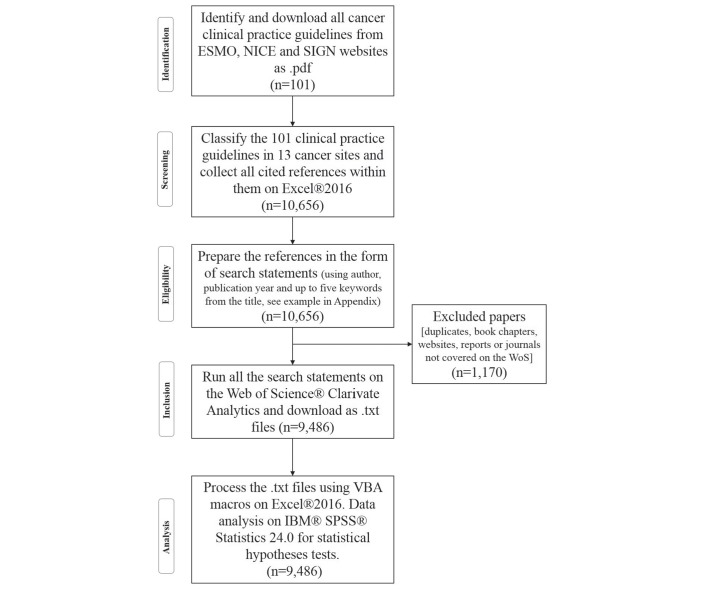
A total of 101 CPGs were identified from ESMO, NICE and SIGN websites across 13 cancer sites. Their 9486 cited references were downloaded from the Web of Science Clarivate Group database, analysed on Excel (2016) using Visual Basic Application macros and imported onto SPSS (V.24.0) for statistical tests.
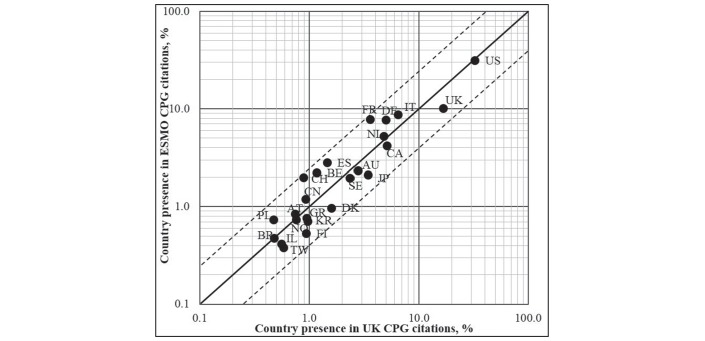
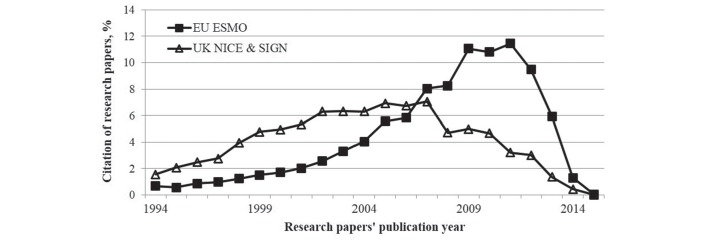
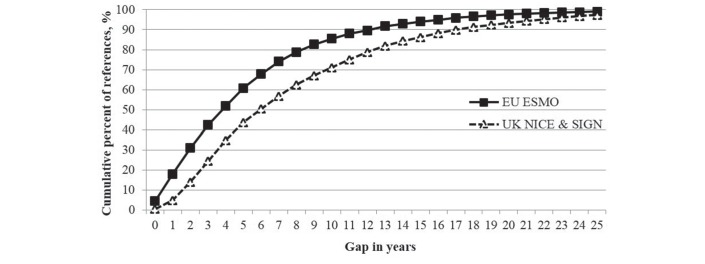
ESMO CPGs mostly cited research from Western Europe, while the NICE and SIGN ones from the UK, Canada, Australia and Scandinavian countries. The ESMO CPGs cited more recent and basic research (eg, drugs treatment), in comparison with NICE and SIGN CPGs where older and more clinical research (eg, surgery) papers were referenced. This chronological difference in the evidence base is also in line with that ESMO has a shorter gap between the publication of the research and its citation on the CPGs. It was demonstrated that ESMO CPGs report more chemotherapy research, while the NICE and SIGN CPGs report more surgery, with the results being statistically significant.
We showed that ESMO, NICE and SIGN differ in their evidence base of CPGs. Healthcare professionals should be aware of this heterogeneity in effective decision-making of tailored treatments to patients, irrespective of geographic location across Europe.
本文评估了欧洲医学肿瘤学会(ESMO)、英国国家卫生与临床优化研究所(NICE)和苏格兰校际指南网络(SIGN)等专业机构在制定癌症临床实践指南(CPG)时所引用研究证据的影响。
从ESMO、NICE和SIGN网站上识别出涵盖13个癌症部位的101份CPG。从科睿唯安集团的Web of Science数据库下载了它们引用的9486篇参考文献,使用Visual Basic Application宏在Excel(2016)中进行分析,并导入到SPSS(V.24.0)中进行统计检验。
ESMO的CPG大多引用来自西欧的研究,而NICE和SIGN的CPG则引用来自英国、加拿大、澳大利亚和斯堪的纳维亚国家的研究。与NICE和SIGN的CPG相比,ESMO的CPG引用了更多近期的基础研究(如药物治疗),而NICE和SIGN的CPG引用的是更早期的临床研究(如手术)论文。证据基础上的这种时间差异也与ESMO在研究发表与其在CPG上被引用之间的间隔时间较短相一致。结果表明,ESMO的CPG报告的化疗研究更多,而NICE和SIGN的CPG报告的手术研究更多,结果具有统计学意义。
我们发现ESMO、NICE和SIGN在CPG的证据基础方面存在差异。医疗保健专业人员在为患者制定个性化治疗的有效决策时应意识到这种异质性,无论患者位于欧洲的哪个地理位置。