Ningxia Medical University, Yinchuan, 750000, China.
Department of General Surgery, Gansu Provincial People's Hospital, 204 Dong Gang West Road, Lanzhou, 730000, Gansu, China.
Int J Clin Oncol. 2018 Aug;23(4):659-670. doi: 10.1007/s10147-018-1242-2. Epub 2018 Jan 17.
Interleukin-1 alpha (IL-1α) plays an important role in tumorigenesis and angiogenesis of gastric cancer. The interleukin-1 receptor antagonist (IL-1RA) inhibits IL-1 selectively and specifically through IL-1R type I (IL-1RI). However, the underlying mechanism by which IL-1RA modulates the interactions of tumor cells and their micro-environment is poorly understood. We have evaluated the role of IL-1RA in the metastatic process as well as the mutual or reciprocal actions between gastric cancer cells and stromal cells.
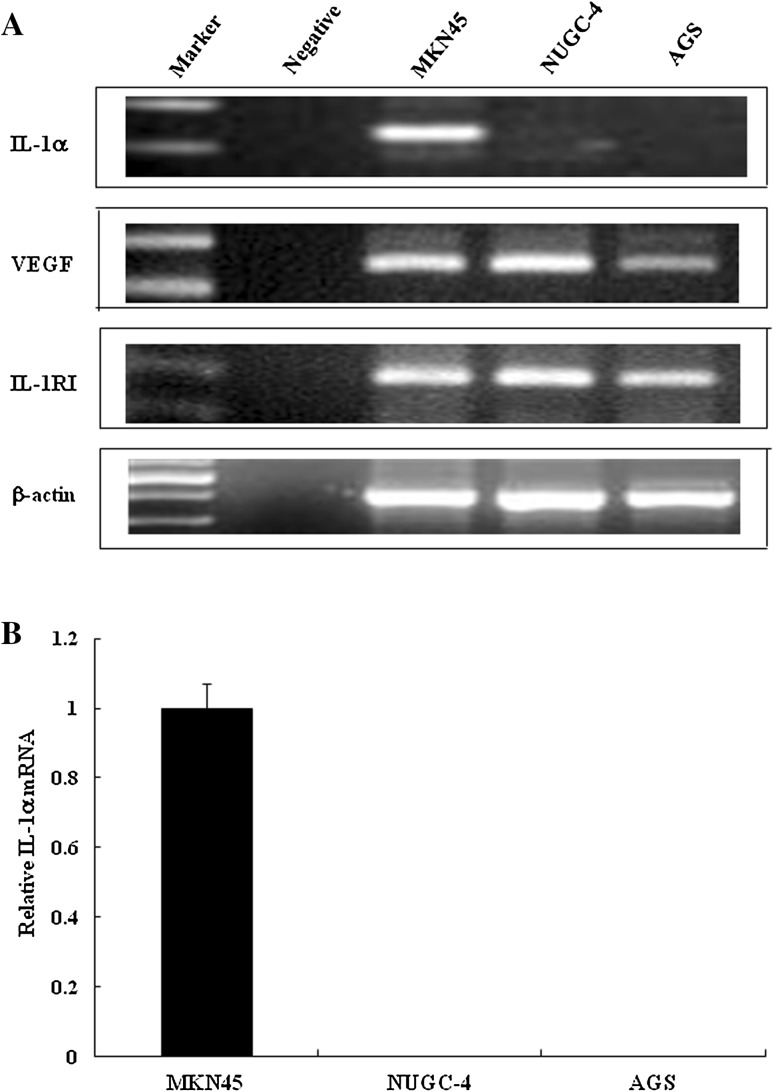
The expressions of IL-1α, vascular endothelial growth factor (VEGF), and IL-1RI mRNA were determined by reverse transcriptase-PCR. The regulatory effect of IL-1RA on the secretion of VEGF in human gastric cancer cells and human umbilical vein endothelial cells (HUVECs) was detected by enzyme-linked immunosorbent assay. The effect of IL-1RA on metastatic potential was evaluated using proliferation, invasion, and angiogenesis assays, respectively, including in vitro co-culture system models consisting of tumor cells and stromal cells that were used to detect invasion and angiogenesis.
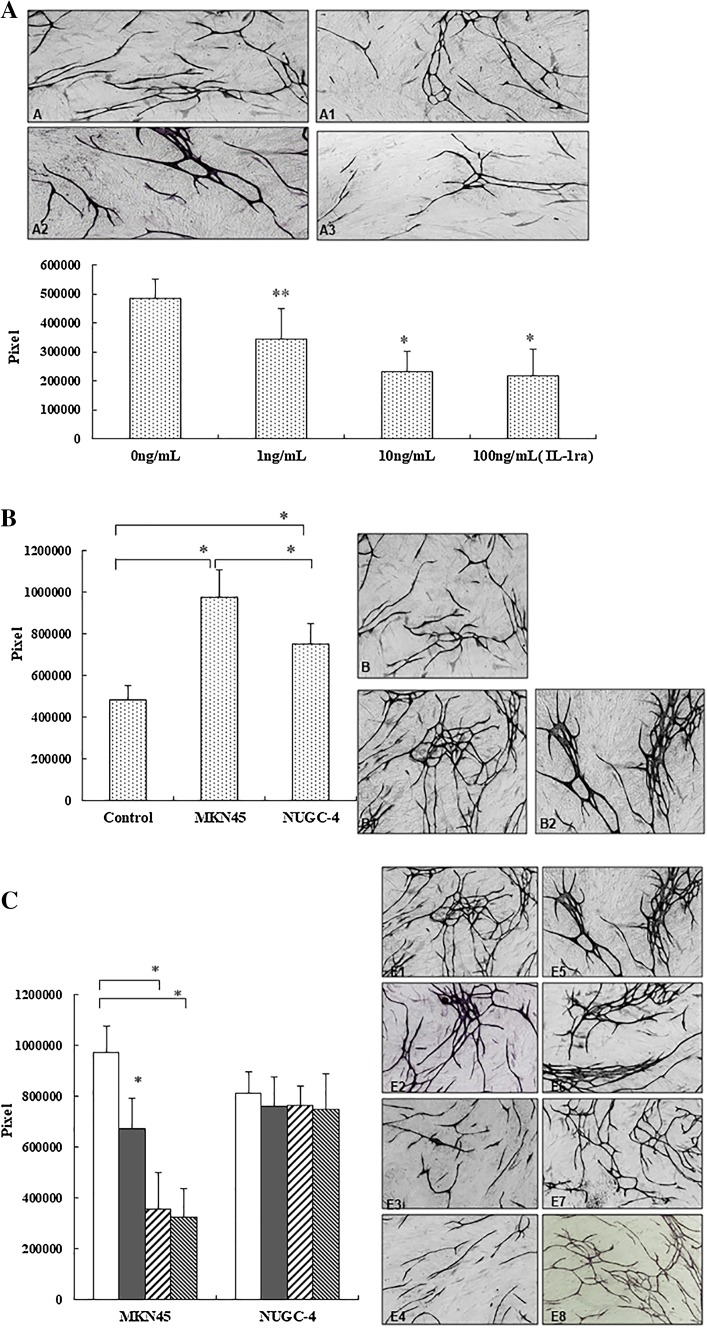
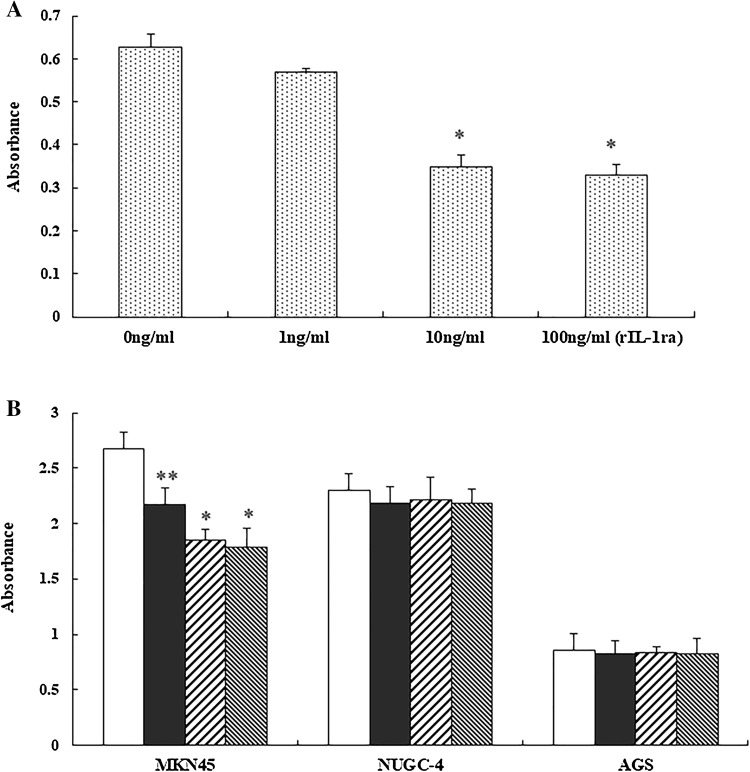
Interleukin-1α mRNA was detected in the higher liver metastatic gastric cell line MKN45. IL-1α protein was expressed in MKN45 cells and in HUVECs. VEGF mRNA and protein were detected in the three gastric cancer cell lines (MKN4, NUGC-4, and AGS). Levels of VEGF secreted by gastric cancer cells and HUVECs appeared to be reduced through the action of IL-1RA via IL-1RI in a dose-dependent manner (P < 0.01). IL-1RA significantly inhibited the proliferation and migration of HUVECs (P < 0.01) and tube formation by HUVECs (P < 0.01), both in a dose-dependent manner. Compared with HUVECs grown without cancer cells (control) or with NUGC-4 cells, tube formation by HUVECs was significantly enhanced by co-culture with MKN45 cells (P < 0.01). The enhanced tube formation in the presence of MKN45 cells was inhibited by the addition of IL-1RA (P < 0.01).
The IL-1RA downregulated the metastatic potential of gastric cancer through blockage of the IL-1α/VEGF signaling pathways. IL-1RA has the potential to play a role in the treatment of gastric cancer.
白细胞介素-1 阿尔法(IL-1α)在胃癌的肿瘤发生和血管生成中发挥重要作用。白细胞介素-1 受体拮抗剂(IL-1RA)通过 IL-1RI 型(IL-1RI)选择性和特异性地抑制 IL-1。然而,IL-1RA 调节肿瘤细胞与其微环境相互作用的潜在机制尚不清楚。我们已经评估了 IL-1RA 在转移过程中的作用以及胃癌细胞和基质细胞之间的相互或相互作用。
通过逆转录-聚合酶链反应测定 IL-1α、血管内皮生长因子(VEGF)和 IL-1RI mRNA 的表达。通过酶联免疫吸附试验检测 IL-1RA 对人胃癌细胞和人脐静脉内皮细胞(HUVEC)中 VEGF 分泌的调节作用。通过增殖、侵袭和血管生成测定分别评估 IL-1RA 对转移潜能的影响,包括使用肿瘤细胞和基质细胞组成的体外共培养系统模型来检测侵袭和血管生成。
在高肝转移胃癌细胞系 MKN45 中检测到白细胞介素-1α mRNA。IL-1α 蛋白在 MKN45 细胞和 HUVEC 中表达。在三种胃癌细胞系(MKN4、NUGC-4 和 AGS)中检测到 VEGF mRNA 和蛋白。通过 IL-1RI,IL-1RA 以剂量依赖性方式作用于胃癌细胞和 HUVEC ,降低 VEGF 的分泌(P < 0.01)。IL-1RA 显著抑制 HUVEC 的增殖和迁移(P < 0.01),并呈剂量依赖性抑制 HUVEC 的管形成(P < 0.01)。与无癌细胞(对照)或 NUGC-4 细胞共培养的 HUVEC 相比,与 MKN45 细胞共培养显著增强了 HUVEC 的管形成(P < 0.01)。在存在 MKN45 细胞的情况下增强的管形成被添加的 IL-1RA 抑制(P < 0.01)。
IL-1RA 通过阻断 IL-1α/VEGF 信号通路下调胃癌的转移潜能。IL-1RA 有可能在胃癌的治疗中发挥作用。