School of Natural Sciences and Psychology, Liverpool John Moores University, Liverpool, L3 3AF, United Kingdom.
ADaPt Project, PAVE Research Group, Department of Archaeology and Anthropology, University of Cambridge, Cambridge, CB2 3QG, United Kingdom.
Am J Phys Anthropol. 2018 May;166(1):56-69. doi: 10.1002/ajpa.23398. Epub 2018 Jan 18.
Estimating body mass from skeletal dimensions is widely practiced, but methods for estimating its components (lean and fat mass) are poorly developed. The ability to estimate these characteristics would offer new insights into the evolution of body composition and its variation relative to past and present health. This study investigates the potential of long bone cross-sectional properties as predictors of body, lean, and fat mass.
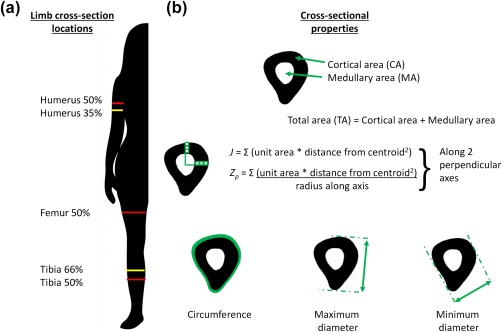
Humerus, femur and tibia midshaft cross-sectional properties were measured by peripheral quantitative computed tomography in sample of young adult women (n = 105) characterized by a range of activity levels. Body composition was estimated from bioimpedance analysis.
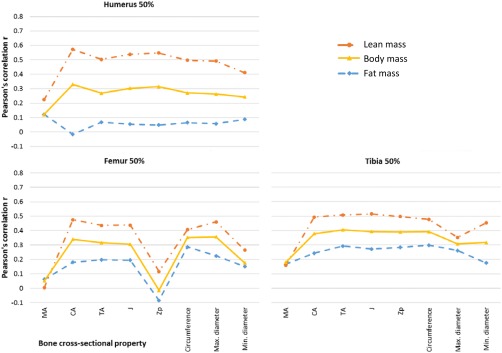
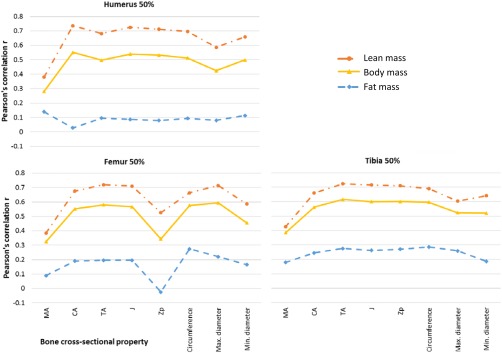
Lean mass correlated most strongly with both upper and lower limb bone properties (r values up to 0.74), while fat mass showed weak correlations (r ≤ 0.29). Estimation equations generated from tibial midshaft properties indicated that lean mass could be estimated relatively reliably, with some improvement using logged data and including bone length in the models (minimum standard error of estimate = 8.9%). Body mass prediction was less reliable and fat mass only poorly predicted (standard errors of estimate ≥11.9% and >33%, respectively).
Lean mass can be predicted more reliably than body mass from limb bone cross-sectional properties. The results highlight the potential for studying evolutionary trends in lean mass from skeletal remains, and have implications for understanding the relationship between bone morphology and body mass or composition.
从骨骼尺寸估计体重的方法被广泛应用,但估计其组成部分(瘦体重和脂肪量)的方法尚不完善。能够估计这些特征将为研究身体成分的进化及其与过去和现在健康状况的变化提供新的见解。本研究探讨了长骨横截面积特征作为预测身体、瘦体重和脂肪量的潜力。
通过外周定量计算机断层扫描对活动水平不同的年轻成年女性(n=105)的肱骨、股骨和胫骨中段横截面积特征进行了测量。身体成分通过生物阻抗分析进行估计。
瘦体重与上肢和下肢骨特性的相关性最强(r 值高达 0.74),而脂肪量的相关性较弱(r≤0.29)。从胫骨中段特性生成的估计方程表明,瘦体重可以相对可靠地估计,使用对数数据和在模型中包含骨长可以提高估计的准确性(最小估计标准误差=8.9%)。体重预测的可靠性较低,而脂肪量的预测则很差(估计标准误差分别≥11.9%和>33%)。
从肢体骨横截面积特征可以更可靠地预测瘦体重,而不是体重。结果强调了从骨骼遗骸研究瘦体重进化趋势的潜力,并对理解骨形态与体重或身体成分之间的关系具有重要意义。