Centre for Cellular and Molecular Platforms, NCBS-TIFR, GKVK Campus, Bellary Road, Bangalore, 560065, Karnataka, India.
Department of Lipid Science, CSIR-Central Food Technology and Research Institute, Mysuru, 570020, Karnataka, India.
Microb Biotechnol. 2018 Mar;11(2):420-428. doi: 10.1111/1751-7915.13041. Epub 2018 Jan 17.
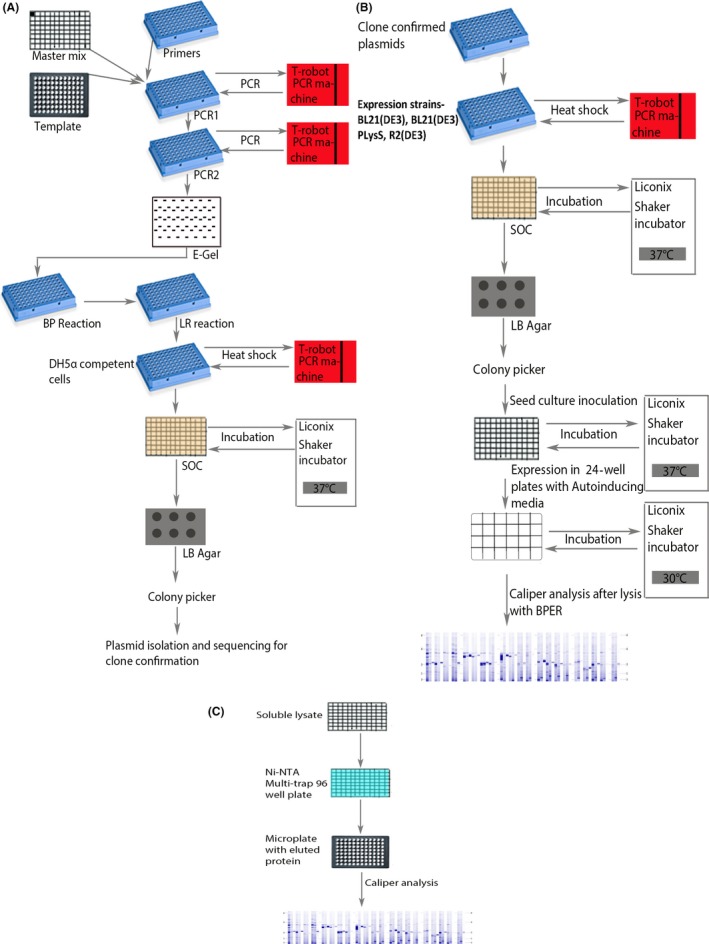
The process of obtaining a well-expressing, soluble and correctly folded constructs can be made easier and quicker by automating the optimization of cloning, expression and purification. While there are many semiautomated pipelines available for cloning, expression and purification, there is hardly any pipeline that involves complete automation. Here, we achieve complete automation of all the steps involved in cloning and in vivo expression screening. This is demonstrated using 18 genes involved in sialic acid catabolism and the surface sialylation pathway. Our main objective was to clone these genes into a His-tagged Gateway vector, followed by their small-scale expression optimization in vivo. The constructs that showed best soluble expression were then selected for purification studies and scaled up for crystallization studies. Our technique allowed us to quickly find conditions for producing significant quantities of soluble proteins in Escherichia coli, their large-scale purification and successful crystallization of a number of these proteins. The method can be implemented in other cases where one needs to screen a large number of constructs, clones and expression vectors for successful recombinant production of functional proteins.
通过自动化克隆、表达和纯化的优化,获得表达良好、可溶性和正确折叠的构建体的过程可以变得更加容易和快捷。虽然有许多半自动化的克隆、表达和纯化管道,但几乎没有涉及完全自动化的管道。在这里,我们实现了克隆和体内表达筛选过程中所有步骤的完全自动化。这是使用涉及唾液酸代谢和表面唾液酸化途径的 18 个基因来证明的。我们的主要目标是将这些基因克隆到带有 His 标签的 Gateway 载体中,然后在体内进行小规模表达优化。显示最佳可溶性表达的构建体随后被选择用于纯化研究,并进行放大以进行结晶研究。我们的技术使我们能够快速找到在大肠杆菌中产生大量可溶性蛋白的条件,对其进行大规模纯化,并成功对其中一些蛋白进行结晶。该方法可用于其他需要筛选大量构建体、克隆和表达载体以成功生产功能性蛋白的情况。