Sacolo Hlengiwe, Chimbari Moses, Kalinda Chester
School of Nursing and Public Health, College of Health Sciences, University of KwaZulu-Natal, Howard Campus, Durban, South Africa.
College of Health Sciences, University of KwaZulu-Natal, Howard Campus, Durban, South Africa.
BMC Infect Dis. 2018 Jan 18;18(1):46. doi: 10.1186/s12879-017-2923-6.
Schistosomiasis remains a global health problem with an estimated 250 million people in 78 countries infected, of whom 85% live in Sub-Saharan Africa. Preventive chemotherapy remains the key public health strategy to combat schistosomiasis worldwide. Recently the WHO emphasized on the use of integrative approaches in the control and elimination of schistosomiasis. However, a detailed understanding of sociocultural factors that may influence the uptake of the intended health activities and services is vital. Thus, our study sought to understand the knowledge, attitudes, perceptions, beliefs and practices about schistosomiasis in various communities in Sub-Saharan Africa.
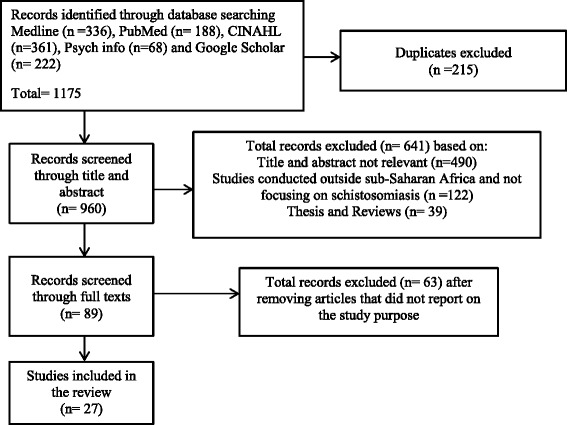
A systematic search of literature for the period 2006-2016 was done on Medline, PubMed, CINAHL, Psych info and Google Scholar using the following key words "Schistosomiasis, S. mansoni, S. haematobium, knowledge, attitudes, perceptions, beliefs and practices in Sub-Saharan Africa" in combination with Bolean operators (OR, AND). In this context, we reviewed studies conducted among school children, community members and caregivers of preschool children. Thematic analysis was utilised for the overall synthesis of the selected studies. This was done after reading the articles in depth. Themes were identified and examined for similarities, differences and contradictions.
Gaps in schistosomiasis related knowledge and sociocultural barriers towards the uptake of preventive and treatment services among communities in Sub-Saharan Africa were identified. In addition to limited knowledge and negative attitudes, risky water related practices among community members, school children and caregivers of preschool children were identified as key factors promoting transmission of the disease.
The study concluded that a comprehensive health education programme using contextual and standardised training tools may improve peoples' knowledge, attitudes and practices in relation to schistosomiasis prevention and control. Findings also highlight the significance of including caregivers in the planning and implementation schistosomiasis control programs targeting pre-school children.
血吸虫病仍然是一个全球性的健康问题,估计在78个国家有2.5亿人感染,其中85%生活在撒哈拉以南非洲。预防性化疗仍然是全球抗击血吸虫病的关键公共卫生战略。最近,世界卫生组织强调在血吸虫病的控制和消除中使用综合方法。然而,详细了解可能影响预期健康活动和服务接受度的社会文化因素至关重要。因此,我们的研究旨在了解撒哈拉以南非洲各社区对血吸虫病的知识、态度、认知、信念和做法。
在2006 - 2016年期间,使用关键词“血吸虫病、曼氏血吸虫、埃及血吸虫、撒哈拉以南非洲的知识、态度、认知、信念和做法”并结合布尔运算符(或、与),在Medline、PubMed、CINAHL、Psych info和谷歌学术上对文献进行系统检索。在此背景下,我们回顾了在学童、社区成员和学龄前儿童照料者中开展的研究。采用主题分析法对所选研究进行总体综合。这是在深入阅读文章后完成的。确定主题并检查其异同和矛盾之处。
确定了撒哈拉以南非洲各社区在血吸虫病相关知识方面的差距以及在接受预防和治疗服务方面的社会文化障碍。除了知识有限和态度消极外,社区成员、学童和学龄前儿童照料者中与水有关的危险行为被确定为促进疾病传播的关键因素。
该研究得出结论,使用因地制宜和标准化培训工具的全面健康教育计划可能会改善人们在血吸虫病预防和控制方面的知识、态度和做法。研究结果还突出了在针对学龄前儿童的血吸虫病控制计划的规划和实施中纳入照料者的重要性。