Redekop William K, Lenk Edeltraud J, Luyendijk Marianne, Fitzpatrick Christopher, Niessen Louis, Stolk Wilma A, Tediosi Fabrizio, Rijnsburger Adriana J, Bakker Roel, Hontelez Jan A C, Richardus Jan H, Jacobson Julie, de Vlas Sake J, Severens Johan L
Institute of Health Policy & Management, Erasmus University Rotterdam, Rotterdam, The Netherlands.
Neglected Tropical Diseases, World Health Organization, Geneva, Switzerland.
PLoS Negl Trop Dis. 2017 Jan 19;11(1):e0005289. doi: 10.1371/journal.pntd.0005289. eCollection 2017 Jan.
Lymphatic filariasis (LF), onchocerciasis, schistosomiasis, soil-transmitted helminths (STH) and trachoma represent the five most prevalent neglected tropical diseases (NTDs). They can be controlled or eliminated by means of safe and cost-effective interventions delivered through programs of Mass Drug Administration (MDA)-also named Preventive Chemotherapy (PCT). The WHO defined targets for NTD control/elimination by 2020, reinforced by the 2012 London Declaration, which, if achieved, would result in dramatic health gains. We estimated the potential economic benefit of achieving these targets, focusing specifically on productivity and out-of-pocket payments.
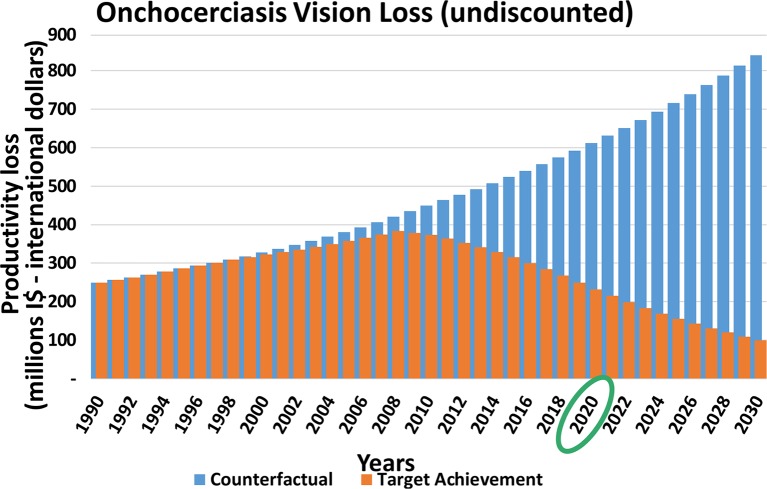
Productivity loss was calculated by combining disease frequency with productivity loss from the disease, from the perspective of affected individuals. Productivity gain was calculated by deducting the total loss expected in the target achievement scenario from the loss in a counterfactual scenario where it was assumed the pre-intervention situation in 1990 regarding NTDs would continue unabated until 2030. Economic benefits from out-of-pocket payments (OPPs) were calculated similarly. Benefits are reported in 2005 US$ (purchasing power parity-adjusted and discounted at 3% per annum from 2010). Sensitivity analyses were used to assess the influence of changes in input parameters.
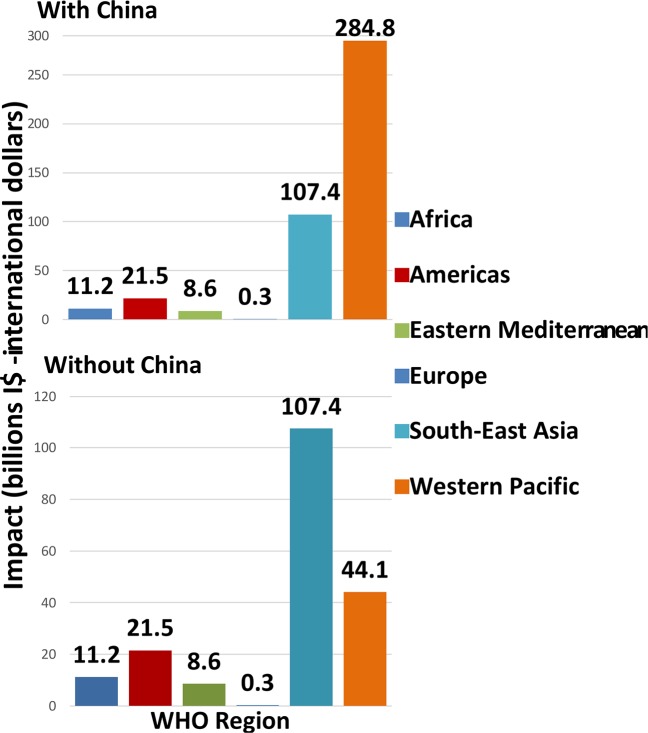
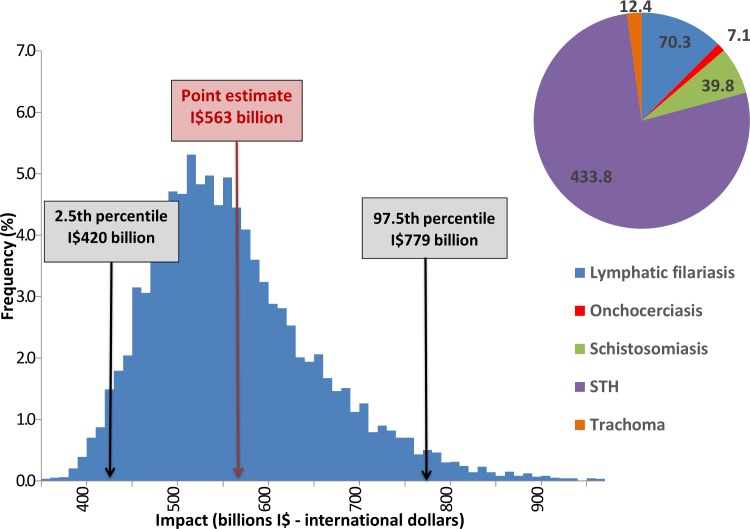
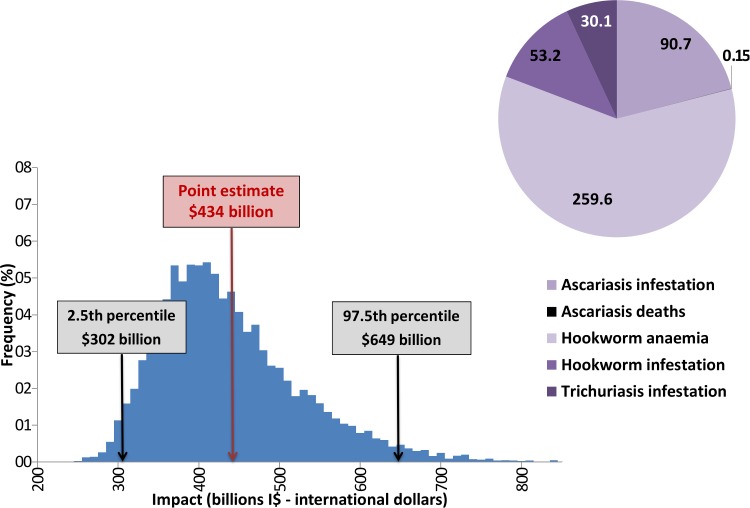
The economic benefit from productivity gain was estimated to be I$251 billion in 2011-2020 and I$313 billion in 2021-2030, considerably greater than the total OPPs averted of I$0.72 billion and I$0.96 billion in the same periods. The net benefit is expected to be US$ 27.4 and US$ 42.8 for every dollar invested during the same periods. Impact varies between NTDs and regions, since it is determined by disease prevalence and extent of disease-related productivity loss.
Achieving the PCT-NTD targets for 2020 will yield significant economic benefits to affected individuals. Despite large uncertainty, these benefits far exceed the investment required by governments and their development partners within all reasonable scenarios. Given the concentration of the NTDs among the poorest households, these investments represent good value for money in efforts to share the world's prosperity and reduce inequity.
淋巴丝虫病、盘尾丝虫病、血吸虫病、土壤传播的蠕虫病和沙眼是最常见的五种被忽视的热带病。通过大规模药物管理(MDA)计划(也称为预防性化疗,PCT)提供的安全且具有成本效益的干预措施,可以控制或消除这些疾病。世界卫生组织确定了到2020年控制/消除被忽视热带病的目标,《2012年伦敦宣言》强化了这一目标,如果实现这些目标,将带来巨大的健康收益。我们估计了实现这些目标的潜在经济效益,特别关注生产力和自付费用。
从受影响个体的角度,将疾病发生率与疾病导致的生产力损失相结合,计算生产力损失。通过从一个反事实情景(假设1990年关于被忽视热带病的干预前情况将持续到2030年且不减弱)的损失中扣除目标实现情景下预期的总损失,计算生产力收益。自付费用(OPPs)的经济效益也以类似方式计算。收益以2005年美元报告(按购买力平价调整并从2010年起按每年3%贴现)。使用敏感性分析来评估输入参数变化的影响。
估计2011 - 2020年生产力收益带来的经济效益为2510亿美元,2021 - 2030年为3130亿美元,大大高于同期避免的自付费用总额(分别为7.2亿美元和9.6亿美元)。预计同期每投资1美元的净收益分别为27.4美元和42.8美元。不同被忽视热带病和地区的影响有所不同,因为这取决于疾病流行率和与疾病相关的生产力损失程度。
实现2020年预防性化疗 - 被忽视热带病目标将给受影响个体带来显著的经济效益。尽管存在很大不确定性,但在所有合理情景下,这些收益远远超过政府及其发展伙伴所需的投资。鉴于被忽视热带病在最贫困家庭中的集中情况,这些投资对于分享世界繁荣和减少不平等而言物有所值。