Sparrow Katy J, Kessler John D, Southon John R, Garcia-Tigreros Fenix, Schreiner Kathryn M, Ruppel Carolyn D, Miller John B, Lehman Scott J, Xu Xiaomei
Department of Earth and Environmental Sciences, University of Rochester, Rochester, NY 14627, USA.
Department of Environmental Science and Analytical Chemistry, Bolin Centre for Climate Research, Stockholm University, Stockholm, Sweden.
Sci Adv. 2018 Jan 17;4(1):eaao4842. doi: 10.1126/sciadv.aao4842. eCollection 2018 Jan.
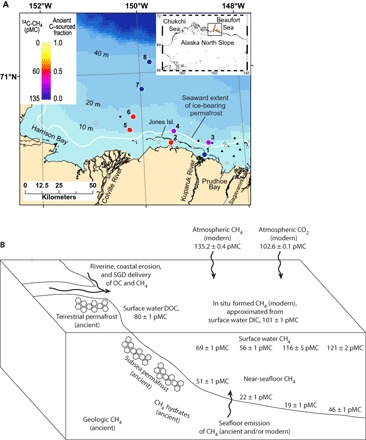
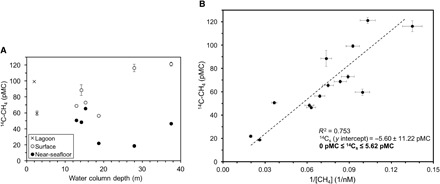
In response to warming climate, methane can be released to Arctic Ocean sediment and waters from thawing subsea permafrost and decomposing methane hydrates. However, it is unknown whether methane derived from this sediment storehouse of frozen ancient carbon reaches the atmosphere. We quantified the fraction of methane derived from ancient sources in shelf waters of the U.S. Beaufort Sea, a region that has both permafrost and methane hydrates and is experiencing significant warming. Although the radiocarbon-methane analyses indicate that ancient carbon is being mobilized and emitted as methane into shelf bottom waters, surprisingly, we find that methane in surface waters is principally derived from modern-aged carbon. We report that at and beyond approximately the 30-m isobath, ancient sources that dominate in deep waters contribute, at most, 10 ± 3% of the surface water methane. These results suggest that even if there is a heightened liberation of ancient carbon-sourced methane as climate change proceeds, oceanic oxidation and dispersion processes can strongly limit its emission to the atmosphere.
作为对气候变暖的响应,甲烷可从海底永久冻土融化和甲烷水合物分解中释放到北冰洋沉积物和水体中。然而,源自这个冻结古代碳沉积物库的甲烷是否会进入大气尚不清楚。我们对美国波弗特海陆架水域中源自古代源的甲烷比例进行了量化,该地区既有永久冻土又有甲烷水合物,且正在经历显著变暖。尽管放射性碳 - 甲烷分析表明古代碳正在被 mobilized 并以甲烷形式排放到陆架底层水体中,但令人惊讶的是,我们发现表层水体中的甲烷主要源自现代年龄的碳。我们报告称,在大约 30 米等深线及以外区域,深水中占主导的古代源对表层水甲烷的贡献最多为 10 ± 3%。这些结果表明,即使随着气候变化古代碳源甲烷的释放有所增加,海洋氧化和扩散过程也能强烈限制其向大气的排放。