• 文献检索
  • 文档翻译
  • 深度研究
  • 学术资讯
  • Suppr Zotero 插件Zotero 插件
  • 邀请有礼
  • 套餐&价格
  • 历史记录
应用&插件
Suppr Zotero 插件Zotero 插件浏览器插件Mac 客户端Windows 客户端微信小程序
定价
高级版会员购买积分包购买API积分包
服务
文献检索文档翻译深度研究API 文档MCP 服务
关于我们
关于 Suppr公司介绍联系我们用户协议隐私条款
关注我们

Suppr 超能文献

核心技术专利:CN118964589B侵权必究
粤ICP备2023148730 号-1Suppr @ 2026

文献检索

告别复杂PubMed语法,用中文像聊天一样搜索,搜遍4000万医学文献。AI智能推荐,让科研检索更轻松。

立即免费搜索

文件翻译

保留排版,准确专业,支持PDF/Word/PPT等文件格式,支持 12+语言互译。

免费翻译文档

深度研究

AI帮你快速写综述,25分钟生成高质量综述,智能提取关键信息,辅助科研写作。

立即免费体验

观看讲座的方式、课程评分与课程时间安排之间的关系。

The Relationship Between Method of Viewing Lectures, Course Ratings, and Course Timing.

作者信息

Burton William B, Ma Terence P, Grayson Martha S

机构信息

Office of Educational Resources, Albert Einstein College of Medicine, Bronx, NY, USA.

Office of Medical Education, Albert Einstein College of Medicine, Bronx, NY, USA.

出版信息

J Med Educ Curric Dev. 2017 Jul 11;4:2382120517720215. doi: 10.1177/2382120517720215. eCollection 2017 Jan-Dec.

DOI:10.1177/2382120517720215
PMID:29349337
原文链接:https://pmc.ncbi.nlm.nih.gov/articles/PMC5736287/
Abstract

BACKGROUND

In recent years, medical schools have provided students access to video recordings of course lectures, but few studies have investigated the impact of this on ratings of courses and teachers. This study investigated whether the method of viewing lectures was related to student ratings of the course and its components and whether the method used changed over time.

METHODS

Preclinical medical students indicated whether ratings of course lectures were based primarily on lecture attendance, video capture, or both. Students were categorized into Lecture, Video, or Both groups based on their responses to this question. The data consisted of 7584 student evaluations collected over 2 years.

RESULTS

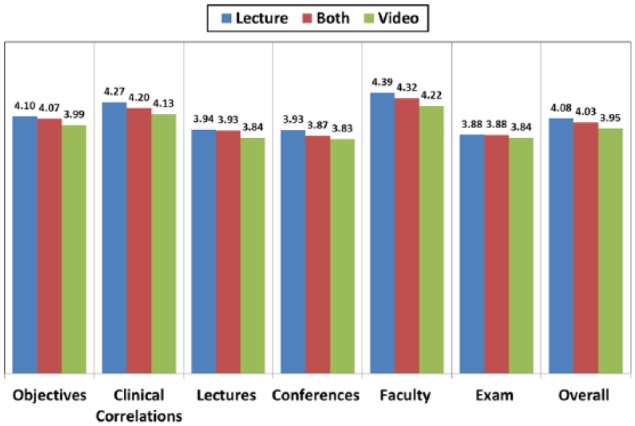
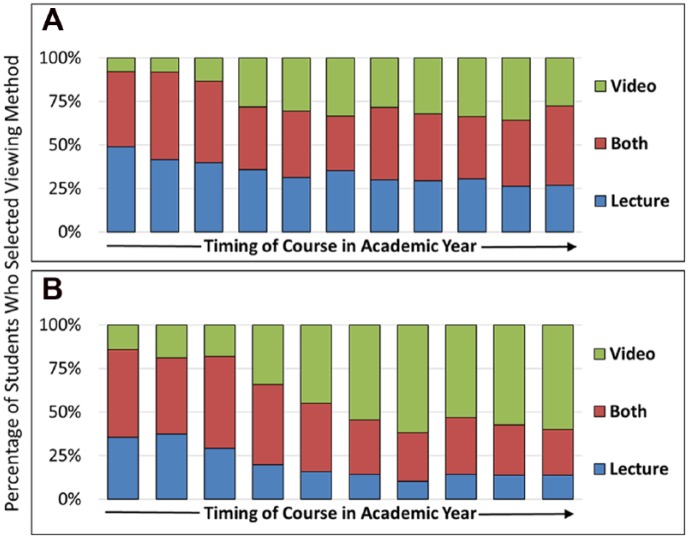
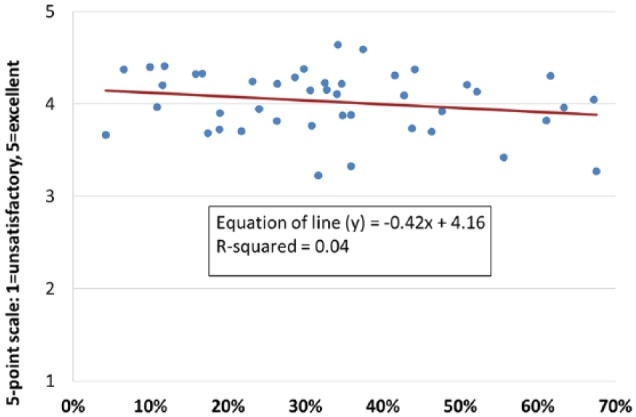
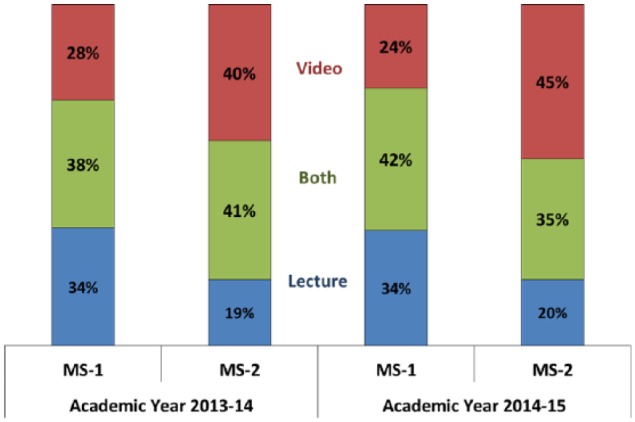
Students who attended live lectures rated the course and its components higher than students who only viewed the video or used both methods, although these differences were very small. Students increasingly watched lectures exclusively by video over time: in comparison with first-year students, second-year students were more likely to watch lectures exclusively by video; in comparison with students in the first half of the academic year, students in the second half of the academic year were more likely to watch lectures exclusively by video.

CONCLUSIONS

With the increase in use of lecture video recordings across medical schools, attention must be paid to student attitudes regarding these methods.

摘要

背景

近年来,医学院校已为学生提供课程讲座的录像,但很少有研究调查这对课程及教师评分的影响。本研究调查了观看讲座的方式是否与学生对课程及其组成部分的评分相关,以及所采用的方式是否随时间变化。

方法

临床前医学生指出课程讲座评分主要基于听课、视频观看,还是两者皆有。根据学生对该问题的回答,将其分为听课组、视频组或两者皆用组。数据包括两年内收集的7584份学生评价。

结果

参加现场讲座的学生对课程及其组成部分的评分高于仅观看视频或两种方式都用的学生,尽管这些差异非常小。随着时间推移,越来越多的学生仅通过视频观看讲座:与一年级学生相比,二年级学生更有可能仅通过视频观看讲座;与学年上半学期的学生相比,学年下半学期的学生更有可能仅通过视频观看讲座。

结论

随着医学院校讲座录像使用的增加,必须关注学生对这些方式的态度。

https://cdn.ncbi.nlm.nih.gov/pmc/blobs/fe5e/5736287/a03e885f9266/10.1177_2382120517720215-fig4.jpg
https://cdn.ncbi.nlm.nih.gov/pmc/blobs/fe5e/5736287/7dbd2459e2ef/10.1177_2382120517720215-fig1.jpg
https://cdn.ncbi.nlm.nih.gov/pmc/blobs/fe5e/5736287/fec28cad6e42/10.1177_2382120517720215-fig2.jpg
https://cdn.ncbi.nlm.nih.gov/pmc/blobs/fe5e/5736287/394bf5eab8e6/10.1177_2382120517720215-fig3.jpg
https://cdn.ncbi.nlm.nih.gov/pmc/blobs/fe5e/5736287/a03e885f9266/10.1177_2382120517720215-fig4.jpg
https://cdn.ncbi.nlm.nih.gov/pmc/blobs/fe5e/5736287/7dbd2459e2ef/10.1177_2382120517720215-fig1.jpg
https://cdn.ncbi.nlm.nih.gov/pmc/blobs/fe5e/5736287/fec28cad6e42/10.1177_2382120517720215-fig2.jpg
https://cdn.ncbi.nlm.nih.gov/pmc/blobs/fe5e/5736287/394bf5eab8e6/10.1177_2382120517720215-fig3.jpg
https://cdn.ncbi.nlm.nih.gov/pmc/blobs/fe5e/5736287/a03e885f9266/10.1177_2382120517720215-fig4.jpg

相似文献

1
The Relationship Between Method of Viewing Lectures, Course Ratings, and Course Timing.观看讲座的方式、课程评分与课程时间安排之间的关系。
J Med Educ Curric Dev. 2017 Jul 11;4:2382120517720215. doi: 10.1177/2382120517720215. eCollection 2017 Jan-Dec.
2
Effect of Live Attendance and Video Capture Viewing on Student Examination Performance.现场出勤和视频捕捉观看对学生考试表现的影响。
Am J Pharm Educ. 2019 Aug;83(6):6897. doi: 10.5688/ajpe6897.
3
Live lecture versus video-recorded lecture: are students voting with their feet?现场讲座与录像讲座:学生们会用脚投票吗?
Acad Med. 2008 Dec;83(12):1174-8. doi: 10.1097/ACM.0b013e31818c6902.
4
The interrupted learner: How distractions during live and video lectures influence learning outcomes.被打断的学习者:现场和视频讲座期间的干扰如何影响学习效果。
Anat Sci Educ. 2018 Jul;11(4):366-376. doi: 10.1002/ase.1754. Epub 2017 Nov 27.
5
Exploring medical student decisions regarding attending live lectures and using recorded lectures.探讨医学生是否选择参加现场讲座和使用录制讲座。
Med Teach. 2013 Sep;35(9):767-71. doi: 10.3109/0142159X.2013.801940. Epub 2013 Jul 22.
6
Academic performance of dental students: A randomised trial comparing live, audio recorded and video recorded lectures.牙科学术表现:比较现场、录音和录像讲座的随机试验。
Eur J Dent Educ. 2021 May;25(2):377-384. doi: 10.1111/eje.12614. Epub 2020 Oct 21.
7
Do prerecorded lecture VODcasts affect lecture attendance of first-yearpre-clinical Graduate Entry to Medicine students?预先录制的讲座视频播客会影响医学研究生入学第一年临床前学生的讲座出勤率吗?
Med Teach. 2017 Mar;39(3):250-254. doi: 10.1080/0142159X.2017.1270436. Epub 2016 Dec 27.
8
The impact of lecture attendance and other variables on how medical students evaluate faculty in a preclinical program.讲座出勤和其他变量对医学生如何评估临床前课程教师的影响。
Acad Med. 2013 Jul;88(7):972-7. doi: 10.1097/ACM.0b013e318294e99a.
9
No apparent association between lecture attendance or accessing lecture recordings and academic outcomes in a medical laboratory science course.在医学实验室科学课程中,课堂出勤率或访问课程录音与学业成绩之间似乎没有明显关联。
BMC Med Educ. 2020 Jun 30;20(1):207. doi: 10.1186/s12909-020-02066-9.
10
Video versus live lecture courses: a comparative evaluation of lecture types and results.视频课程与现场讲座课程:讲座类型和效果的比较评估。
Med Educ Online. 2018 Dec;23(1):1555434. doi: 10.1080/10872981.2018.1555434.

引用本文的文献

1
Video Lecture Capture in Pharmacy Education: Insights From the Pandemic Experience.药学教育中的视频讲座录制:疫情经历带来的见解
Cureus. 2024 Nov 13;16(11):e73649. doi: 10.7759/cureus.73649. eCollection 2024 Nov.
2
The PEGASUS Games: Physical Exam, Gross Anatomy, phySiology and UltraSound Games for Preclinical Medical Education.PEGASUS游戏:用于临床前医学教育的体格检查、大体解剖学、生理学和超声游戏。
POCUS J. 2021 Apr 22;6(1):22-28. doi: 10.24908/pocus.v6i1.14758. eCollection 2021.
3
Implementation of Team-Based Learning: a Tale of Two New Medical Schools.

本文引用的文献

1
Medical student lecture attendance versus iTunes U.医学生课堂出勤率与iTunes U对比
Med Educ. 2015 May;49(5):530-1. doi: 10.1111/medu.12723.
2
Student and faculty perceptions of lecture recording in a doctor of pharmacy curriculum.学生和教师对药学博士课程中讲座录音的看法。
Am J Pharm Educ. 2013 Oct 14;77(8):165. doi: 10.5688/ajpe778165.
3
To record or not to record?记录还是不记录?
基于团队的学习的实施:两所新医学院的故事。
Med Sci Educ. 2019 Oct 15;29(4):1201-1210. doi: 10.1007/s40670-019-00815-0. eCollection 2019 Dec.
Am J Pharm Educ. 2011 Oct 10;75(8):149. doi: 10.5688/ajpe758149.
4
Evaluation of a lecture recording system in a medical curriculum.医学课程中讲座录音系统的评估。
Anat Sci Educ. 2010 Nov-Dec;3(6):300-8. doi: 10.1002/ase.183. Epub 2010 Oct 15.
5
Live lecture versus video-recorded lecture: are students voting with their feet?现场讲座与录像讲座:学生们会用脚投票吗?
Acad Med. 2008 Dec;83(12):1174-8. doi: 10.1097/ACM.0b013e31818c6902.
6
Medical student evaluations of lectures attended in person or from rural sites via interactive videoconferencing.医学生对通过交互式视频会议亲自参加或从农村站点参加的讲座的评价。
Teach Learn Med. 2004 Winter;16(1):46-50. doi: 10.1207/s15328015tlm1601_10.
7
A comparison of student evaluations and faculty peer evaluations of faculty lectures.学生对教师授课的评价与教师同行对教师授课的评价之比较。
Acad Med. 1999 Oct;74(10 Suppl):S22-4. doi: 10.1097/00001888-199910000-00029.
8
Videotaped vs traditional lectures for medical students.医学生的录像讲座与传统讲座对比
Med Educ. 1980 Nov;14(6):387-93. doi: 10.1111/j.1365-2923.1980.tb02389.x.
9
Teaching the mental status examination: comparison of three methods.精神状态检查教学:三种方法的比较
J Med Educ. 1982 Aug;57(8):626-9. doi: 10.1097/00001888-198208000-00008.
10
Comparison of a videotape instructional program with a traditional lecture series for medical student emergency medicine teaching.录像带教学程序与传统讲座系列用于医学生急诊医学教学的比较。
Ann Emerg Med. 1986 Jan;15(1):16-8. doi: 10.1016/s0196-0644(86)80480-2.