Kim Hyuk, So Eunsun, Karm Myong-Hwan, Kim Hyun Jeong, Seo Kwang-Suk
Department of Dental Anesthesiology, School of Dentistry, Seoul National University, Seoul, Korea.
Department of Dental Anesthesiology, Seoul National University Dental Hospital, Seoul, Korea.
J Dent Anesth Pain Med. 2017 Dec;17(4):297-305. doi: 10.17245/jdapm.2017.17.4.297. Epub 2017 Dec 28.
Fiberoptic nasotracheal intubation (FNI) is performed if it is difficult to open the mouth or if intubation using laryngoscope is expected to be difficult. However, training is necessary because intubation performed by inexperienced operators leads to complications.
Every resident performed intubation in 40 patients. Success of FNI was evaluated as the time of FNI. First intubation time was restricted to 2 min 30 s. If the second attempt was unsuccessful, it was considered a failed case, and a specialist performed nasotracheal intubation. If the general method of intubation was expected to be difficult, awake intubation was performed. The degree of nasal bleeding during intubation was also evaluated.
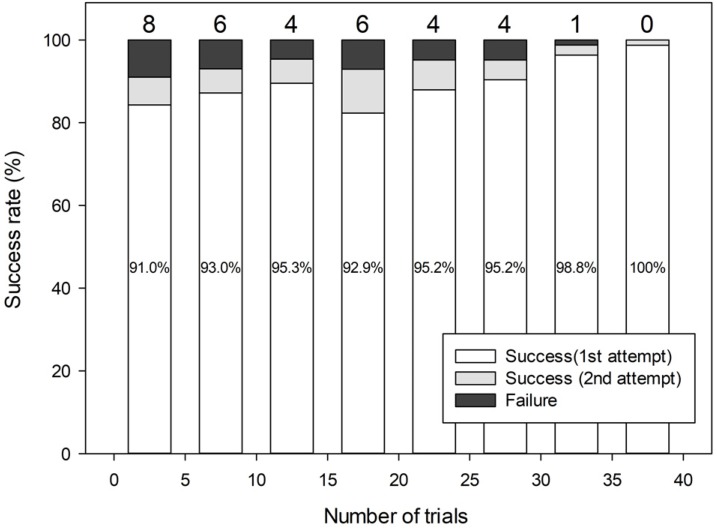
The mean age of the operators (11 men, 7 women) was 27.8 years. FNI was performed in a total of 716 patients. The success rate was 88.3% for the first attempt and 94.6% for the second attempt. The failure rate of intubation in anesthetized patients was 4.9%, and 13.6% in awake patients. When intubation was performed in anesthetized patients, the failure rate from the first to fifth trial was 9.6%, which decreased to 0.7% when the number of trials increased to > 30 times. In terms of awake intubation, there was no failed attempt when the resident had performed the FNI > 30 times. The number of FNIs performed and nasal bleeding were important factors influencing the failure rate.
The success rate of FNI increased as the number of FNI performed by residents increased despite the nasal bleeding.
如果难以开口或预计使用喉镜进行插管困难,则进行纤维鼻气管插管(FNI)。然而,由于经验不足的操作者进行插管会导致并发症,因此培训是必要的。
每位住院医师对40例患者进行插管。FNI的成功以FNI时间来评估。首次插管时间限制为2分30秒。如果第二次尝试不成功,则视为失败病例,由专科医生进行鼻气管插管。如果预计常规插管方法困难,则进行清醒插管。同时评估插管期间鼻出血的程度。
操作者平均年龄(11名男性,7名女性)为27.8岁。共对716例患者进行了FNI。首次尝试成功率为88.3%,第二次尝试成功率为94.6%。麻醉患者插管失败率为4.9%,清醒患者为13.6%。在麻醉患者中进行插管时,首次至第五次尝试的失败率为9.6%,当尝试次数增加到>30次时,失败率降至0.7%。在清醒插管方面,当住院医师进行FNI>30次时,没有失败的尝试。进行FNI的次数和鼻出血是影响失败率的重要因素。
尽管存在鼻出血,但随着住院医师进行FNI次数的增加,FNI的成功率提高。