Emerg Infect Dis. 2018 Feb;24(2):284-293. doi: 10.3201/eid2402.170704.
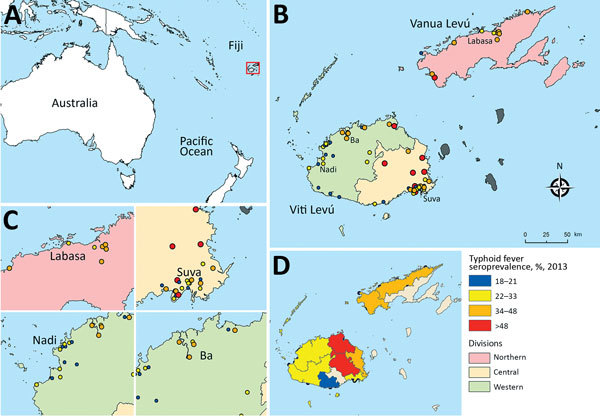
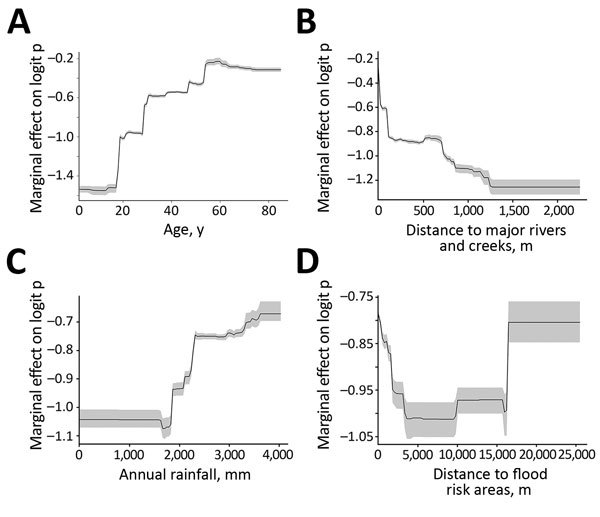
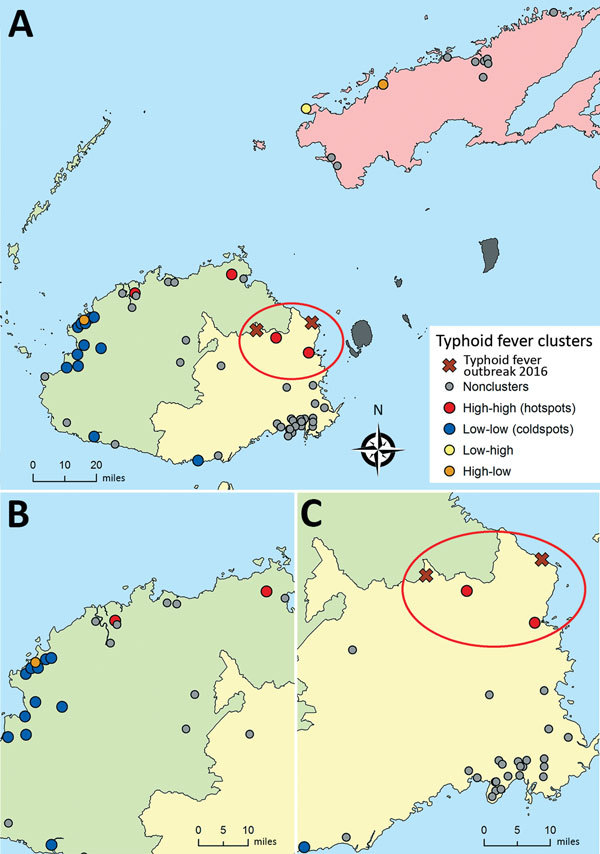
Fiji recently experienced a sharp increase in reported typhoid fever cases. To investigate geographic distribution and environmental risk factors associated with Salmonella enterica serovar Typhi infection, we conducted a cross-sectional cluster survey with associated serologic testing for Vi capsular antigen-specific antibodies (a marker for exposure to Salmonella Typhi in Fiji in 2013. Hotspots with high seroprevalence of Vi-specific antibodies were identified in northeastern mainland Fiji. Risk for Vi seropositivity increased with increased annual rainfall (odds ratio [OR] 1.26/quintile increase, 95% CI 1.12-1.42), and decreased with increased distance from major rivers and creeks (OR 0.89/km increase, 95% CI 0.80-0.99) and distance to modeled flood-risk areas (OR 0.80/quintile increase, 95% CI 0.69-0.92) after being adjusted for age, typhoid fever vaccination, and home toilet type. Risk for exposure to Salmonella Typhi and its spatial distribution in Fiji are driven by environmental factors. Our findings can directly affect typhoid fever control efforts in Fiji.
斐济最近报告的伤寒病例急剧增加。为了调查与感染伤寒沙门氏菌血清型 Typhi 相关的地理分布和环境风险因素,我们进行了一项横断面聚类调查,并进行了与 Vi 荚膜抗原特异性抗体相关的血清学检测(这是 2013 年斐济接触伤寒沙门氏菌的标志物)。在斐济东北部大陆发现了 Vi 特异性抗体高血清阳性率的热点。Vi 血清阳性的风险随着年降雨量的增加而增加(优势比 [OR] 每增加五分位数 1.26,95%置信区间 [CI] 1.12-1.42),随着与主要河流和溪流的距离增加而降低(OR 每增加 1 公里 0.89,95%CI 0.80-0.99),以及与建模洪水风险区域的距离增加而降低(OR 每增加五分位数 0.80,95%CI 0.69-0.92),在调整年龄、伤寒疫苗接种和家庭厕所类型后。斐济感染伤寒沙门氏菌的风险及其空间分布受环境因素驱动。我们的研究结果可以直接影响斐济的伤寒控制工作。