Ghasemi-Roudsari Shima, Al-Shimary Abbas, Varcoe Benjamin, Byrom Rowena, Kearney Lorraine, Kearney Mark
Department of Physics and Astronomy, University of Leeds, Leeds, United Kingdom.
Division of Cardiovascular and Diabetes Research, Leeds Institute of Cardiovascular and Metabolic Medicine, University of Leeds, Leeds, United Kingdom.
PLoS One. 2018 Jan 19;13(1):e0191241. doi: 10.1371/journal.pone.0191241. eCollection 2018.
Magnetocardiography (MCG) is a non-invasive technique used to measure and map cardiac magnetic fields. We describe the predictive performance of a portable prototype magnetometer designed for use in acute and routine clinical settings. We assessed the predictive ability of the measurements derived from the magnetometer for the ruling-out of healthy subjects and patients whose chest pain has a non-ischemic origin from those with ischemic heart disease (IHD).
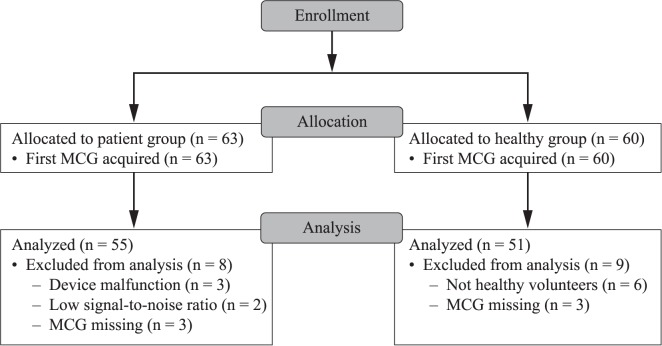
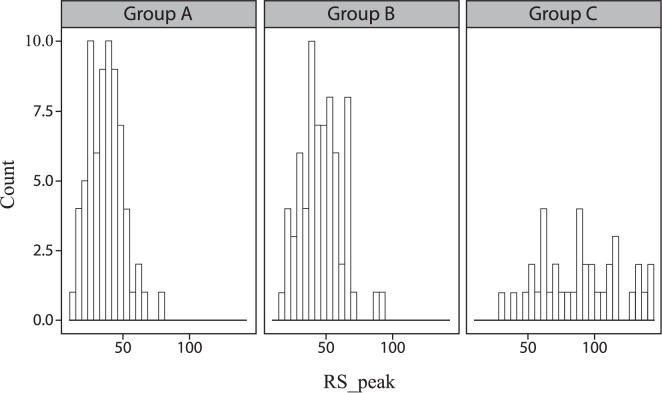
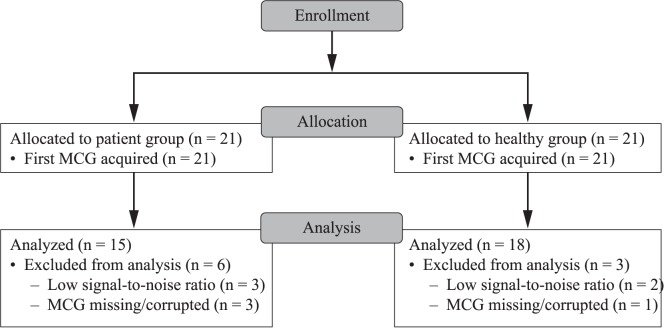
MCG data were analyzed from a technical performance study, a pilot clinical study, and a young healthy reference group. Participants were grouped to enable differentiation of those with IHD versus non-IHD versus controls: Group A (70 IHD patients); Group B (69 controls); Group C (37 young healthy volunteers). Scans were recorded in an unshielded room. Between-group differences were explored using analysis of variance. The ability of 10 candidate MCG predictors to predict normal/abnormal cases was analyzed using logistic regression. Predictive performance was internally validated using repeated five-fold cross-validation.
Three MCG predictors showed a significant difference between patients and age-matched controls (P<0.001); eight predictors showed a significant difference between patients and young healthy volunteers (P<0.001). Logistic regression comparing patients with controls yielded a specificity of 35.0%, sensitivity of 95.4%, and negative predictive value for the ruling-out of IHD of 97.8% (area under the curve 0.78).
This analysis represents a preliminary indication that the portable magnetometer can help rule-out healthy subjects and patients whose chest pain has a non-ischemic origin from those with IHD.
心脏磁图描记术(MCG)是一种用于测量和绘制心脏磁场的非侵入性技术。我们描述了一种设计用于急性和常规临床环境的便携式原型磁力计的预测性能。我们评估了该磁力计测量结果对于排除健康受试者以及胸痛病因非缺血性的患者与缺血性心脏病(IHD)患者的预测能力。
对一项技术性能研究、一项临床试点研究以及一个年轻健康参考组的MCG数据进行了分析。将参与者分组以区分IHD患者、非IHD患者和对照组:A组(70例IHD患者);B组(69例对照组);C组(37名年轻健康志愿者)。扫描在未屏蔽的房间内进行。使用方差分析探究组间差异。使用逻辑回归分析10个候选MCG预测指标预测正常/异常病例的能力。通过重复的五折交叉验证对预测性能进行内部验证。
三个MCG预测指标在患者与年龄匹配的对照组之间显示出显著差异(P<0.001);八个预测指标在患者与年轻健康志愿者之间显示出显著差异(P<0.001)。比较患者与对照组的逻辑回归得出特异性为35.0%,敏感性为95.4%,排除IHD的阴性预测值为97.8%(曲线下面积为0.78)。
该分析初步表明,便携式磁力计有助于排除健康受试者以及胸痛病因非缺血性的患者与IHD患者。