Ekelund Ulf, Akbarzadeh Mahin, Khoshnood Ardavan, Björk Jonas, Ohlsson Mattias
Department of Emergency Medicine, Skåne University Hospital, Lund, SE-221 85, Sweden.
BMC Res Notes. 2012 Aug 8;5:420. doi: 10.1186/1756-0500-5-420.
There is a circadian and circaseptal (weekly) variation in the onset of acute coronary syndrome (ACS). The aim of this study was to elucidate whether the likelihood of ACS among emergency department (ED) chest pain patients varies with the time of presentation.
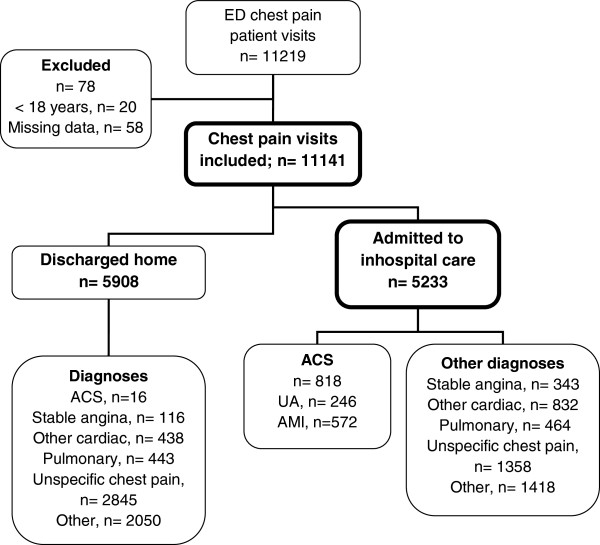
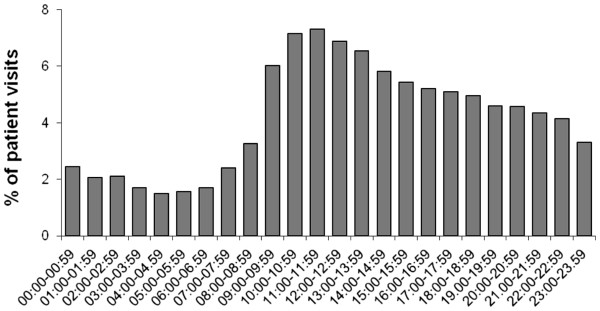
All patients presenting to the Lund ED at Skåne University Hospital with chest pain or discomfort during 2006 and 2007 were retrospectively included. Age, sex, arrival time at the ED and discharge diagnose (ACS or not) were obtained from the electronic medical records.
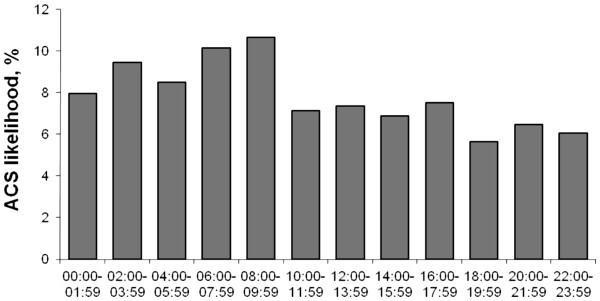
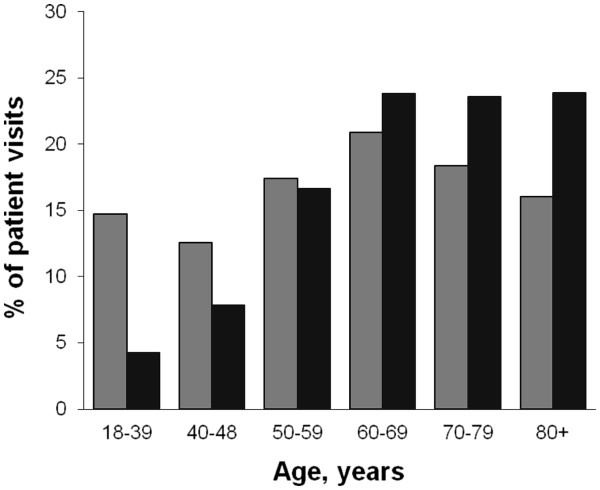
There was a clear but moderate circadian variation in the likelihood of ACS among presenting chest pain patients, the likelihood between 8 and 10 am being almost twice as high as between 6 and 8 pm. This was mainly explained by a variation in the ACS likelihood in females and patients under 65 years, with no significant variation in males and patients over 65 years. There was no significant circaseptal variation in the ACS likelihood.
Our results indicate that there is a circadian variation in the likelihood of ACS among ED chest pain patients, and suggest that physicians should consider the time of presentation to the ED when determining the likelihood of ACS.
急性冠状动脉综合征(ACS)的发病存在昼夜节律和每周节律(每周一次)变化。本研究的目的是阐明急诊科(ED)胸痛患者发生ACS的可能性是否随就诊时间而变化。
回顾性纳入2006年和2007年在斯科讷大学医院隆德急诊科因胸痛或不适就诊的所有患者。从电子病历中获取年龄、性别、到达急诊科的时间和出院诊断(是否为ACS)。
就诊的胸痛患者发生ACS的可能性存在明显但中等程度的昼夜节律变化,上午8点至10点的可能性几乎是下午6点至8点的两倍。这主要是由女性和65岁以下患者ACS可能性的变化所解释,男性和65岁以上患者无明显变化。ACS可能性无明显的每周节律变化。
我们的结果表明,急诊科胸痛患者发生ACS的可能性存在昼夜节律变化,并建议医生在确定ACS可能性时应考虑患者到急诊科就诊的时间。