Department of Urology, The First Affiliated Hospital with Nanjing Medical University, Nanjing, Jiangsu, China (mainland).
Department of Urology, Huai'an First People's Hospital, Nanjing Medical University, Huai'an, Jiangsu, China (mainland).
Med Sci Monit. 2018 Jan 20;24:387-396. doi: 10.12659/msm.905752.
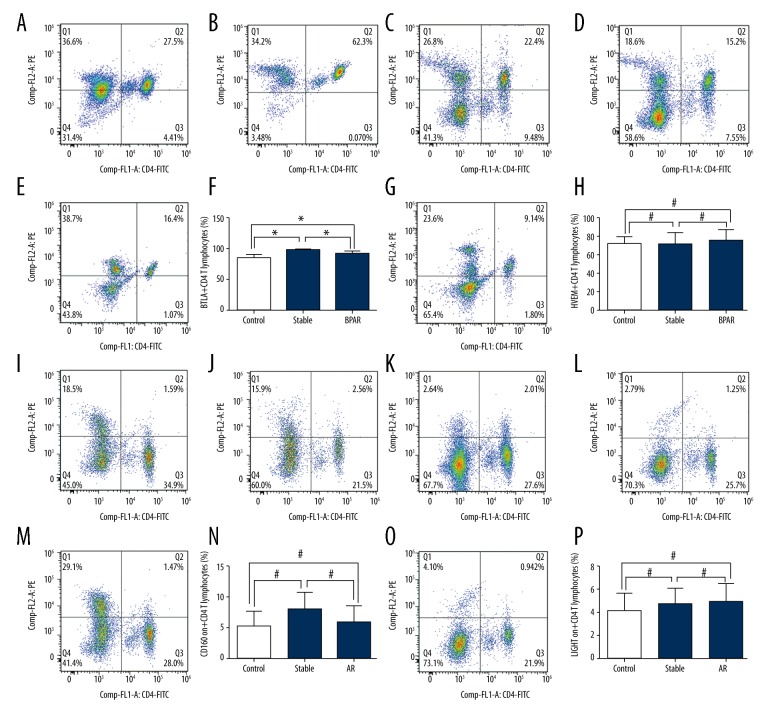
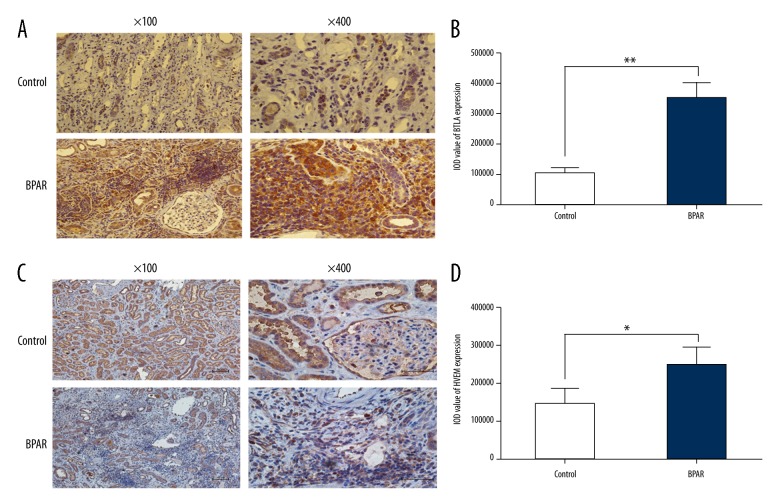
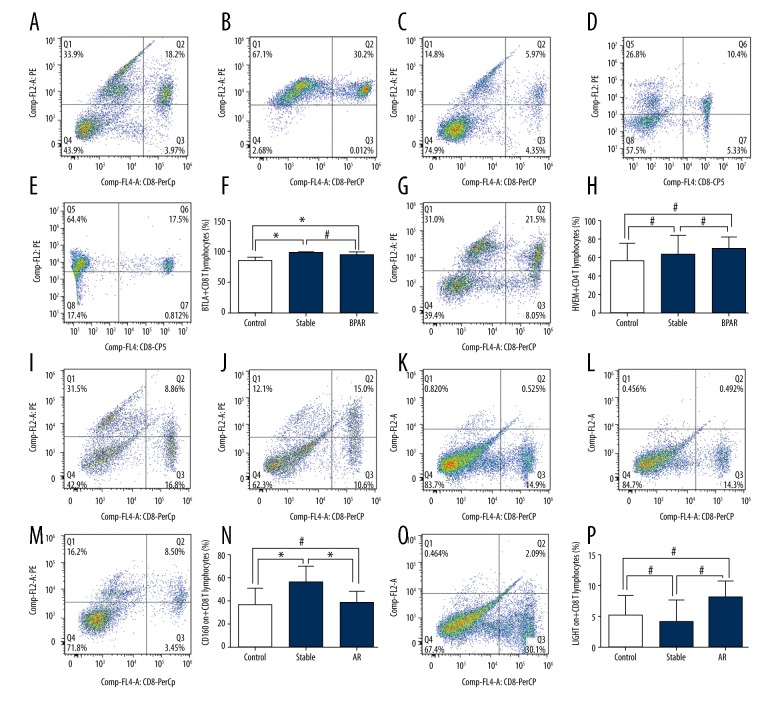
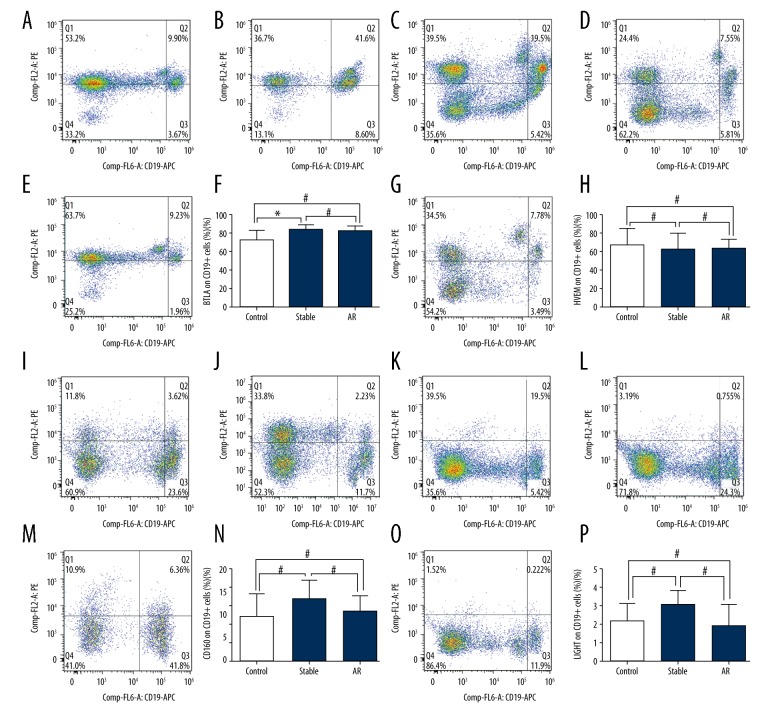
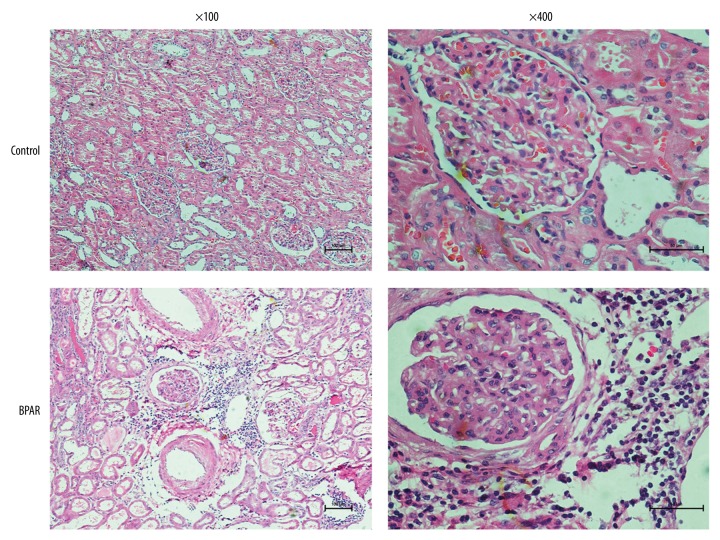
BACKGROUND Acute rejection is a common predisposing cause of allograft dysfunction in kidney transplantation. Recently, the B and T lymphocyte attenuator (BTLA)/herpes virus entry mediator (HVEM)/lymphotoxin (LIGHT)/CD160 pathway was found to be potentially involved in the regulation of T cell activation. This could mean that this pathway is involved in graft rejection in kidney transplantation; the present study aimed to explore this possibility. MATERIAL AND METHODS The expression of BTLA, HVEM, LIGHT and CD160 on peripheral CD4+, CD8+ and CD19+ lymphocytes were analyzed by flow cytometry in recipients with biopsy-proven acute rejection (BPAR) or stable allograft function, as well as in healthy volunteers. Moreover, we performed HE staining and immunohistochemical staining to assess the expression of BTLA and HVEM in kidney samples from recipients with BPAR and patients who underwent the surgery of radical nephrectomy. RESULTS We observed the significantly lower expression of BTLA on CD4+ T cells in recipients from the BPAR group than in recipients from the stable group. The expression of BTLA on CD8+ T cells among recipients both from the BPAR and stable group was statistically increased than that in the healthy volunteers. A significant difference in the expression of CD160 in the stable group was found when compared with the BPAR group or control group. Moreover, there was no significance in the expression of HVEM, LIGHT or CD160 on other subtypes of T cells between the 3 groups or in the expression of BTLA on CD4+ T cells between the BPAR and control group. CONCLUSIONS The findings indicate that the BTLA/HVEM pathway does be involved in pathogenesis of acute rejection following kidney transplantation, as well as the induction of transplant tolerance. This pathway may therefore be a useful target for therapy against acute rejection after kidney transplantation.
急性排斥反应是导致肾移植后同种异体移植物功能障碍的常见原因。最近,B 和 T 淋巴细胞衰减子(BTLA)/疱疹病毒进入介质(HVEM)/淋巴毒素(LIGHT)/CD160 途径被发现可能参与 T 细胞激活的调节。这意味着该途径可能参与肾移植中的移植物排斥反应;本研究旨在探讨这种可能性。
通过流式细胞术分析活检证实的急性排斥反应(BPAR)或稳定的同种异体功能受者以及健康志愿者外周血 CD4+、CD8+和 CD19+淋巴细胞上 BTLA、HVEM、LIGHT 和 CD160 的表达。此外,我们进行了 HE 染色和免疫组织化学染色,以评估 BPAR 受者和接受根治性肾切除术的患者肾组织中 BTLA 和 HVEM 的表达。
我们观察到 BPAR 组受者 CD4+T 细胞上 BTLA 的表达明显低于稳定组。BPAR 组和稳定组受者 CD8+T 细胞上 BTLA 的表达均明显高于健康志愿者。稳定组 CD160 的表达与 BPAR 组或对照组相比有显著差异。此外,3 组间其他 T 细胞亚群 HVEM、LIGHT 或 CD160 的表达或 BPAR 组与对照组间 CD4+T 细胞上 BTLA 的表达均无显著差异。
这些发现表明,BTLA/HVEM 途径确实参与了肾移植后急性排斥反应的发病机制,以及移植耐受的诱导。因此,该途径可能是治疗肾移植后急性排斥反应的一个有用靶点。