Han Seung Seog, Park Gyeong Hun, Lim Woohyung, Kim Myoung Shin, Na Jung Im, Park Ilwoo, Chang Sung Eun
I Dermatology, Seoul, Korea.
Department of Dermatology, Dongtan Sacred Heart Hospital, Hallym University College of Medicine, Dongtan, Korea.
PLoS One. 2018 Jan 19;13(1):e0191493. doi: 10.1371/journal.pone.0191493. eCollection 2018.
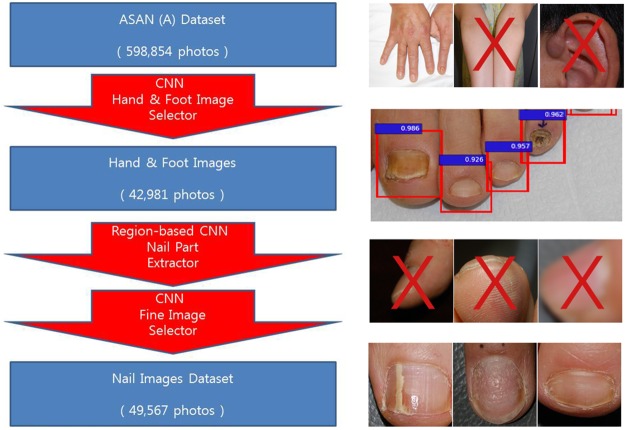
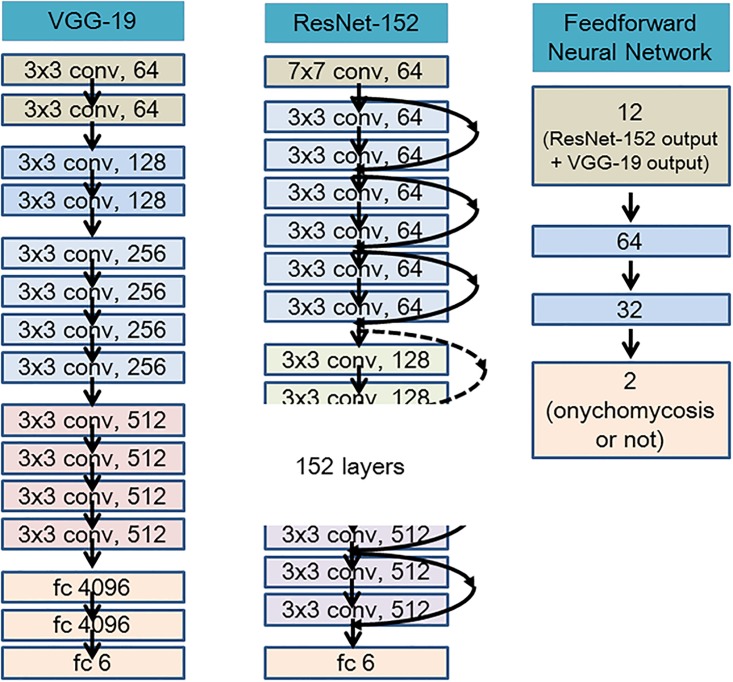
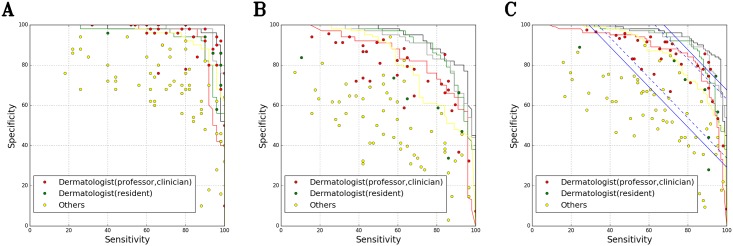
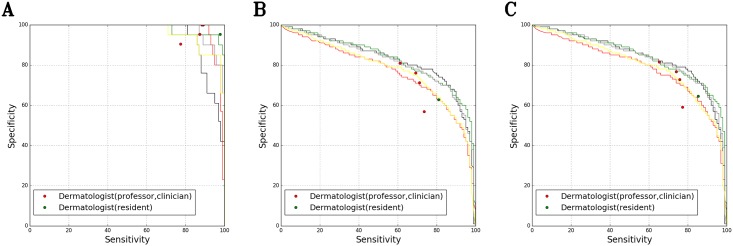
Although there have been reports of the successful diagnosis of skin disorders using deep learning, unrealistically large clinical image datasets are required for artificial intelligence (AI) training. We created datasets of standardized nail images using a region-based convolutional neural network (R-CNN) trained to distinguish the nail from the background. We used R-CNN to generate training datasets of 49,567 images, which we then used to fine-tune the ResNet-152 and VGG-19 models. The validation datasets comprised 100 and 194 images from Inje University (B1 and B2 datasets, respectively), 125 images from Hallym University (C dataset), and 939 images from Seoul National University (D dataset). The AI (ensemble model; ResNet-152 + VGG-19 + feedforward neural networks) results showed test sensitivity/specificity/ area under the curve values of (96.0 / 94.7 / 0.98), (82.7 / 96.7 / 0.95), (92.3 / 79.3 / 0.93), (87.7 / 69.3 / 0.82) for the B1, B2, C, and D datasets. With a combination of the B1 and C datasets, the AI Youden index was significantly (p = 0.01) higher than that of 42 dermatologists doing the same assessment manually. For B1+C and B2+ D dataset combinations, almost none of the dermatologists performed as well as the AI. By training with a dataset comprising 49,567 images, we achieved a diagnostic accuracy for onychomycosis using deep learning that was superior to that of most of the dermatologists who participated in this study.
尽管已有使用深度学习成功诊断皮肤疾病的报道,但人工智能(AI)训练需要不切实际的大量临床图像数据集。我们使用经过训练以区分指甲与背景的基于区域的卷积神经网络(R-CNN)创建了标准化指甲图像数据集。我们使用R-CNN生成了49,567张图像的训练数据集,然后用其对ResNet-152和VGG-19模型进行微调。验证数据集包括来自仁济大学的100张和194张图像(分别为B1和B2数据集)、来自翰林大学的125张图像(C数据集)以及来自首尔国立大学的939张图像(D数据集)。AI(集成模型;ResNet-152 + VGG-19 + 前馈神经网络)结果显示,对于B1、B2、C和D数据集,测试敏感度/特异度/曲线下面积值分别为(96.0 / 94.7 / 0.98)、(82.7 / 96.7 / 0.95)、(92.3 / 79.3 / 0.93)、(87.7 / 69.3 / 0.82)。将B1和C数据集结合使用时,AI的约登指数显著高于42名皮肤科医生手动进行相同评估时的约登指数(p = 0.01)。对于B1 + C和B2 + D数据集组合,几乎没有皮肤科医生的表现能与AI相媲美。通过使用包含49,567张图像的数据集进行训练,我们利用深度学习实现了对甲癣的诊断准确性,该准确性优于参与本研究的大多数皮肤科医生。