Graduate School of Medical Science and Engineering, KAIST, Daejeon 34141, Korea.
BMB Rep. 2018 Mar;51(3):151-156. doi: 10.5483/bmbrep.2018.51.3.012.
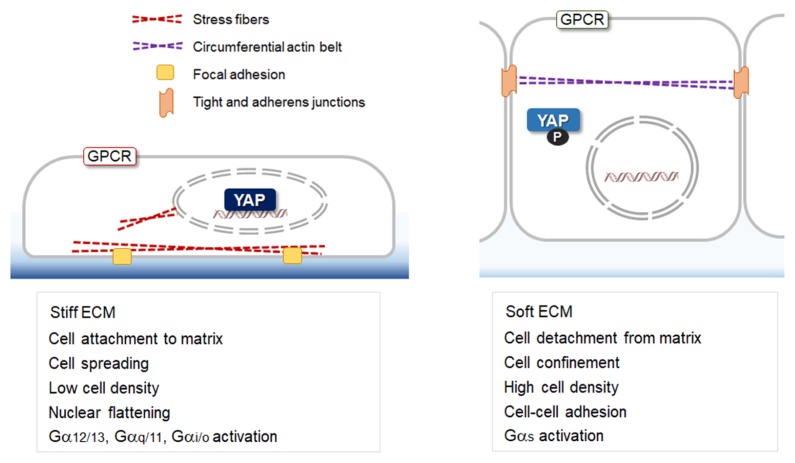
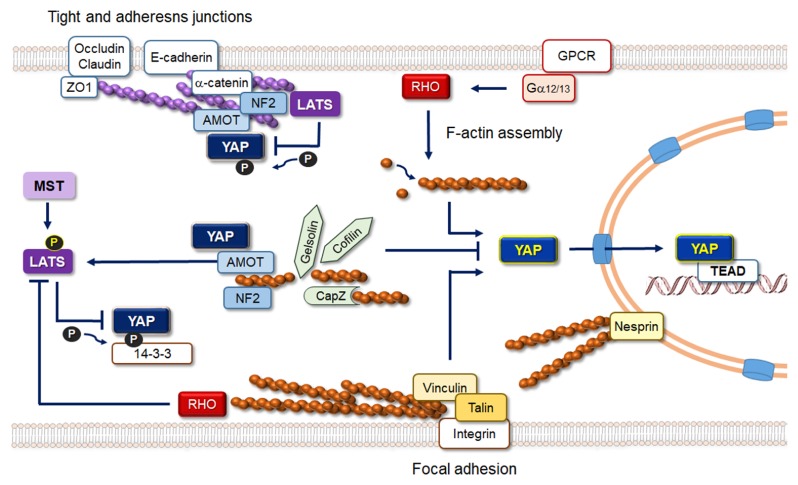
The Hippo signaling pathway controls nuclear accumulation and stability of the transcriptional coregulator YAP and its paralog TAZ. The activity of Hippo-YAP signaling is influenced not only by biochemical signals, but also by cell shape and mechanical tension transmitted through cell-cell junctions and cell-matrix adhesions. Data accumulated thus far indicates that the actin cytoskeleton is a key mediator of the regulation of Hippo-YAP signaling by means of a variety of biochemical and mechanical cues. In this review, we have outlined the role of actin dynamics and actin-associated proteins in the regulation of Hippo-YAP signaling. In addition, we discuss actinmediated regulation of YAP/TAZ activity independent of the core Hippo kinases MST and LATS. Although our understanding of the link between Hippo-YAP signaling and the actin cytoskeleton is progressing rapidly, many open questions remain. [BMB Reports 2018; 51(3): 151-156].
Hippo 信号通路控制核内 YAP 和其同源物 TAZ 的转录共激活因子的积累和稳定性。Hippo-YAP 信号的活性不仅受到生化信号的影响,还受到通过细胞-细胞连接和细胞-基质黏附传递的细胞形状和机械张力的影响。迄今为止积累的数据表明,肌动蛋白细胞骨架是通过各种生化和机械线索调节 Hippo-YAP 信号的关键介质。在这篇综述中,我们概述了肌动蛋白动力学和肌动蛋白相关蛋白在 Hippo-YAP 信号调节中的作用。此外,我们还讨论了肌动蛋白介导的 MST 和 LATS 核心 Hippo 激酶对 YAP/TAZ 活性的调节作用。尽管我们对 Hippo-YAP 信号与肌动蛋白细胞骨架之间的联系的理解正在迅速发展,但仍有许多悬而未决的问题。[BMB 报告 2018;51(3):151-156]。