Kerkhofs Amber, Xavier Ana C, da Silva Beatriz S, Canas Paula M, Idema Sander, Baayen Johannes C, Ferreira Samira G, Cunha Rodrigo A, Mansvelder Huibert D
Department of Integrative Neurophysiology, Center for Neurogenomics and Cognitive Research, Neuroscience Amsterdam, Vrije Universiteit Amsterdam, Amsterdam, Netherlands.
Center for Neuroscience and Cell Biology, University of Coimbra, Coimbra, Portugal.
Front Pharmacol. 2018 Jan 4;8:899. doi: 10.3389/fphar.2017.00899. eCollection 2017.
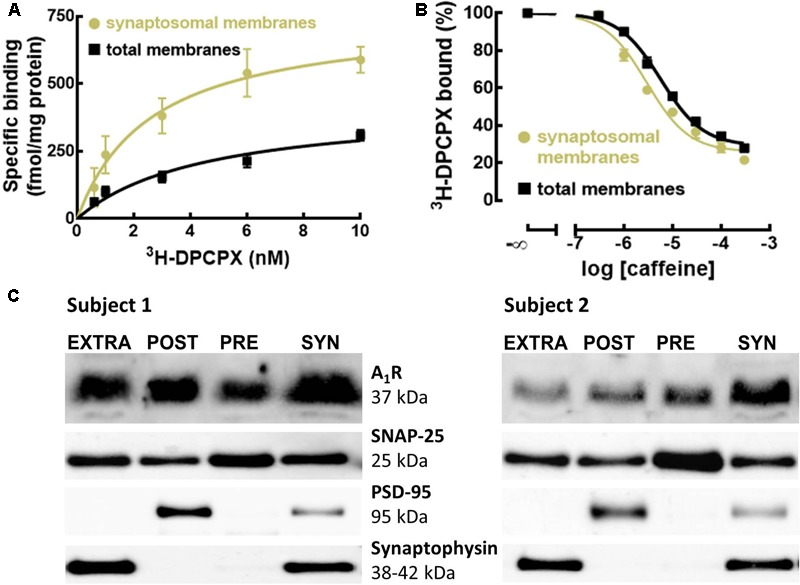
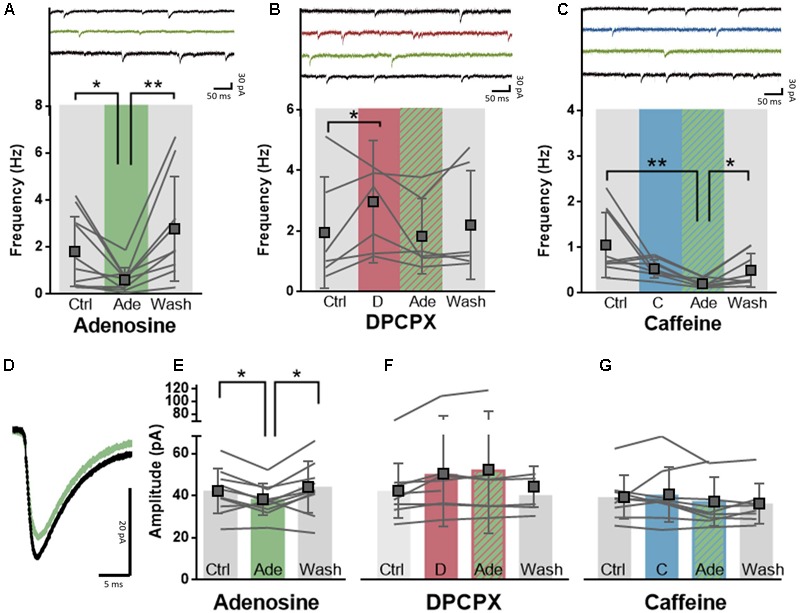
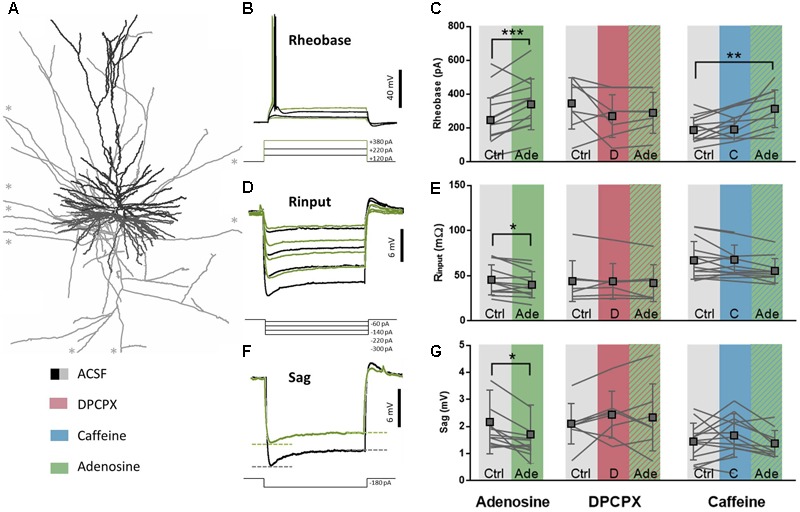
Caffeine is the most widely used psychoactive drug, bolstering attention and normalizing mood and cognition, all functions involving cerebral cortical circuits. Whereas studies in rodents showed that caffeine acts through the antagonism of inhibitory A adenosine receptors (AR), neither the role of AR nor the impact of caffeine on human cortical neurons is known. We here provide the first characterization of the impact of realistic concentrations of caffeine experienced by moderate coffee drinkers (50 μM) on excitability of pyramidal neurons and excitatory synaptic transmission in the human temporal cortex. Moderate concentrations of caffeine disinhibited several of the inhibitory AR-mediated effects of adenosine, similar to previous observations in the rodent brain. Thus, caffeine restored the adenosine-induced decrease of both intrinsic membrane excitability and excitatory synaptic transmission in the human pyramidal neurons through antagonism of post-synaptic AR. Indeed, the AR-mediated effects of endogenous adenosine were more efficient to inhibit synaptic transmission than neuronal excitability. This was associated with a distinct affinity of caffeine for synaptic extra-synaptic human cortical AR, probably resulting from a different molecular organization of AR in human cortical synapses. These findings constitute the first neurophysiological description of the impact of caffeine on pyramidal neuron excitability and excitatory synaptic transmission in the human temporal cortex, providing adequate ground for the effects of caffeine on cognition in humans.
咖啡因是使用最广泛的精神活性药物,可增强注意力、使情绪和认知正常化,所有这些功能都涉及大脑皮层回路。尽管对啮齿动物的研究表明,咖啡因通过拮抗抑制性A类腺苷受体(AR)发挥作用,但AR的作用以及咖啡因对人类皮层神经元的影响尚不清楚。我们在此首次描述了适度咖啡饮用者所经历的实际浓度咖啡因(50μM)对人类颞叶皮层锥体神经元兴奋性和兴奋性突触传递的影响。适度浓度的咖啡因解除了腺苷的几种由AR介导的抑制作用,这与先前在啮齿动物大脑中的观察结果相似。因此,咖啡因通过拮抗突触后AR,恢复了腺苷诱导的人类锥体神经元内在膜兴奋性和兴奋性突触传递的降低。事实上,内源性腺苷由AR介导的对突触传递的抑制作用比对神经元兴奋性的抑制作用更有效。这与咖啡因对人类皮层突触和突触外AR的不同亲和力有关,这可能是由于人类皮层突触中AR的分子组织不同所致。这些发现构成了咖啡因对人类颞叶皮层锥体神经元兴奋性和兴奋性突触传递影响的首个神经生理学描述,为咖啡因对人类认知的影响提供了充分依据。