Baltar Federico
Department of Marine Science, University of Otago, Dunedin, New Zealand.
NIWA/University of Otago Research Centre for Oceanography, Dunedin, New Zealand.
Front Microbiol. 2018 Jan 4;8:2438. doi: 10.3389/fmicb.2017.02438. eCollection 2017.
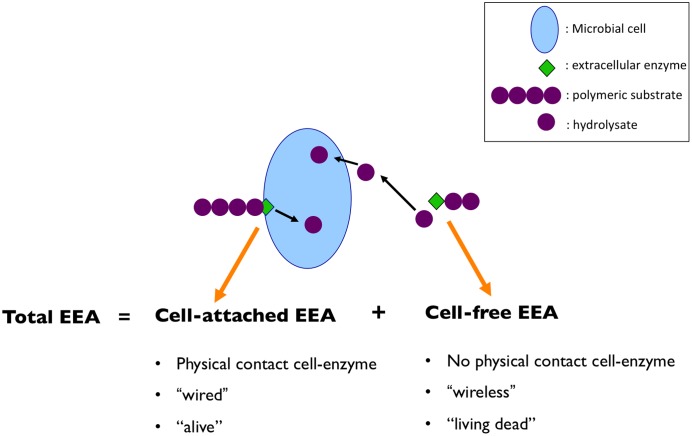
Microbes are the engines driving biogeochemical cycles. Microbial extracellular enzymatic activities (EEAs) are the "gatekeepers" of the carbon cycle. The total EEA is the sum of cell-bound (i.e., cell-attached), and dissolved (i.e., cell-free) enzyme activities. Cell-free enzymes make up a substantial proportion (up to 100%) of the total marine EEA. Although we are learning more about how microbial diversity and function (including total EEA) will be affected by environmental changes, little is known about what factors control the importance of the abundant cell-free enzymes. Since cell-attached EEAs are linked to the cell, their fate will likely be linked to the factors controlling the cell's fate. In contrast, cell-free enzymes belong to a kind of "living dead" realm because they are not attached to a living cell but still are able to perform their function away from the cell; and as such, the factors controlling their activity and fate might differ from those affecting cell-attached enzymes. This article aims to place cell-free EEA into the wider context of hydrolysis of organic matter, deal with recent studies assessing what controls the production, activity and lifetime of cell-free EEA, and what their fate might be in response to environmental stressors. This perspective article advocates the need to go "beyond the living things," studying the response of cells/organisms to different stressors, but also to study cell-free enzymes, in order to fully constrain the future and evolution of marine biogeochemical cycles.
微生物是驱动生物地球化学循环的引擎。微生物胞外酶活性(EEA)是碳循环的“守门人”。总EEA是细胞结合(即细胞附着)酶活性和溶解(即游离)酶活性的总和。游离酶在海洋总EEA中占相当大的比例(高达100%)。尽管我们越来越了解微生物多样性和功能(包括总EEA)将如何受到环境变化的影响,但对于控制大量游离酶重要性的因素却知之甚少。由于细胞附着的EEA与细胞相关联,其命运可能与控制细胞命运的因素相关。相比之下,游离酶属于一种“活死人”领域,因为它们不附着于活细胞,但仍能在细胞外发挥功能;因此,控制其活性和命运的因素可能与影响细胞附着酶的因素不同。本文旨在将游离EEA置于更广泛的有机物水解背景下,探讨最近评估控制游离EEA产生、活性和寿命的因素以及它们在应对环境压力源时可能的命运的研究。这篇观点文章主张有必要“超越生物”,不仅要研究细胞/生物体对不同压力源的反应,还要研究游离酶,以便全面限制海洋生物地球化学循环的未来和演变。