Nicholls Justine, MacKenzie Craig, Braund Rhiannon
Dunedin Hospital Pharmacy.
School of Pharmacy, University of Otago, Dunedin, New Zealand.
Integr Pharm Res Pract. 2017 Feb 13;6:61-69. doi: 10.2147/IPRP.S104639. eCollection 2017.
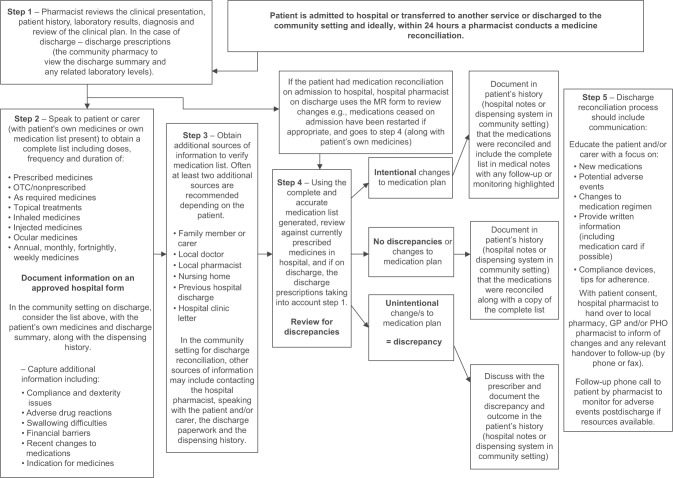
Transition of care (ToC) points, and in particular hospital admission and discharge, can be associated with an increased risk of adverse drug events (ADEs) and other drug-related problems (DRPs). The growing recognition of the pharmacist as an expert in medication management, patient education and communication makes them well placed to intervene. There is evidence to indicate that the inclusion of pharmacists in the health care team at ToC points reduces ADEs and DRPs and improves patient outcomes. The objectives of this paper are to outline the following using current literature: 1) the increased risk of medication-related problems at ToC points; 2) to highlight some strategies that have been successful in reducing these problems; and 3) to illustrate how the role of the pharmacist across all facets of care can contribute to the reduction of ADEs, particularly for patients at ToC points.
医疗护理过渡(ToC)节点,尤其是住院和出院环节,可能与药物不良事件(ADEs)及其他药物相关问题(DRPs)的风险增加有关。药剂师作为药物管理、患者教育和沟通方面的专家,其作用日益受到认可,这使他们具备进行干预的良好条件。有证据表明,在医疗护理过渡节点将药剂师纳入医疗团队可减少药物不良事件和药物相关问题,并改善患者预后。本文的目的是利用当前文献概述以下内容:1)医疗护理过渡节点药物相关问题的风险增加情况;2)强调一些成功减少这些问题的策略;3)说明药剂师在护理各方面的作用如何有助于减少药物不良事件,特别是对于处于医疗护理过渡节点的患者。