Wessler Silja, Backert Steffen
Dept. of Molecular Biology, University of Salzburg, Austria.
Dept. of Biology, Division of Microbiology, University of Erlangen-Nuremberg, Germany.
Microb Cell. 2017 Dec 9;5(1):60-62. doi: 10.15698/mic2018.01.611.
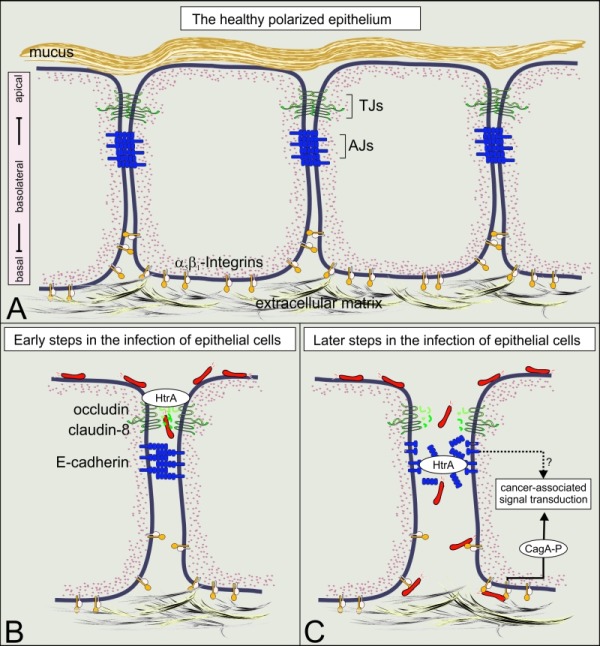
Intercellular junctions are crucial structural elements for the formation and maintenance of epithelial barrier functions to control homeostasis or protect against intruding pathogens in humans. Alterations in these complexes represent key events in the development and progression of numerous cancers as well as multiple infectious diseases. Many bacterial pathogens harbor type IV secretion systems (T4SSs), which translocate virulence factors into host cells to hijack cellular processes. The pathology of the gastric pathogen and type-I carcinogen strongly depends on a T4SS encoded by the pathogenicity island (PAI). This T4SS forms a needle-like pilus and its activity is accomplished by the pilus-associated factors CagL, CagI and CagY which target the host integrin-β receptor followed by injection of the CagA oncoprotein into non-polarized AGS gastric epithelial cells. The finding of a T4SS receptor, however, suggested the presence of a sophisticated control mechanism for the injection of CagA. In fact, integrins constitute a group of basolateral receptors, which are normally absent at apical surfaces of the polarized epithelium . Our new results demonstrate that T4SS-pilus formation during infection of polarized epithelial cells occurs preferentially at basolateral sites, and not at apical membranes (Tegtmeyer ., 2017). We propose a stepwise process how interacts with components of intercellular tight junctions (TJs) and adherens junctions (AJs), followed by contacting integrin-based focal adhesions to disrupt and transform the epithelial cell layer in the human stomach. The possible impact of this novel signaling cascade on pathogenesis during infection is reviewed.
细胞间连接是形成和维持上皮屏障功能以控制体内平衡或抵御人类入侵病原体的关键结构要素。这些复合物的改变是众多癌症以及多种传染病发生和发展的关键事件。许多细菌病原体具有IV型分泌系统(T4SSs),该系统将毒力因子转运到宿主细胞中以劫持细胞过程。胃病原体和I型致癌物的病理状况很大程度上取决于致病岛(PAI)编码的T4SS。这种T4SS形成针状菌毛,其活性由菌毛相关因子CagL、CagI和CagY完成,这些因子靶向宿主整合素-β受体,随后将CagA癌蛋白注入非极化的AGS胃上皮细胞中。然而,T4SS受体的发现表明存在一种复杂的CagA注射控制机制。事实上,整合素是一组基底外侧受体,通常不存在于极化上皮的顶端表面。我们的新结果表明,极化上皮细胞感染期间T4SS菌毛的形成优先发生在基底外侧部位,而不是顶端膜(Tegtmeyer等人,2017年)。我们提出了一个逐步过程,即 如何与细胞间紧密连接(TJs)和黏附连接(AJs)的成分相互作用,随后接触基于整合素的黏着斑以破坏和转化人胃中的上皮细胞层。本文综述了这种新型信号级联在感染期间对发病机制的可能影响。