Debussche Xavier, Besançon Stéphane, Balcou-Debussche Maryvette, Ferdynus Cyril, Delisle Hélène, Huiart Laetitia, Sidibe Assa T
Department of Endocrinology Diabetology Nutrition, Felix Guyon University Hospital, Saint-Denis, La Réunion.
Centre d'Investigations Cliniques 1410 INSERM, Reunion University Hospital, Saint-Pierre, La Réunion.
PLoS One. 2018 Jan 22;13(1):e0191262. doi: 10.1371/journal.pone.0191262. eCollection 2018.
Our objective was to evaluate the effectiveness of peer-led self-management education in improving glycaemic control in patients with type 2 diabetes in a low-income country (Mali).
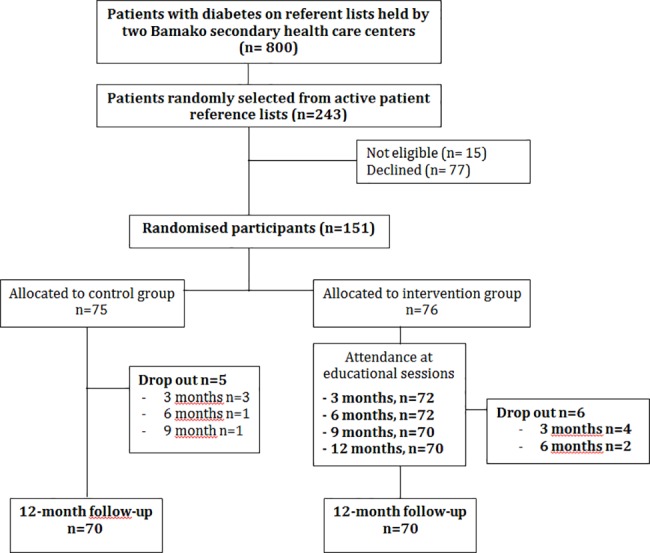
We conducted an open-label randomised controlled trial. A total of 151 adults (76% women, mean age 52.5) with type 2 diabetes (HbA1c≥8%), treated in the diabetes consultation units of two secondary health centres in Bamako, were allocated to peer-led structured patient education (n = 76) or conventional care alone (n = 75). The intervention group received 1 year of culturally tailored structured patient education (3 courses of 4 sessions) delivered in the community by five trained peer educators. Both groups underwent conventional diabetes monitoring and follow-up. Primary outcome was the mean absolute change in HbA1c from baseline to 12 months.
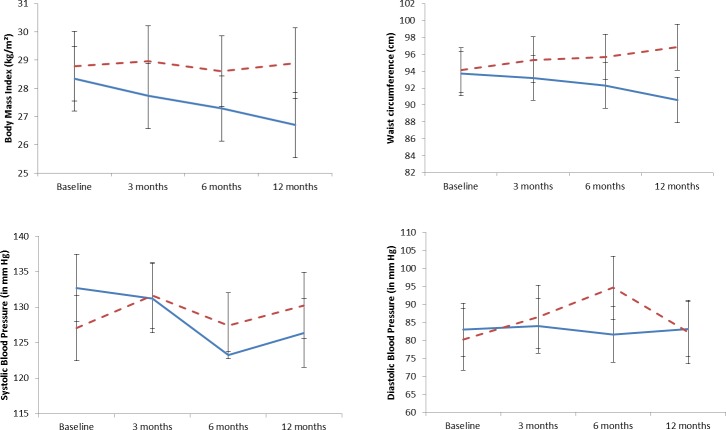
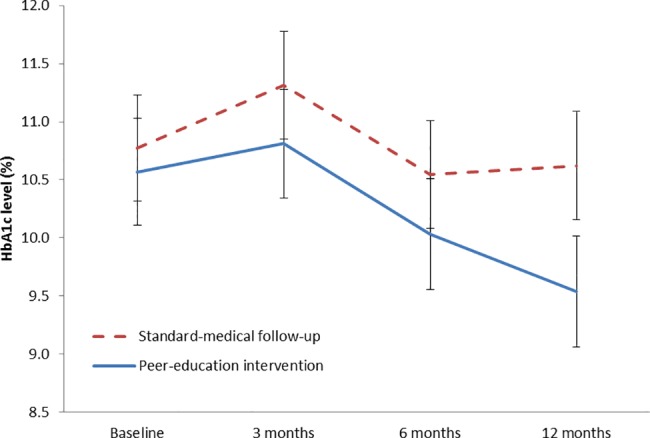
177 education sessions were delivered to the intervention group. Patient attrition was 8%. From baseline to 12 months, the decrease in HbA1c levels was 1.05% (SD = 2.0; CI95%: 1.54;-0.56) in the intervention group compared with 0.15% (SD = 1.7; CI95%: -0.56; 0.26) in the control group, p = 0.006. Mean BMI change was -1.65 kg/m2 (SD = 2.5; CI95%: -2.25; -1.06) in the intervention group and +0.05 kg/m2 (SD = 3.2; CI95%: -0.71; 0.81) in the control group, p = 0.0005. Mean waist circumference decreased by 3.34 cm (SD = 9.3; CI95%: -5.56;-1.13) in the intervention group and increased by 2.65 cm (SD = 10.3; CI95%: 0.20; 5.09) in the control group, p = 0.0003.
Peer-led structured patient education delivered over 1 year to patients with poorly controlled type 2 diabetes in Mali yielded substantial improvements in glycaemic control and anthropometric parameters. This is of importance for the scaling up of efficient interventions in low-resource settings in the future.
ClinicalTrials.gov NCT01485913.
我们的目标是评估同伴主导的自我管理教育对低收入国家(马里)2型糖尿病患者血糖控制的改善效果。
我们开展了一项开放标签随机对照试验。共有151名2型糖尿病患者(女性占76%,平均年龄52.5岁),糖化血红蛋白(HbA1c)≥8%,在巴马科两家二级医疗中心的糖尿病咨询科室接受治疗,被分配至同伴主导的结构化患者教育组(n = 76)或单纯常规治疗组(n = 75)。干预组接受了为期1年、由5名经过培训的同伴教育者在社区开展的符合当地文化的结构化患者教育(共3个疗程,每个疗程4节课程)。两组均接受常规糖尿病监测和随访。主要结局指标是从基线到12个月时HbA1c的平均绝对变化。
干预组共进行了177节教育课程。患者流失率为8%。从基线到12个月,干预组HbA1c水平下降了1.05%(标准差 = 2.0;95%置信区间:1.54;-0.56),而对照组下降了0.15%(标准差 = 1.7;95%置信区间:-0.56;0.26),p = 0.006。干预组平均体重指数(BMI)变化为-1.65kg/m²(标准差 = 2.5;95%置信区间:-2.25;-1.06),对照组为+0.05kg/m²(标准差 = 3.2;95%置信区间:-0.71;0.81),p = 0.0005。干预组平均腰围减少了3.34cm(标准差 = 9.3;95%置信区间:-5.56;-1.13),对照组增加了2.65cm(标准差 = 10.3;95%置信区间:0.20;5.09),p = 0.0003。
在马里,对血糖控制不佳的2型糖尿病患者进行为期1年的同伴主导的结构化患者教育,在血糖控制和人体测量参数方面取得了显著改善。这对于未来在资源匮乏地区扩大有效干预措施具有重要意义。
ClinicalTrials.gov NCT01485913。