Liu Yan, Tan Xiaojie, Liu Wenbin, Chen Xi, Hou Xiaomei, Shen Dan, Ding Yibo, Yin Jianhua, Wang Ling, Zhang Hongwei, Yu Yongwei, Hou Jianguo, Thompson Timothy C, Cao Guangwen
Department of Epidemiology, Second Military Medical University, Shanghai, 200433, P. R. China.
Department of Urology, Changhai Hospital, Second Military Medical University, Shanghai, 200433, P. R. China.
Chin J Cancer. 2018 Jan 22;37(1):2. doi: 10.1186/s40880-018-0267-2.
We previously showed that the expression of follistatin-like protein 1 (FSTL1) was significantly down-regulated in metastatic clear-cell renal cell carcinoma (ccRCC). In this study, we aimed to characterize the role of FSTL1 in the development of ccRCC.
The effects of FSTL1 on cell activity and cell cycle were investigated in ccRCC cell lines with altered FSTL1 expression. Gene expression microarray assays were performed to identify the major signaling pathways affected by FSTL1 knockdown. The expression of FSTL1 in ccRCC and its effect on postoperative prognosis were estimated in a cohort with 89 patients.
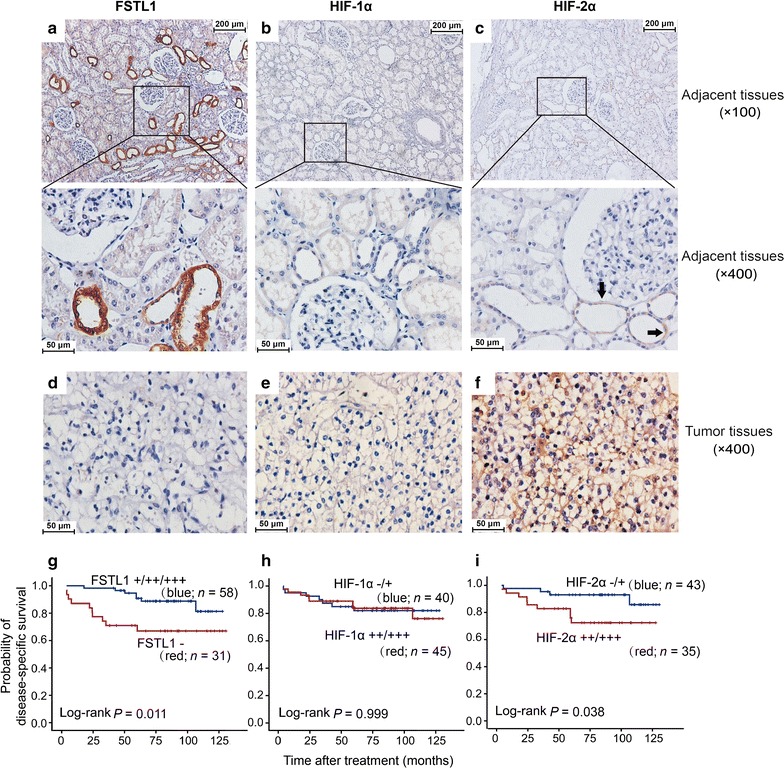
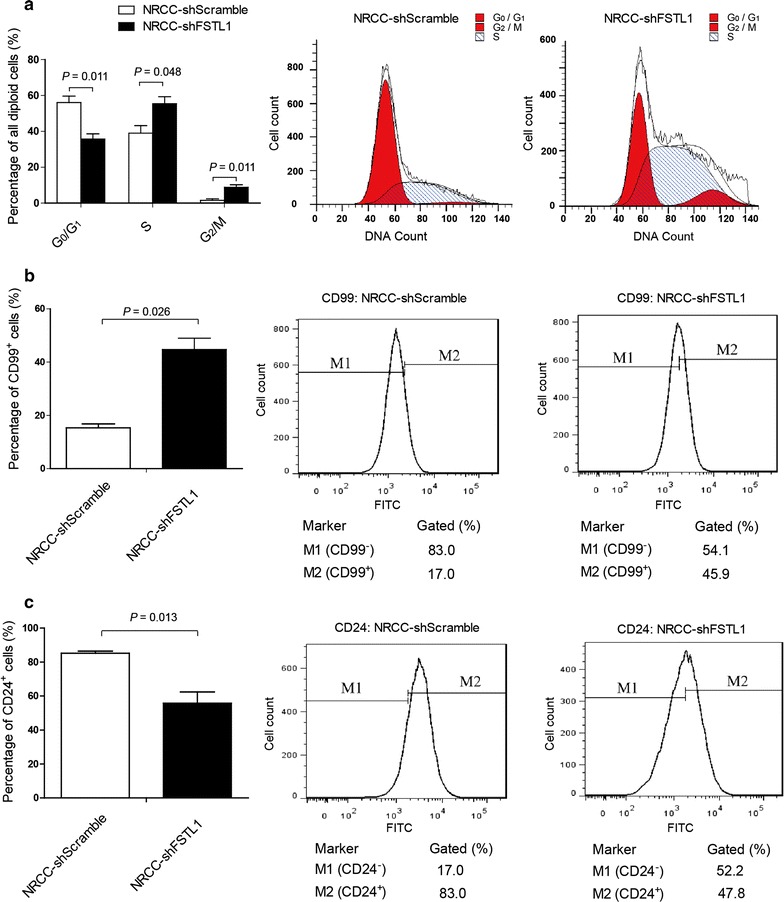
FSTL1 knockdown promoted anchorage-independent growth, migration, invasion, and cell cycle of ccRCC cell lines, whereas FSTL1 overexpression attenuated cell migration. FSTL1 knockdown up-regulated nuclear factor-κB (NF-κB) and hypoxia-inducible factor (HIF) signaling pathways, increased epithelial-to-mesenchymal transition, up-regulated interleukin-6 expression, and promoted tumor necrosis factor-α-induced degradation of NF-κB inhibitor (IκBα) in ccRCC cell lines. FSTL1 immunostaining was selectively positive in epithelial cytoplasm in the loop of Henle, and positive rate of FSTL1 was significantly lower in ccRCC tissues than in adjacent renal tissues (P < 0.001). The multivariate Cox regression analysis showed that the intratumoral FSTL1 expression conferred a favorable independent prognosis with a hazard ratio of 0.325 (95% confidence interval 0.118-0.894). HIF-2α expression was negatively correlated with FSTL1 expression in ccRCC specimens (r = - 0.229, P = 0.044). Intratumoral expression of HIF-2α, rather than HIF-1α, significantly predicted an unfavorable prognosis in ccRCC (log-rank, P = 0.038).
FSTL1 plays a tumor suppression role possibly via repressing the NF-κB and HIF-2α signaling pathways. To increase FSTL1 expression might be a candidate therapeutic strategy for metastatic ccRCC.
我们之前的研究表明,卵泡抑素样蛋白1(FSTL1)的表达在转移性透明细胞肾细胞癌(ccRCC)中显著下调。在本研究中,我们旨在明确FSTL1在ccRCC发生发展中的作用。
在FSTL1表达改变的ccRCC细胞系中研究FSTL1对细胞活性和细胞周期的影响。进行基因表达微阵列分析以确定受FSTL1敲低影响的主要信号通路。在一个包含89例患者的队列中评估FSTL1在ccRCC中的表达及其对术后预后的影响。
FSTL1敲低促进了ccRCC细胞系的非锚定依赖性生长、迁移、侵袭及细胞周期进程,而FSTL1过表达则减弱了细胞迁移。FSTL1敲低上调了核因子-κB(NF-κB)和缺氧诱导因子(HIF)信号通路,增加了上皮-间质转化,上调了白细胞介素-6表达,并促进了肿瘤坏死因子-α诱导的ccRCC细胞系中NF-κB抑制剂(IκBα)的降解。FSTL1免疫染色在髓袢上皮细胞质中呈选择性阳性,且FSTL1在ccRCC组织中的阳性率显著低于相邻肾组织(P < 0.001)。多因素Cox回归分析显示,肿瘤内FSTL1表达具有良好的独立预后价值,风险比为0.325(95%置信区间0.118 - 0.894)。在ccRCC标本中,HIF-2α表达与FSTL1表达呈负相关(r = - 0.229,P = 0.044)。肿瘤内HIF-2α而非HIF-1α的表达显著预测了ccRCC的不良预后(对数秩检验,P = 0.038)。
FSTL1可能通过抑制NF-κB和HIF-2α信号通路发挥肿瘤抑制作用。增加FSTL1表达可能是转移性ccRCC的一种候选治疗策略。