Bureau of Economic Geology, Jackson School of Geosciences, University of Texas at Austin, Austin, TX 78758;
State Key Laboratory of Geodesy and Earth's Dynamics, Institute of Geodesy and Geophysics, Chinese Academy of Sciences, Wuhan 43007, China.
Proc Natl Acad Sci U S A. 2018 Feb 6;115(6):E1080-E1089. doi: 10.1073/pnas.1704665115. Epub 2018 Jan 22.
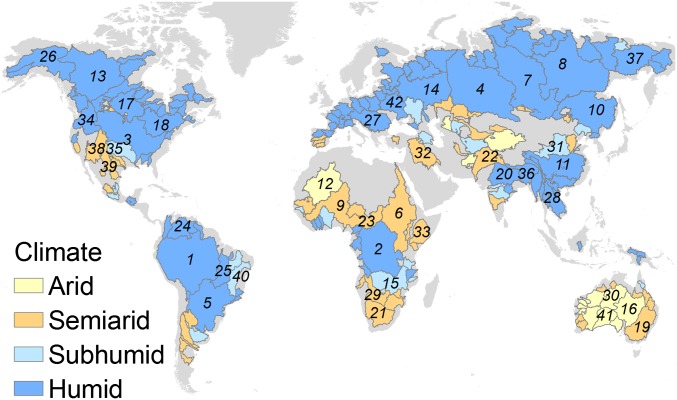
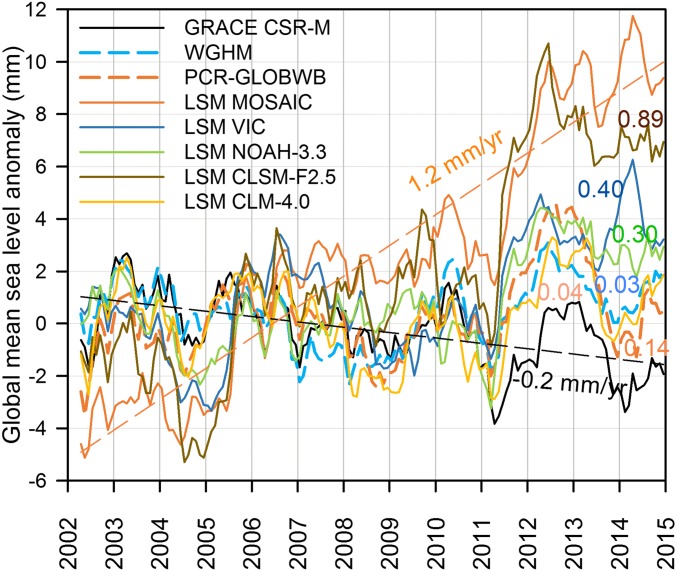
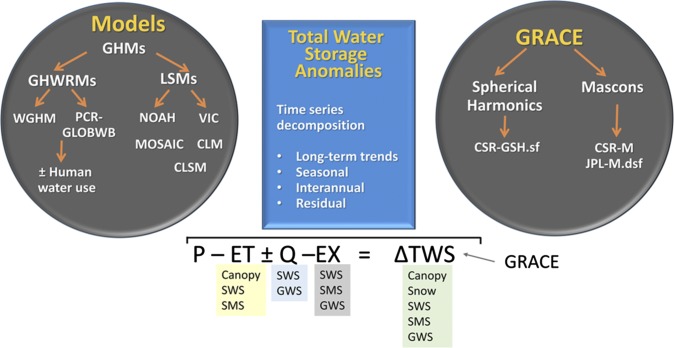
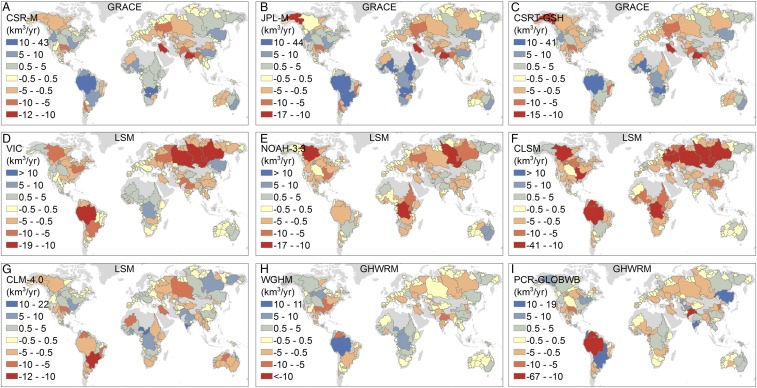
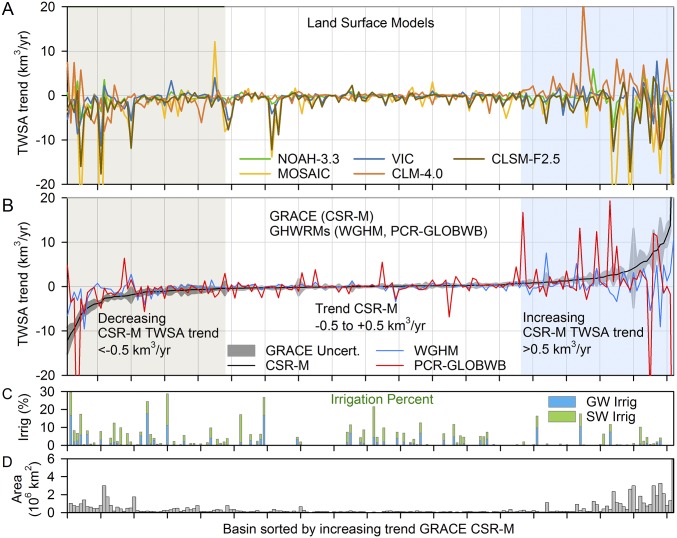
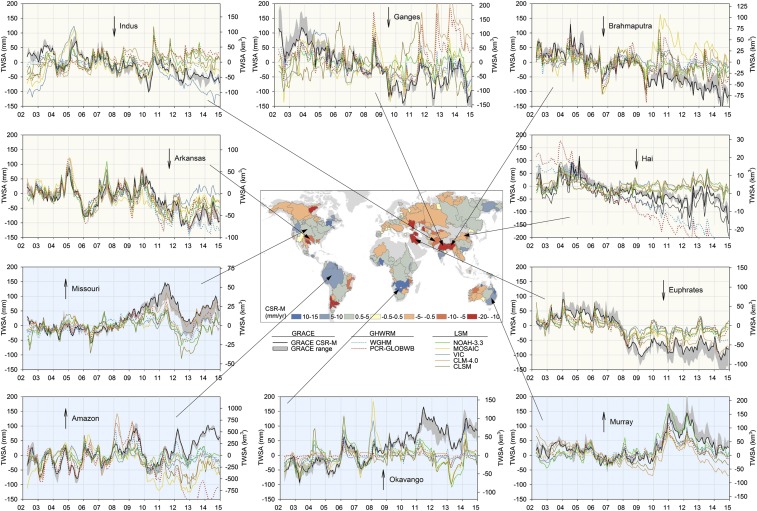
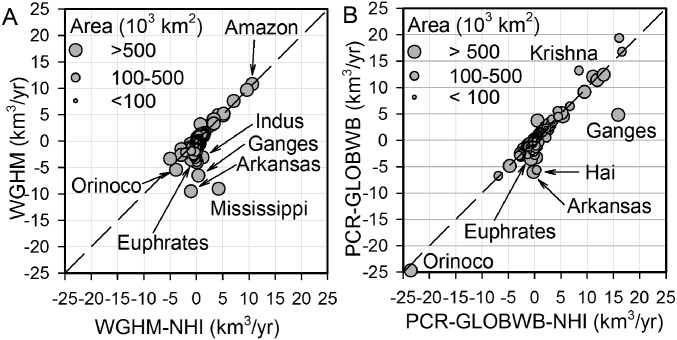
Assessing reliability of global models is critical because of increasing reliance on these models to address past and projected future climate and human stresses on global water resources. Here, we evaluate model reliability based on a comprehensive comparison of decadal trends (2002-2014) in land water storage from seven global models (WGHM, PCR-GLOBWB, GLDAS NOAH, MOSAIC, VIC, CLM, and CLSM) to trends from three Gravity Recovery and Climate Experiment (GRACE) satellite solutions in 186 river basins (∼60% of global land area). Medians of modeled basin water storage trends greatly underestimate GRACE-derived large decreasing (≤-0.5 km/y) and increasing (≥0.5 km/y) trends. Decreasing trends from GRACE are mostly related to human use (irrigation) and climate variations, whereas increasing trends reflect climate variations. For example, in the Amazon, GRACE estimates a large increasing trend of ∼43 km/y, whereas most models estimate decreasing trends (-71 to 11 km/y). Land water storage trends, summed over all basins, are positive for GRACE (∼71-82 km/y) but negative for models (-450 to -12 km/y), contributing opposing trends to global mean sea level change. Impacts of climate forcing on decadal land water storage trends exceed those of modeled human intervention by about a factor of 2. The model-GRACE comparison highlights potential areas of future model development, particularly simulated water storage. The inability of models to capture large decadal water storage trends based on GRACE indicates that model projections of climate and human-induced water storage changes may be underestimated.
评估全球模型的可靠性至关重要,因为人们越来越依赖这些模型来应对过去和预测未来的气候以及人类对全球水资源的压力。在这里,我们基于对七个全球模型(WGHM、PCR-GLOBWB、GLDAS NOAH、MOSAIC、VIC、CLM 和 CLSM)和三个重力恢复和气候实验(GRACE)卫星解决方案在 186 个流域(约占全球陆地面积的 60%)中土地水储量的年代际趋势(2002-2014 年)进行全面比较,来评估模型的可靠性。模型化流域水储量趋势的中位数大大低估了 GRACE 得出的大的减少(≤-0.5 km/y)和增加(≥0.5 km/y)趋势。GRACE 得出的减少趋势主要与人类用水(灌溉)和气候变化有关,而增加趋势则反映了气候变化。例如,在亚马逊地区,GRACE 估计的一个大的增加趋势约为 43 km/y,而大多数模型估计的则是减少趋势(-71 到 11 km/y)。对所有流域进行求和,GRACE 的陆地水储量趋势为正值(约 71-82 km/y),而模型的趋势为负值(-450 到-12 km/y),这对全球海平面变化产生了相反的影响。气候强迫对年代际陆地水储量趋势的影响比模型模拟的人为干预影响大约 2 倍。模型与 GRACE 的比较突出了未来模型发展的潜在领域,特别是模拟水储量。模型无法根据 GRACE 捕捉到大的年代际水储量趋势,表明模型对气候和人类引起的水储量变化的预测可能被低估了。