Wong Annette T Y, Mannix Carly, Grantham Jared J, Allman-Farinelli Margaret, Badve Sunil V, Boudville Neil, Byth Karen, Chan Jessie, Coulshed Susan, Edwards Marie E, Erickson Bradley J, Fernando Mangalee, Foster Sheryl, Haloob Imad, Harris David C H, Hawley Carmel M, Hill Julie, Howard Kirsten, Howell Martin, Jiang Simon H, Johnson David W, Kline Timothy L, Kumar Karthik, Lee Vincent W, Lonergan Maureen, Mai Jun, McCloud Philip, Peduto Anthony, Rangan Anna, Roger Simon D, Sud Kamal, Torres Vincent, Vilayur Eswari, Rangan Gopala K
Centre for Transplant and Renal Research, The Westmead Institute for Medical Research, The University of Sydney, Sydney, Australia.
Department of Renal Medicine, Westmead Hospital, Western Sydney Local Health District, Sydney, Australia.
BMJ Open. 2018 Jan 21;8(1):e018794. doi: 10.1136/bmjopen-2017-018794.
Maintaining fluid intake sufficient to reduce arginine vasopressin (AVP) secretion has been hypothesised to slow kidney cyst growth in autosomal dominant polycystic kidney disease (ADPKD). However, evidence to support this as a clinical practice recommendation is of poor quality. The aim of the present study is to determine the long-term efficacy and safety of prescribed water intake to prevent the progression of height-adjusted total kidney volume (ht-TKV) in patients with chronic kidney disease (stages 1-3) due to ADPKD.
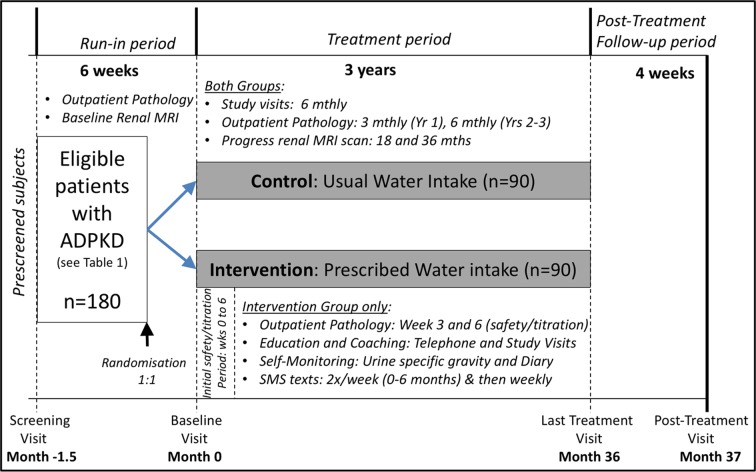
A multicentre, prospective, parallel-group, open-label, randomised controlled trial will be conducted. Patients with ADPKD (n=180; age ≤65 years, estimated glomerular filtration rate (eGFR) ≥30 mL/min/1.73 m) will be randomised (1:1) to either the control (standard treatment+usual fluid intake) or intervention (standard treatment+prescribed fluid intake) group. Participants in the intervention arm will be prescribed an individualised daily fluid intake to reduce urine osmolality to ≤270 mOsmol/kg, and supported with structured clinic and telephonic dietetic review, self-monitoring of urine-specific gravity, short message service text reminders and internet-based tools. All participants will have 6-monthly follow-up visits, and ht-TKV will be measured by MRI at 0, 18 and 36 months. The primary end point is the annual rate of change in ht-TKV as determined by serial renal MRI in control vs intervention groups, from baseline to 3 years. The secondary end points are differences between the two groups in systemic AVP activity, renal disease (eGFR, blood pressure, renal pain), patient adherence, acceptability and safety.
The trial was approved by the Human Research Ethics Committee, Western Sydney Local Health District. The results will inform clinicians, patients and policy-makers regarding the long-term safety, efficacy and feasibility of prescribed fluid intake as an approach to reduce kidney cyst growth in patients with ADPKD.
ANZCTR12614001216606.
据推测,保持足够的液体摄入量以减少精氨酸加压素(AVP)分泌,可减缓常染色体显性多囊肾病(ADPKD)患者肾囊肿的生长。然而,支持将此作为临床实践建议的证据质量较差。本研究的目的是确定规定的水摄入量对预防因ADPKD导致的慢性肾脏病(1-3期)患者身高校正后的总肾体积(ht-TKV)进展的长期疗效和安全性。
将开展一项多中心、前瞻性、平行组、开放标签的随机对照试验。ADPKD患者(n = 180;年龄≤65岁,估计肾小球滤过率(eGFR)≥30 mL/min/1.73 m²)将被随机(1:1)分为对照组(标准治疗+常规液体摄入量)或干预组(标准治疗+规定的液体摄入量)。干预组的参与者将被规定个体化的每日液体摄入量,以使尿渗透压降低至≤270 mOsmol/kg,并通过结构化门诊和电话饮食评估、尿比重自我监测、短信提醒和基于互联网的工具提供支持。所有参与者将每6个月进行一次随访,并在0、18和36个月时通过MRI测量ht-TKV。主要终点是对照组与干预组从基线到3年通过系列肾脏MRI测定的ht-TKV的年变化率。次要终点是两组在全身AVP活性、肾脏疾病(eGFR、血压、肾区疼痛)、患者依从性、可接受性和安全性方面的差异。
该试验已获得西悉尼地方卫生区人类研究伦理委员会的批准。研究结果将为临床医生、患者和政策制定者提供关于规定液体摄入量作为减少ADPKD患者肾囊肿生长方法的长期安全性、疗效和可行性的信息。
ANZCTR12614001216606。