Booij Sanne H, Wichers Marieke, de Jonge Peter, Sytema Sjoerd, van Os Jim, Wunderink Lex, Wigman Johanna T W
Department of Psychiatry, Interdisciplinary Center Psychopathology and Emotion Regulation, University of Groningen, University Medical Center Groningen, Groningen, The Netherlands.
Department of Research and Education, Friesland Mental Health Services, Groningen, The Netherlands.
BMJ Open. 2018 Jan 21;8(1):e019059. doi: 10.1136/bmjopen-2017-019059.
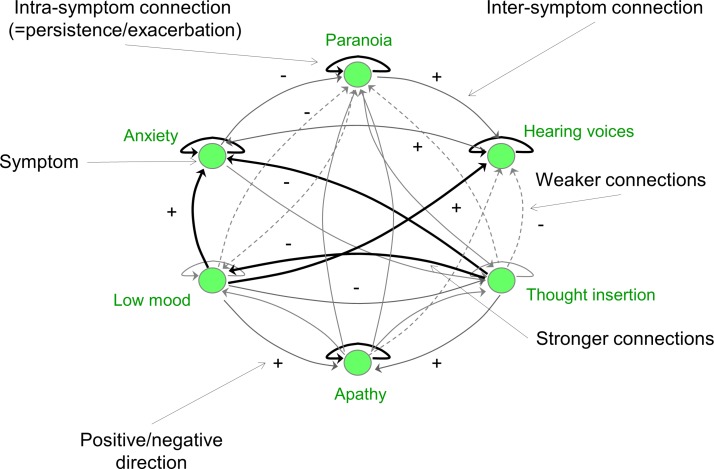
Our current ability to predict the course and outcome of early psychotic symptoms is limited, hampering timely treatment. To improve our understanding of the development of psychosis, a different approach to psychopathology may be productive. We propose to reconceptualise psychopathology from a network perspective, according to which symptoms act as a dynamic, interconnected system, impacting on each other over time and across diagnostic boundaries to form symptom networks. Adopting this network approach, the Mapping Individual Routes of Risk and Resilience study aims to determine whether characteristics of symptom networks can predict illness course and outcome of early psychotic symptoms.
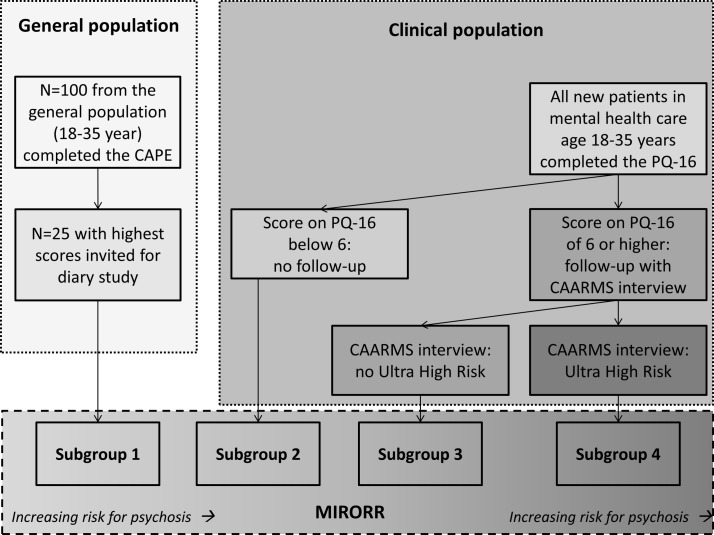
The sample consists of n=100 participants aged 18-35 years, divided into four subgroups (n=4×25) with increasing levels of severity of psychopathology, representing successive stages of clinical progression. Individuals representing the initial stage have a relatively low expression of psychotic experiences (general population), whereas individuals representing the end stage are help seeking and display a psychometric expression of psychosis, putting them at ultra-high risk for transition to psychotic disorder. At baseline and 1-year follow-up, participants report their symptoms, affective states and experiences for three consecutive months in short, daily questionnaires on their smartphone, which will be used to map individual networks. Network parameters, including the strength and directionality of symptom connections and centrality indices, will be estimated and associated to individual differences in and within-individual progression through stages of clinical severity and functioning over the next 3 years.
The study has been approved by the local medical ethical committee (ABR no. NL52974.042.15). The results of the study will be published in (inter)national peer-reviewed journals, presented at research, clinical and general public conferences. The results will assist in improving and fine-tuning dynamic models of psychopathology, stimulating both clinical and scientific progress.
NTR6205 ; Pre-results.
我们目前预测早期精神病症状病程和结果的能力有限,这妨碍了及时治疗。为了更好地理解精神病的发展,采用一种不同的精神病理学研究方法可能会有所成效。我们建议从网络角度重新概念化精神病理学,根据这一观点,症状构成一个动态的、相互关联的系统,随着时间推移并跨越诊断界限相互影响,形成症状网络。采用这种网络方法,“绘制个体风险与复原力路径”研究旨在确定症状网络的特征是否能够预测早期精神病症状的病程和结果。
样本包括100名年龄在18至35岁之间的参与者,分为四个亚组(每组n = 25),精神病理学严重程度逐渐增加,代表临床进展的连续阶段。处于初始阶段的个体精神病体验表达相对较低(普通人群),而处于末期阶段的个体正在寻求帮助并表现出精神病的心理测量学表现,使其处于转变为精神障碍的超高风险中。在基线和1年随访时,参与者通过智能手机上简短的每日问卷连续三个月报告他们的症状、情感状态和经历,这些数据将用于绘制个体网络。将估计网络参数,包括症状连接的强度和方向性以及中心性指数,并将其与未来3年临床严重程度和功能阶段的个体间差异以及个体内进展相关联。
该研究已获得当地医学伦理委员会批准(批准号NL52974.042.15)。研究结果将发表在(国际)同行评审期刊上,并在研究、临床和公众会议上展示。这些结果将有助于改进和微调精神病理学动态模型,推动临床和科学进步。
NTR6205;预结果。