Research School of Biology, Australian National University, Canberra, ACT 2601, Australia.
Sci Rep. 2018 Jan 22;8(1):1356. doi: 10.1038/s41598-018-19850-9.
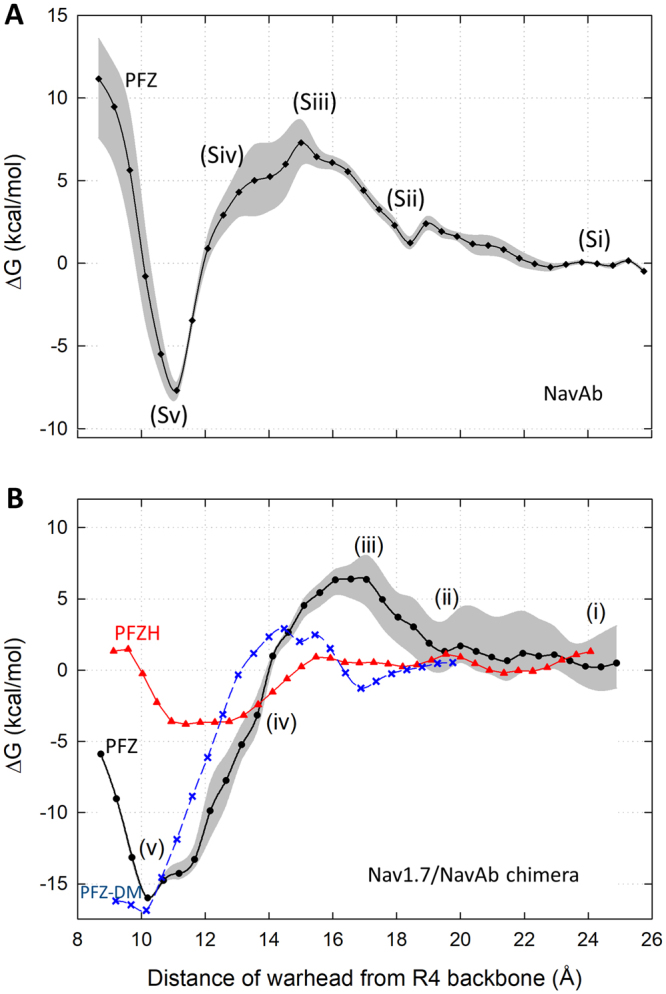
Nerve and muscle signalling is controlled by voltage-gated sodium (Nav) channels which are the targets of local anesthetics, anti-epileptics and anti-arrythmics. Current medications do not selectively target specific types of Nav found in the body, but compounds that do so have the potential to be breakthrough treatments for chronic pain, epilepsy and other neuronal disorders. We use long computer simulations totaling more than 26 μs to show how a promising lead compound can target one Nav implicated in pain perception and specific channels found in bacteria, and accurately predict the affinity of the compound to different channel types. Most importantly, we provide two explanations for the slow kinetics of this class of compound that limits their therapeutic utility. Firstly, the negative charge on the compound is essential for high affinity binding but is also responsible for energetic barriers that slow binding. Secondly, the compound has to undergo a conformational reorientation during the binding process. This knowledge aids the design of compounds affecting specific eukaryotic and bacterial channels and suggests routes for future drug development.
神经和肌肉信号由电压门控钠离子(Nav)通道控制,局部麻醉剂、抗癫痫药和抗心律失常药的作用靶点即为 Nav 通道。目前的药物并不能有选择性地针对体内特定类型的 Nav 通道,但是能够做到这一点的化合物有可能成为治疗慢性疼痛、癫痫和其他神经元疾病的突破性疗法。我们使用长达 26 微秒的长计算机模拟来展示一种有前途的先导化合物如何靶向一种与疼痛感知有关的 Nav 通道以及细菌中发现的特定通道,并准确预测该化合物对不同通道类型的亲和力。最重要的是,我们为该类化合物的缓慢动力学提供了两种解释,这限制了它们的治疗用途。首先,化合物上的负电荷对于高亲和力结合至关重要,但也是导致结合缓慢的能量障碍的原因。其次,在结合过程中,化合物必须经历构象重排。这些知识有助于设计针对特定真核生物和细菌通道的化合物,并为未来的药物开发提供了途径。