Azar Ibrahim, Esfandiarifard Saghi, Sinai Pedram, Wazir Ali, Foulke Llewellyn, Mehdi Syed
Department of Internal Medicine, Albany Medical Center, 47 New Scotland Ave., Albany, NY 12208, USA.
Department of Pathology, Albany Medical Center, 47 New Scotland Ave., Albany, NY 12208, USA.
Case Rep Oncol Med. 2017;2017:6328204. doi: 10.1155/2017/6328204. Epub 2017 Nov 22.
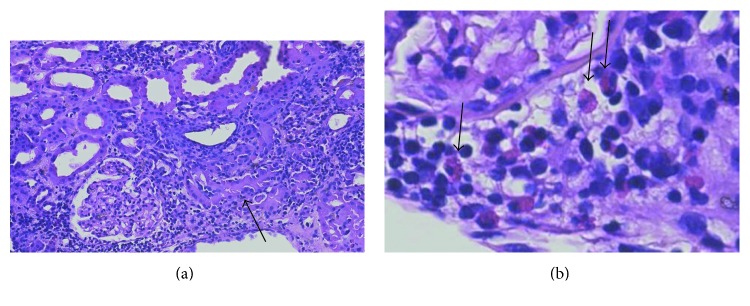
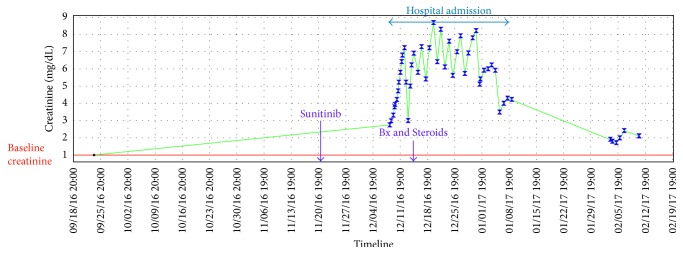
Sunitinib, a multitargeted tyrosine kinase inhibitor (TKI), is currently the standard of care for patients with metastatic renal cell carcinoma. Renal adverse events associated with sunitinib include proteinuria, renal insufficiency secondary to focal segmental glomerulosclerosis (FSGS), and thrombotic microangiopathy. We describe the second reported instance of biopsy-proven sunitinib-induced acute interstitial nephritis (AIN), in a challenging case complicated by thrombocytopenia. The case illustrates the importance of early diagnosis and intervention in ensuring long-term recovery from renal complications. Four other cases of AIN reported along with inhibition of the vascular endothelial growth factor (VEGF) by either TKI (sunitinib and sorafenib) or antibodies (bevacizumab) suggest a possible class effect. Given our experience, we recommend monitoring renal function with VEGF inhibition, and in the case of renal failure in the setting of an unclear diagnosis, we recommend prompt biopsy.
舒尼替尼是一种多靶点酪氨酸激酶抑制剂(TKI),目前是转移性肾细胞癌患者的标准治疗药物。与舒尼替尼相关的肾脏不良事件包括蛋白尿、局灶节段性肾小球硬化(FSGS)继发的肾功能不全以及血栓性微血管病。我们描述了第二例经活检证实的舒尼替尼诱导的急性间质性肾炎(AIN)病例,该病例具有挑战性,并发血小板减少症。该病例说明了早期诊断和干预对于确保从肾脏并发症中实现长期康复的重要性。另外还有4例AIN病例报告,这些病例是在使用TKI(舒尼替尼和索拉非尼)或抗体(贝伐单抗)抑制血管内皮生长因子(VEGF)时出现的,提示可能存在类效应。根据我们的经验,我们建议在使用VEGF抑制剂时监测肾功能,对于诊断不明情况下出现肾衰竭的病例,我们建议及时进行活检。