Neurobiology Research Unit, Okinawa Institute of Science and Technology, 1919-1 Tancha, Onna, Kunigami, Okinawa, 904-0495, Japan.
Eur J Neurosci. 2018 May;47(10):1194-1205. doi: 10.1111/ejn.13820. Epub 2018 Feb 19.
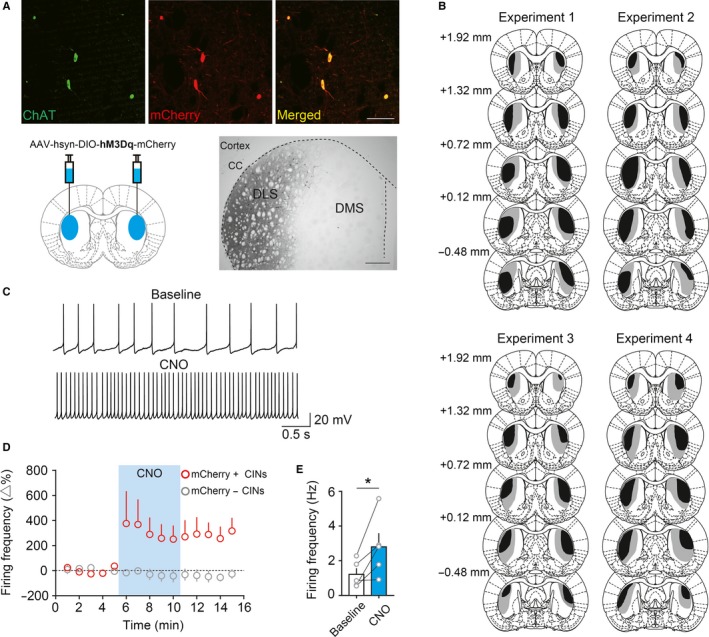
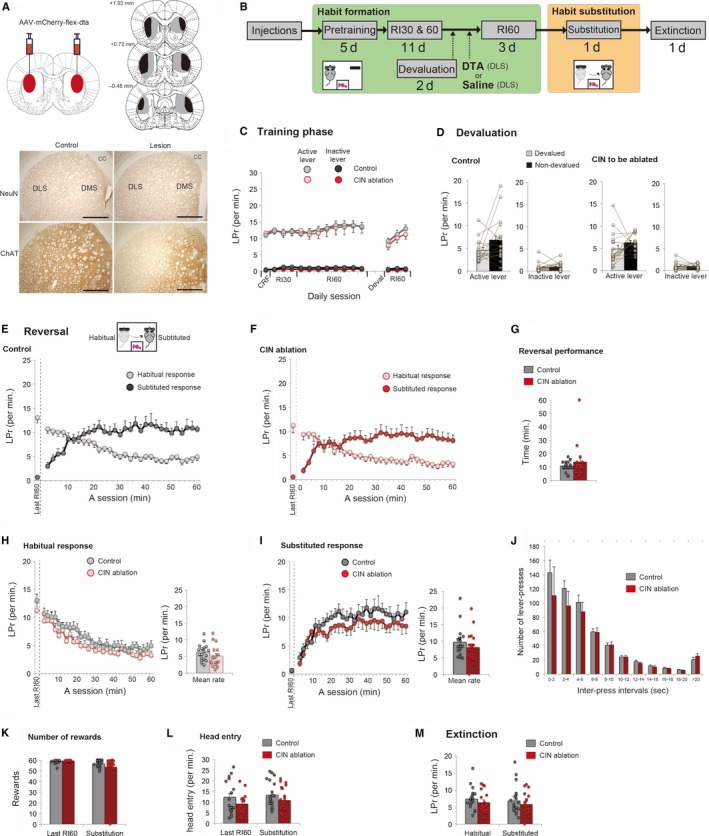
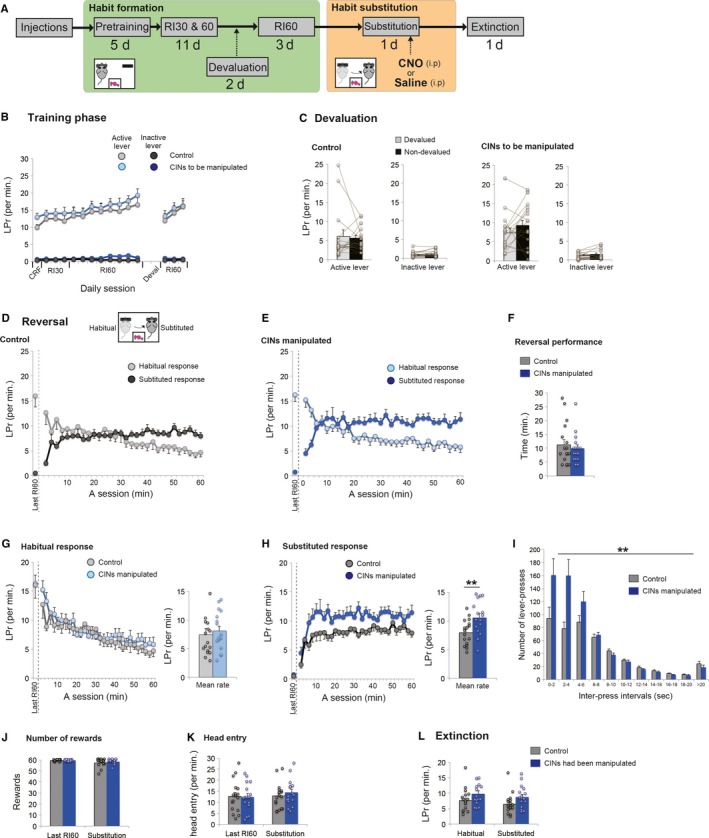
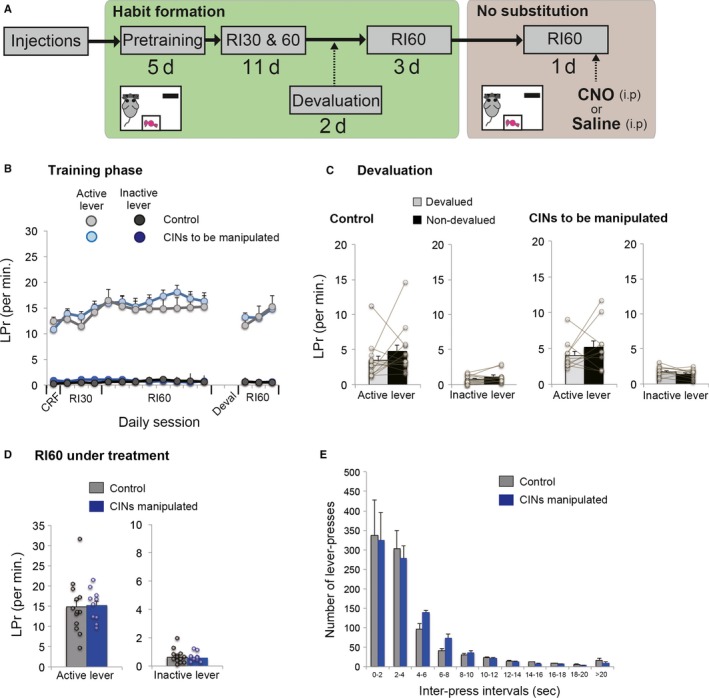
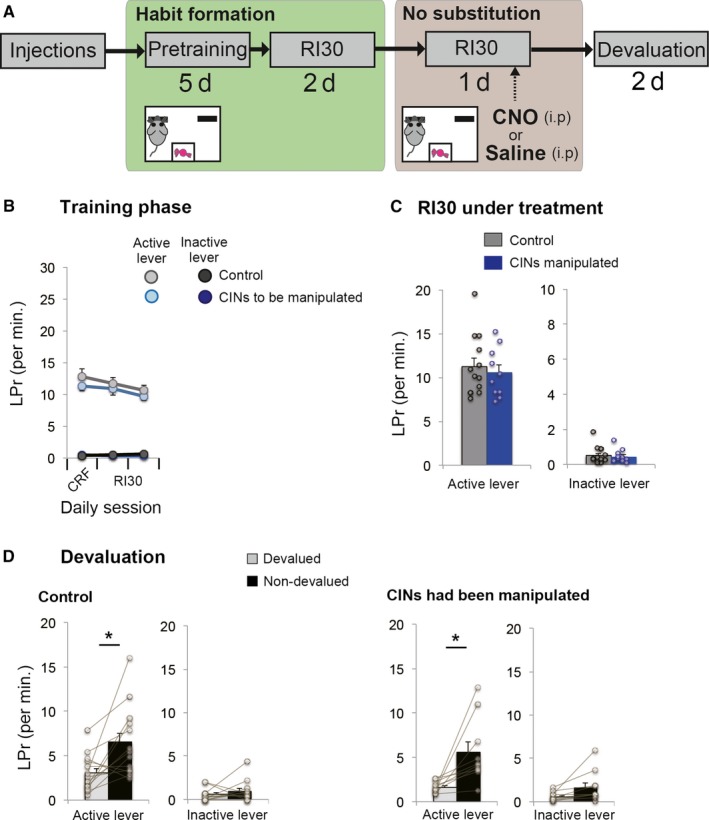
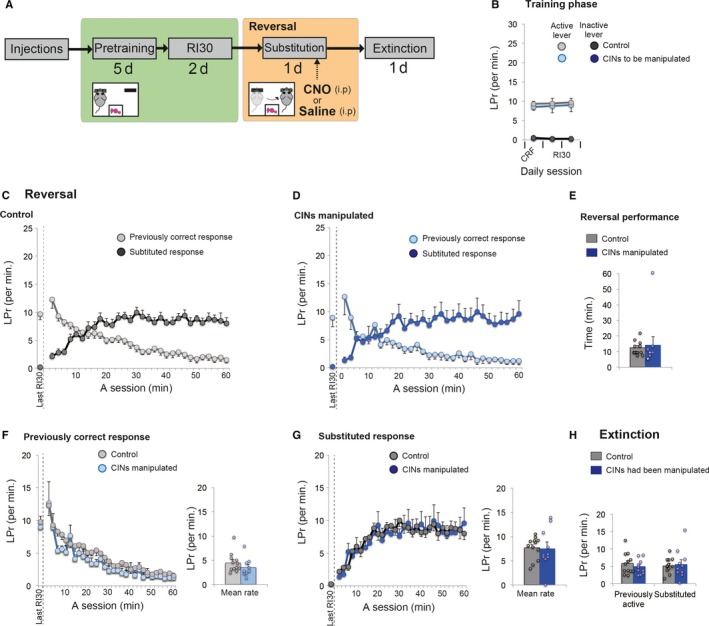
Behavioural flexibility is crucial for adaptive behaviour, and recent evidence suggests that cholinergic interneurons of the striatum play a distinct role. Previous studies of cholinergic function have focused on strategy switching by the dorsomedial or ventral striatum. We here investigated whether cholinergic interneurons in the dorsolateral striatum play a similar role at the level of switching of habitual responses. Because the dorsolateral striatum is particularly involved in habitual responding, we developed a habit substitution task that involved switching habitual lever-press responses to one side to another. We first measured the effect of cholinergic activation in the dorsolateral striatum on this task. Chemogenetic activation of cholinergic interneurons caused an increase in the response rate for the substituted response that was significantly greater than the increase normally seen in control animals. The increase was due to burst-like responses with shorter inter-press intervals. However, there was no effect on inhibiting the old habit, or on habitual responding that did not require a switch. There was also no effect on lever-press performance and its reversal before lever-press responses became habitual. Conversely, neurochemically specific ablation of cholinergic interneurons did not significantly change habitual responding or response substitution. Thus, activation -but not ablation -of cholinergic interneurons in the dorsolateral striatum modulates expression of a new habit when an old habit is replaced by a new one. Together with previous work, this suggests that striatal cholinergic interneurons facilitate behavioural flexibility in both dorsolateral striatum in addition to dorsomedial and ventral striatum.
行为灵活性对于适应行为至关重要,最近的证据表明纹状体中的胆碱能中间神经元起着独特的作用。先前关于胆碱能功能的研究主要集中在背侧和腹侧纹状体的策略转换上。在这里,我们研究了背外侧纹状体中的胆碱能中间神经元是否在习惯反应的转换水平上发挥类似的作用。由于背外侧纹状体特别参与习惯反应,我们开发了一种习惯替代任务,涉及将习惯性压杆反应从一侧切换到另一侧。我们首先测量了背外侧纹状体中胆碱能激活对该任务的影响。背外侧纹状体中胆碱能中间神经元的化学遗传激活导致替代反应的反应率增加,明显大于对照组动物通常观察到的增加。这种增加是由于短间隔的爆发样反应引起的。然而,这对抑制旧习惯或不需要切换的习惯性反应没有影响。对压杆反应成为习惯之前的压杆反应性能及其反转也没有影响。相反,胆碱能中间神经元的神经化学特异性消融并没有显著改变习惯性反应或反应替代。因此,当旧习惯被新习惯取代时,背外侧纹状体中胆碱能中间神经元的激活——而不是消融——调节新习惯的表达。结合以前的工作,这表明纹状体胆碱能中间神经元除了背侧和腹侧纹状体外,还促进了行为灵活性。