Belqaid Kerstin, Tishelman Carol, Orrevall Ylva, Månsson-Brahme Eva, Bernhardson Britt-Marie
Medical Management Centre, Department of Learning, Informatics, Management and Ethics, Karolinska Institutet, Stockholm, Sweden.
Function Area Clinical Nutrition, Karolinska University Hospital, Stockholm, Sweden.
PLoS One. 2018 Jan 23;13(1):e0191117. doi: 10.1371/journal.pone.0191117. eCollection 2018.
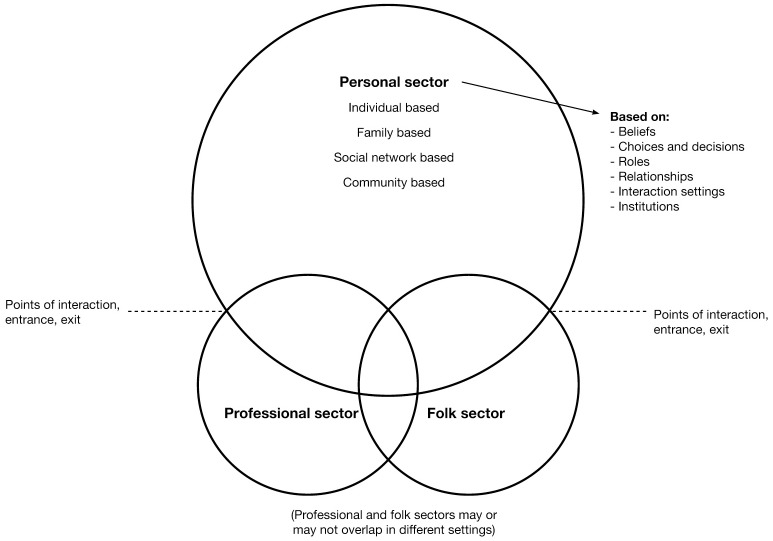
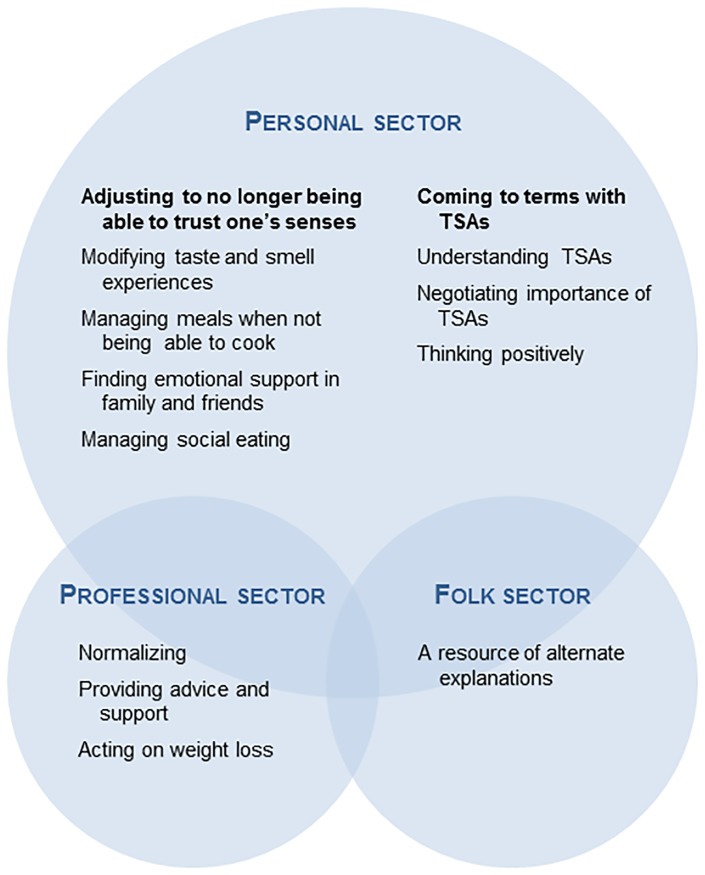
Taste and smell alterations have been recognized as common symptoms in relation to various cancers. However, previous research suggests that patients do not receive sufficient support in managing taste and smell alterations. Therefore, the objective of this study is to investigate how persons with experience from lung cancer-related taste and smell alterations reason about resources and strategies offered and used to manage these symptoms. Data from semi-structured individual interviews with 13 women and four men were analyzed with qualitative content analysis. We used Kleinman's now classic medical anthropological model of local health care systems, consisting of the personal, professional, and folk sector, to interpret and understand how people respond to sickness experiences in their daily lives. By presenting the findings using this model, we demonstrate that most strategies for dealing with taste and smell alterations were undertaken in the personal sector, i.e. in participants' daily lives, on an individual level and in interaction with family, social networks and communities. Taste and smell alterations implied two overarching challenges: 1) adjusting to no longer being able to trust information provided by one's own senses of taste and/or smell, and 2) coming to terms with taste and smell alterations as a part of having lung cancer. Health care professionals' involvement was described as limited, but appeared to fulfil most participants' expectations. However, through provision of normalizing information, practical advice, and to some extent, emotional support, health care professionals had potential to influence strategies and resources used for dealing with taste and smell alterations. With this study, we further the understanding of how people deal with lung cancer-related taste and smell alterations and discuss the role of health care professionals for this process.
味觉和嗅觉改变已被认为是各类癌症的常见症状。然而,先前的研究表明,患者在应对味觉和嗅觉改变方面未得到足够的支持。因此,本研究的目的是调查有肺癌相关味觉和嗅觉改变经历的人如何看待用于管理这些症状的资源和策略。采用定性内容分析法,对13名女性和4名男性进行半结构化个人访谈所得的数据进行了分析。我们运用克莱曼现在经典的地方卫生保健系统医学人类学模型(该模型由个人、专业和民间部门组成)来解释和理解人们在日常生活中对疾病经历的反应。通过使用该模型呈现研究结果,我们证明,应对味觉和嗅觉改变的大多数策略是在个人部门进行的,即在参与者的日常生活中,在个人层面以及与家庭、社交网络和社区的互动中进行。味觉和嗅觉改变意味着两大总体挑战:1)适应不再能够信任自己味觉和/或嗅觉所提供的信息,以及2)接受味觉和嗅觉改变是患肺癌的一部分。医疗保健专业人员的参与被描述为有限,但似乎满足了大多数参与者的期望。然而,通过提供规范化信息、实用建议以及在一定程度上提供情感支持,医疗保健专业人员有可能影响用于应对味觉和嗅觉改变的策略和资源。通过本研究,我们进一步了解了人们如何应对肺癌相关的味觉和嗅觉改变,并讨论了医疗保健专业人员在此过程中的作用。