Menigoz Karen, Nathan Andrea, Heesch Kristiann C, Turrell Gavin
School of Public Health and Social Work and Institute of Health and Biomedical Innovation, Queensland University of Technology (QUT), Brisbane, Queensland, Australia.
Institute for Health & Ageing, Australian Catholic University (ACU), Melbourne, Victoria, Australia.
PLoS One. 2018 Jan 23;13(1):e0191729. doi: 10.1371/journal.pone.0191729. eCollection 2018.
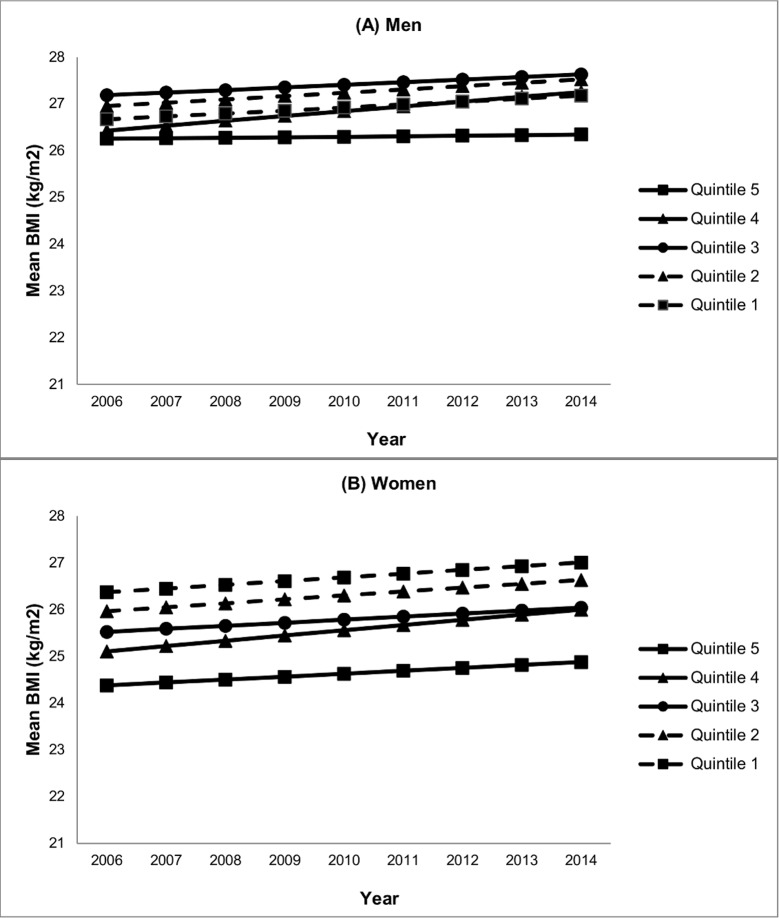
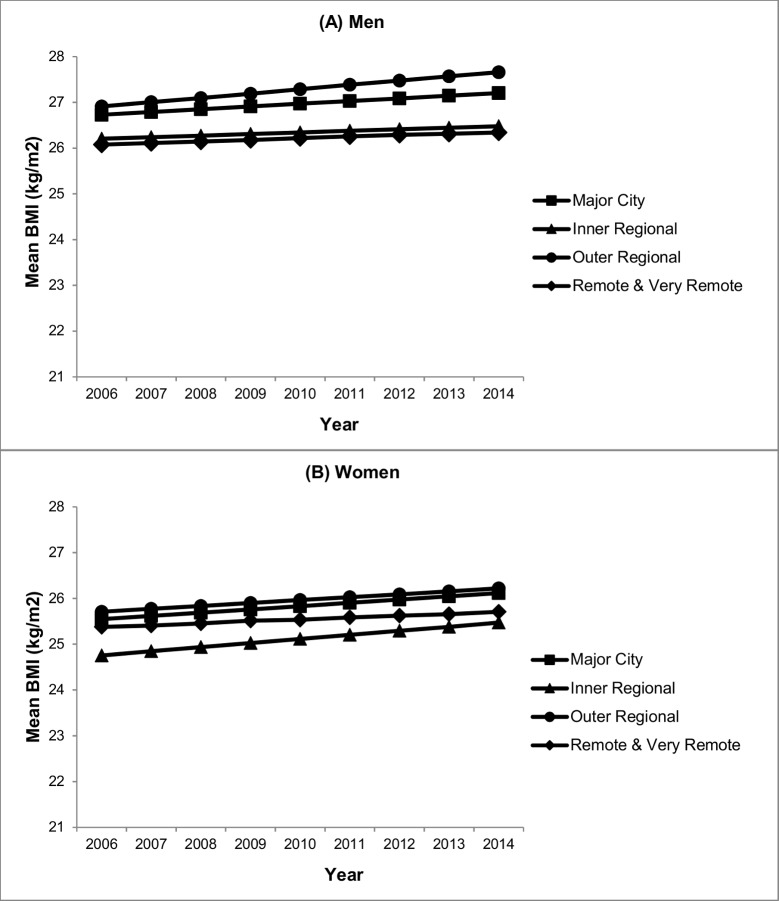
Obesity is socioeconomically, geographically and ethnically patterned. Understanding these elements of disadvantage is vital in understanding population obesity trends and the development of effective and equitable interventions. This study examined the relationship between neighbourhood socioeconomic disadvantage and geographic remoteness with prospective trends in mean body mass index (BMI) among immigrants to Australia. Longitudinal data (2006-2014) from a national panel survey of Australian adults was divided into an immigrant-only sample (n = 4,293, 52.6% women and 19,404 person-year observations). The data were analysed using multi-level random effects linear regression modelling that controlled for individual socioeconomic and demographic factors. Male immigrants living in the most disadvantaged neighbourhoods had significantly higher mean BMI compared with those living in the least disadvantaged. Over time, mean BMI increased for all groups except for men living in the least disadvantaged neighbourhoods, for whom mean BMI remained almost static (0.1 kg/m2 increase from 2006 to 2014), effectively widening neighbourhood inequalities. Among women, mean BMI was also significantly higher in the most compared with the least, disadvantaged neighbourhoods (β = 2.08 kg/m2; 95%CI: 1.48, 2.68). Neighbourhood inequalities were maintained over time as mean BMI increased for all groups at a similar rate. Male and female immigrants residing in outer regional areas had significantly higher mean BMI compared with those living in major cities; however, differences were attenuated and no longer significant following adjustment for ethnicity, individual socioeconomic position and neighbourhood disadvantage. Over time, mean BMI increased in all male and female groups with no differences based on geographic remoteness. Obesity prevention policy targeted at immigrant cohorts needs to include area-level interventions that address inequalities in BMI arising from neighbourhood disadvantage, and be inclusive of immigrants living outside Australia's major cities.
肥胖在社会经济、地理和种族方面呈现出一定模式。了解这些不利因素对于理解人群肥胖趋势以及制定有效且公平的干预措施至关重要。本研究探讨了澳大利亚移民中邻里社会经济劣势和地理偏远程度与平均体重指数(BMI)的前瞻性趋势之间的关系。来自澳大利亚成年人全国性面板调查的纵向数据(2006 - 2014年)被分为仅包含移民的样本(n = 4293,52.6%为女性,共19404人年观察数据)。使用多水平随机效应线性回归模型对数据进行分析,该模型控制了个体社会经济和人口统计学因素。与生活在最不贫困社区的男性移民相比,生活在最贫困社区的男性移民平均BMI显著更高。随着时间推移,除了生活在最不贫困社区的男性,所有群体的平均BMI都有所增加,而这些男性的平均BMI几乎保持不变(从2006年到2014年增加了0.1kg/m²),这实际上加剧了邻里间的不平等。在女性中,与最不贫困社区相比,最贫困社区的平均BMI也显著更高(β = 2.08kg/m²;95%置信区间:1.48,2.68)。随着所有群体的平均BMI以相似速度增加,邻里间的不平等在一段时间内持续存在。与居住在大城市的移民相比,居住在偏远地区的男性和女性移民平均BMI显著更高;然而,在对种族、个体社会经济地位和邻里劣势进行调整后,差异减弱且不再显著。随着时间推移,所有男性和女性群体的平均BMI都有所增加,且不存在基于地理偏远程度的差异。针对移民群体的肥胖预防政策需要包括针对邻里劣势导致的BMI不平等问题的地区层面干预措施,并且要涵盖居住在澳大利亚主要城市以外的移民。