Viral Pathogenesis and Evolution Section, Laboratory of Infectious Diseases, Division of Intramural Research, National Institute of Allergy and Infectious Diseases, National Institutes of Health, Bethesda, Maryland, USA.
Viral Pathogenesis and Evolution Section, Laboratory of Infectious Diseases, Division of Intramural Research, National Institute of Allergy and Infectious Diseases, National Institutes of Health, Bethesda, Maryland, USA
mBio. 2018 Jan 23;9(1):e02284-17. doi: 10.1128/mBio.02284-17.
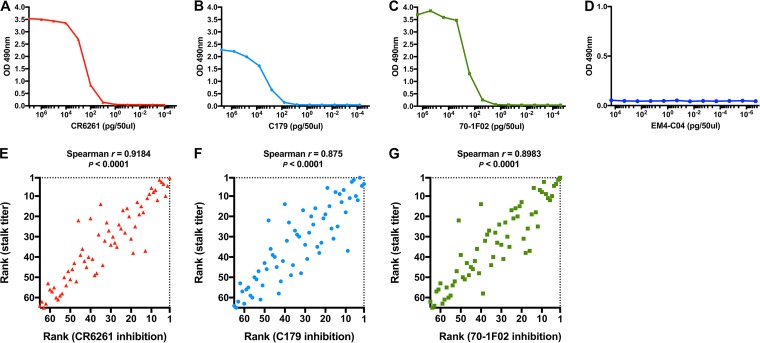
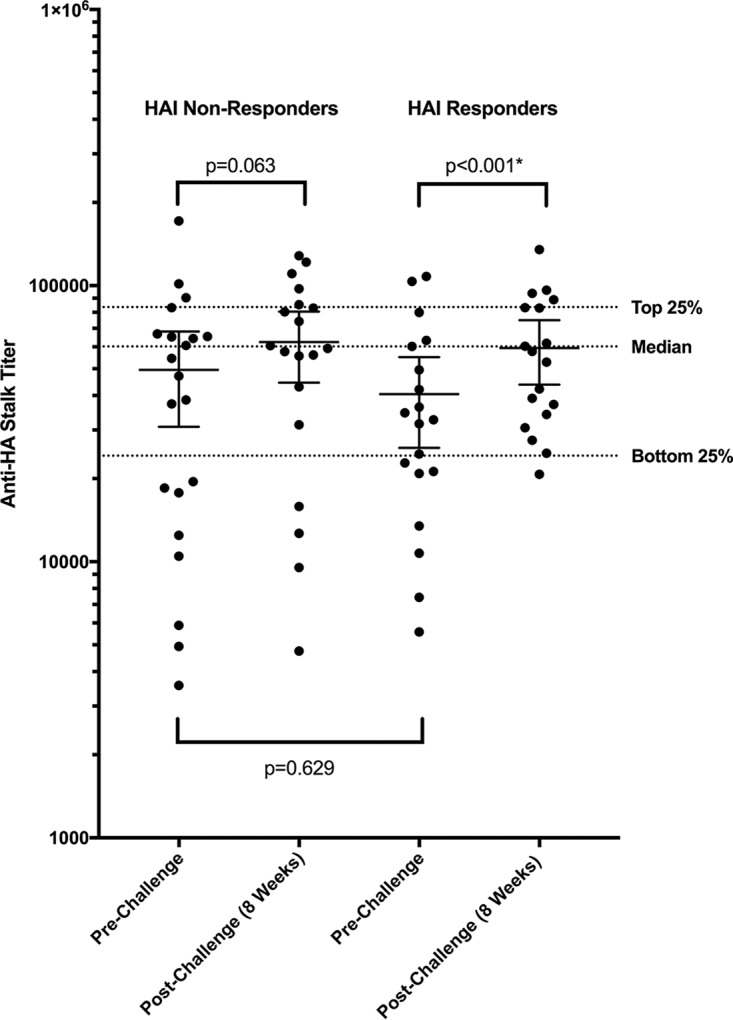
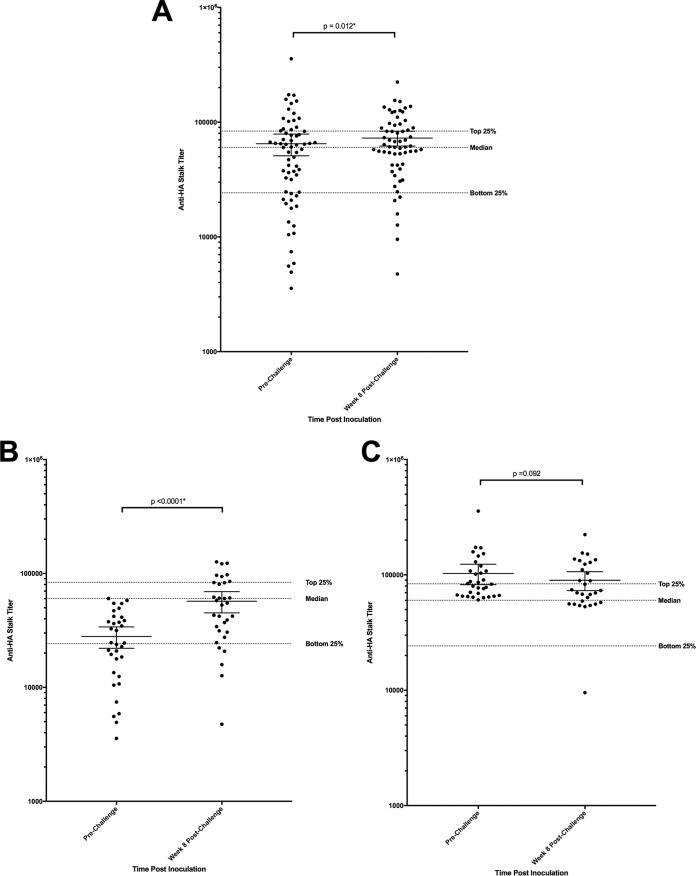
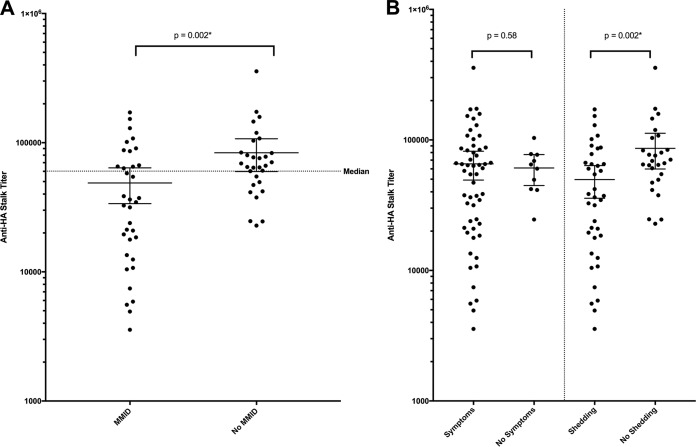
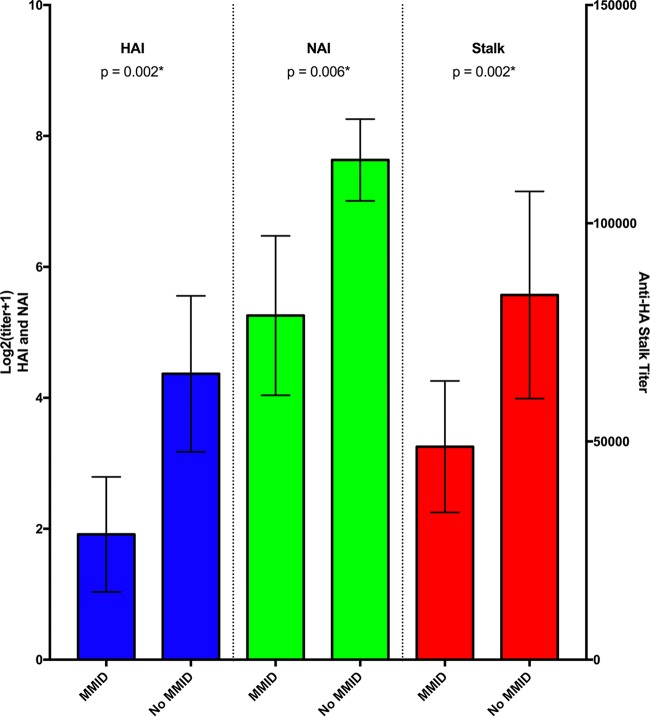
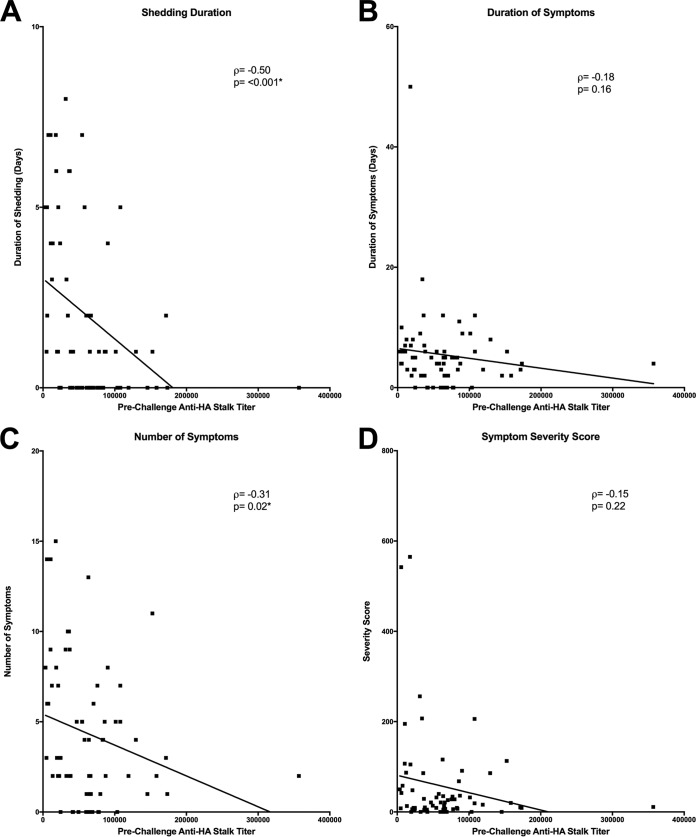
Influenza virus hemagglutinin (HA) surface glycoprotein is currently the primary target of licensed influenza vaccines. Recently, broadly reactive antibodies that target the stalk region of the HA have become a major focus of current novel vaccine development. These antibodies have been observed in humans after natural infection with influenza A virus, but the data are limited. Using samples and data from the uniquely controlled setting of an influenza A/H1N1 virus human challenge study of healthy volunteers, we performed a secondary analysis that for the first time explores the role of anti-HA stalk antibody as a human correlate of protection. An anti-HA stalk antibody enzyme-linked immunosorbent assay (ELISA) was performed on samples from 65 participants challenged with a 2009 H1N1pdm virus. Pre- and postchallenge anti-HA stalk titers were then correlated with multiple outcome measures to evaluate anti-HA stalk antibody titer as a correlate of protection. Anti-HA stalk antibody titers were present before challenge and rose in response to challenge in 64% of individuals. Those individuals with higher titers at baseline were less likely to develop shedding, but not less likely to develop symptoms. Similar to the hemagglutination inhibition (HAI) titer, the baseline anti-HA stalk antibody titer did not independently predict a decrease in the severity of influenza disease, while the antineuraminidase (neuraminidase inhibition [NAI]) titer did. As a correlate of protection, the naturally occurring anti-HA stalk antibody titer is predictive of a reduction of certain aspects of disease similar to HAI titer, but the NAI titer is the only identified correlate that is an independent predictor of a reduction of all assessed influenza clinical outcome measures. This is the first study to evaluate preexisting anti-HA stalk antibodies as a predictor of protection. We use a healthy volunteer influenza challenge trial for an examination of the role such antibodies play in protection. This study demonstrates that anti-HA stalk antibodies are naturally generated in response to an infection, but there is significant variability in response. Similar to antibodies that target the HA head, baseline anti-HA stalk antibody titer is a correlate of protection in terms of reduced shedding, but it is not a predictor of reduced clinical disease or an independent predictor of disease severity. These results, in the context of the limited data available in humans, suggest that vaccines that induce anti-HA stalk antibodies could play a role in future vaccine strategies, but alone, this target may be insufficient to induce a fully protective vaccine and overcome some of the issues identified with current vaccines.
流感病毒血凝素 (HA) 表面糖蛋白目前是许可流感疫苗的主要靶标。最近,针对 HA 茎部的广泛反应性抗体已成为当前新型疫苗开发的主要焦点。这些抗体在人类感染甲型流感病毒后被观察到,但数据有限。利用在健康志愿者中进行的甲型 H1N1 流感病毒人体挑战研究的独特控制环境中的样本和数据,我们进行了二次分析,首次探讨了抗 HA 茎部抗体作为人类保护相关因素的作用。对 65 名接受 2009 年 H1N1pdm 病毒挑战的参与者的样本进行了抗 HA 茎部抗体酶联免疫吸附测定 (ELISA)。然后将预先和挑战后的抗 HA 茎部滴度与多种结果测量相关联,以评估抗 HA 茎部抗体滴度作为保护相关因素。在挑战之前就存在抗 HA 茎部抗体滴度,并且在 64%的个体中响应挑战而增加。基线时滴度较高的个体不太可能发生脱落,但不太可能发生症状。与血凝抑制 (HAI) 滴度类似,基线抗 HA 茎部抗体滴度不能独立预测流感疾病严重程度的降低,而神经氨酸酶抑制 (NAI) 滴度可以。作为保护相关因素,天然存在的抗 HA 茎部抗体滴度可预测疾病某些方面的减少,类似于 HAI 滴度,但 NAI 滴度是唯一确定的可独立预测所有评估的流感临床结局测量值减少的相关因素。这是第一项评估预先存在的抗 HA 茎部抗体作为保护预测因子的研究。我们使用健康志愿者流感挑战试验来检查此类抗体在保护中的作用。这项研究表明,抗 HA 茎部抗体是针对感染自然产生的,但反应存在很大差异。与针对 HA 头部的抗体类似,基线抗 HA 茎部抗体滴度是减少脱落的保护相关因素,但不是减少临床疾病的预测因子,也不是疾病严重程度的独立预测因子。这些结果在人类中可用数据有限的背景下表明,诱导抗 HA 茎部抗体的疫苗可能在未来疫苗策略中发挥作用,但仅凭这一目标可能不足以诱导完全保护性疫苗并克服当前疫苗存在的一些问题。