Tebyanian Hamid, Karami Ali, Motavallian Ebrahim, Aslani Jafar, Samadikuchaksaraei Ali, Arjmand Babak, Nourani Mohammad Reza
Division of Tissue Engineering and Regenerative Medicine, Nanobiotechnology Research Center, Baqiyatallah University of Medical Sciences, Tehran, Iran.
Research Center for Prevention of Oral and Dental Disease, Baqiyatallah University of Medical Sciences, Tehran, Iran.
Open Access Maced J Med Sci. 2017 Dec 6;5(7):859-865. doi: 10.3889/oamjms.2017.179. eCollection 2017 Dec 15.
Lung disease is the most common cause of death in the world. The last stage of pulmonary diseases is lung transplantation. Limitation and shortage of donor organs cause to appear tissue engineering field. Decellularization is a hope for producing intact ECM in the development of engineered organs.
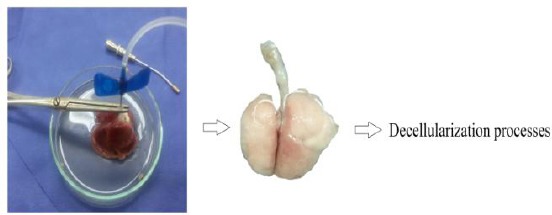
The goal of the decellularization process is to remove cellular and nuclear material while retaining lung three-dimensional and molecular proteins. Different concentration of detergents was used for finding the best approach in lung decellularization.
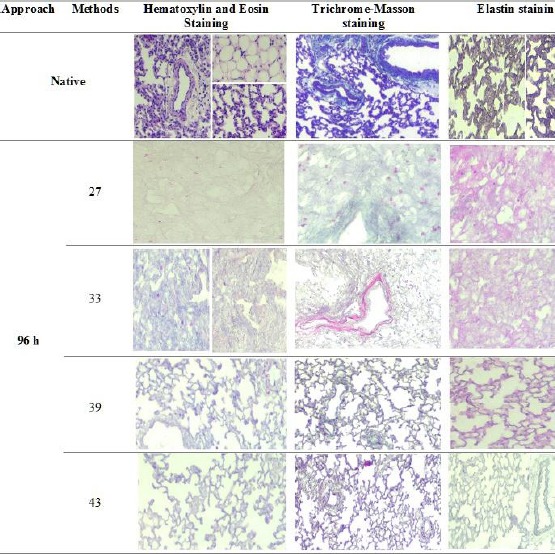
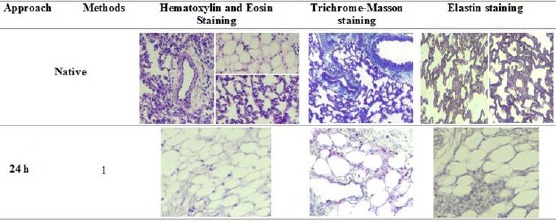
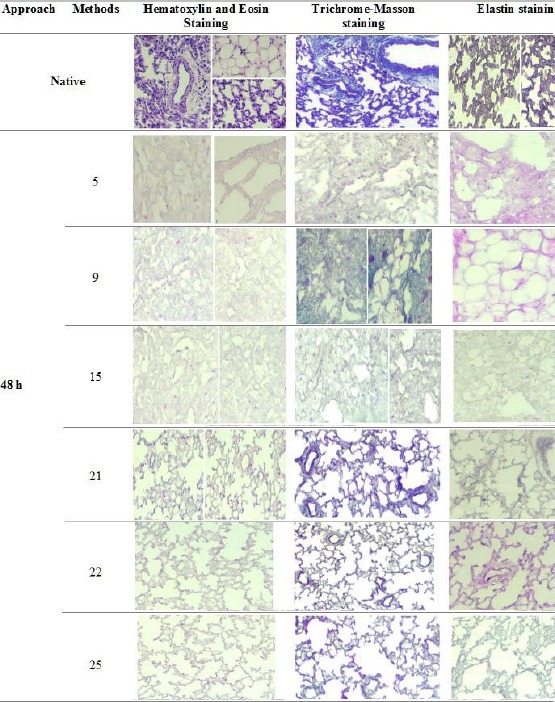
In this study, three-time approaches (24, 48 and 96 h) with four detergents (CHAPS, SDS, SDC and Triton X-100) were used for decellularizing rat lungs for maintaining of three-dimensional lung architecture and ECM protein composition which have significant roles in differentiation and migration of stem cells. This comparative study determined that variable decellularization approaches can cause significantly different effects on decellularized lungs.
Results showed that destruction was increased with increasing the detergent concentration. Single detergent showed a significant reduction in maintaining of three-dimensional of lung and ECM proteins (Collagen and Elastin). But, the best methods were mixed detergents of SDC and CHAPS in low concentration in 48 and 96 h decellularization.
Decellularized lung tissue can be used in the laboratory to study various aspects of pulmonary biology and physiology and also, these results can be used in the continued improvement of engineered lung tissue.
肺部疾病是全球最常见的死亡原因。肺部疾病的最后阶段是肺移植。供体器官的限制和短缺促使组织工程领域的出现。去细胞化是在工程器官开发中产生完整细胞外基质(ECM)的希望。
去细胞化过程的目标是去除细胞和核物质,同时保留肺的三维结构和分子蛋白。使用不同浓度的去污剂来寻找肺去细胞化的最佳方法。
在本研究中,采用三种时长方法(24、48和96小时)以及四种去污剂(CHAPS、SDS、SDC和Triton X-100)对大鼠肺进行去细胞化处理,以维持对干细胞分化和迁移具有重要作用的肺三维结构和ECM蛋白组成。这项比较研究确定,不同的去细胞化方法对去细胞化后的肺会产生显著不同的影响。
结果表明,随着去污剂浓度的增加,破坏程度加剧。单一去污剂在维持肺的三维结构和ECM蛋白(胶原蛋白和弹性蛋白)方面显示出显著降低。但是,最佳方法是在48小时和96小时去细胞化处理中使用低浓度的SDC和CHAPS混合去污剂。
去细胞化的肺组织可用于实验室研究肺部生物学和生理学的各个方面,而且,这些结果可用于持续改进工程肺组织。