Angell Joseph William, Grove-White Dai H, Duncan Jennifer S
Department of Epidemiology and Population Health, Institute of Infection and Global Health, The University of Liverpool, Neston, UK.
Wern Veterinary Surgeons, Unit 11, Lon Parcwr Industrial Estate, Ruthin, UK.
Vet Rec. 2018 Mar 10;182(10):293. doi: 10.1136/vr.104553. Epub 2018 Jan 23.
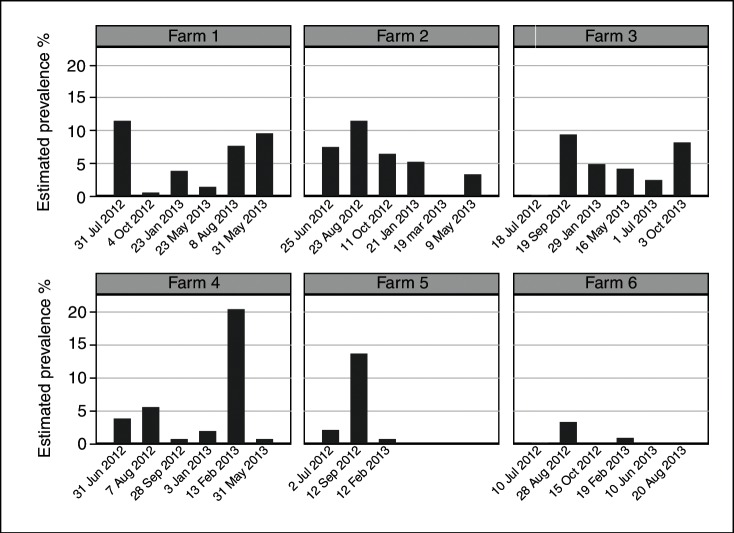
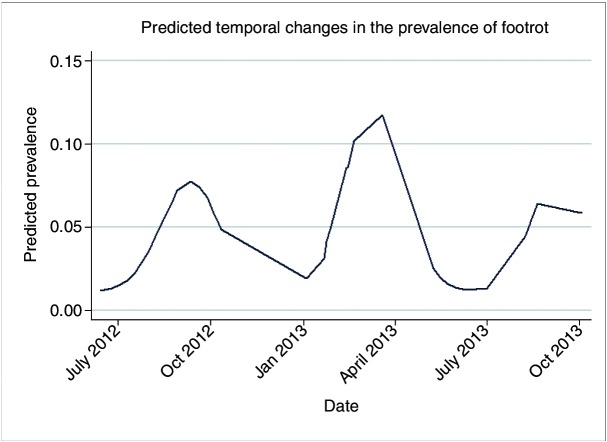
Footrot is an ovine foot disease of infectious origin and a cause of serious welfare and economic compromise in affected animals and flocks. The development of footrot in sheep is associated with the infectious agent , which may invade as a primary pathogen, but the risk of disease is increased following damage to the interdigital skin of the foot. In this study, we used data from six farms in North Wales collected between June 2012 and October 2013 to model the dynamic changes of footrot prevalence over time and investigate the association of footrot with multiple farm, management, environmental and sheep factors. Footrot prevalence varied widely within and between farms and overall varied with season with an increase in prevalence shown in late summer and again in the spring. In addition, sheep were more likely to have footrot when the flock size was larger, when grazing poached pasture or when grazing a longer sward, and yearling sheep were less likely to have footrot when compared with lambs and adult sheep. These data may be helpful for advising farmers of likely environmental events, risk groups and management practices that may increase the probability of sheep developing footrot.
腐蹄病是一种具有传染性的绵羊足部疾病,会给患病动物和羊群带来严重的福利问题和经济损失。绵羊腐蹄病的发生与感染因子有关,该感染因子可能作为原发性病原体侵入,但足部趾间皮肤受损后疾病风险会增加。在本研究中,我们使用了2012年6月至2013年10月期间从北威尔士六个农场收集的数据,对腐蹄病患病率随时间的动态变化进行建模,并研究腐蹄病与多种农场、管理、环境和绵羊因素之间的关联。农场内部和农场之间的腐蹄病患病率差异很大,总体上随季节变化,夏末和春季患病率会升高。此外,当羊群规模较大、在泥泞的牧场放牧或放牧较高的草时,绵羊患腐蹄病的可能性更大,与羔羊和成年羊相比,一岁羊患腐蹄病的可能性较小。这些数据可能有助于向农民提供建议,告知他们可能导致绵羊患腐蹄病概率增加的环境事件、风险群体和管理措施。