Laboratory of Viral Hepatitis, Oswaldo Cruz Institute, FIOCRUZ, Rio de Janeiro 210360-040, Brazil.
Molecular Virology Laboratory, Helio and Peggy Pereira Pavillion-Ground Floor, FIOCRUZ, Rio de Janeiro 210360-040, Brazil.
Int J Environ Res Public Health. 2018 Jan 24;15(2):189. doi: 10.3390/ijerph15020189.
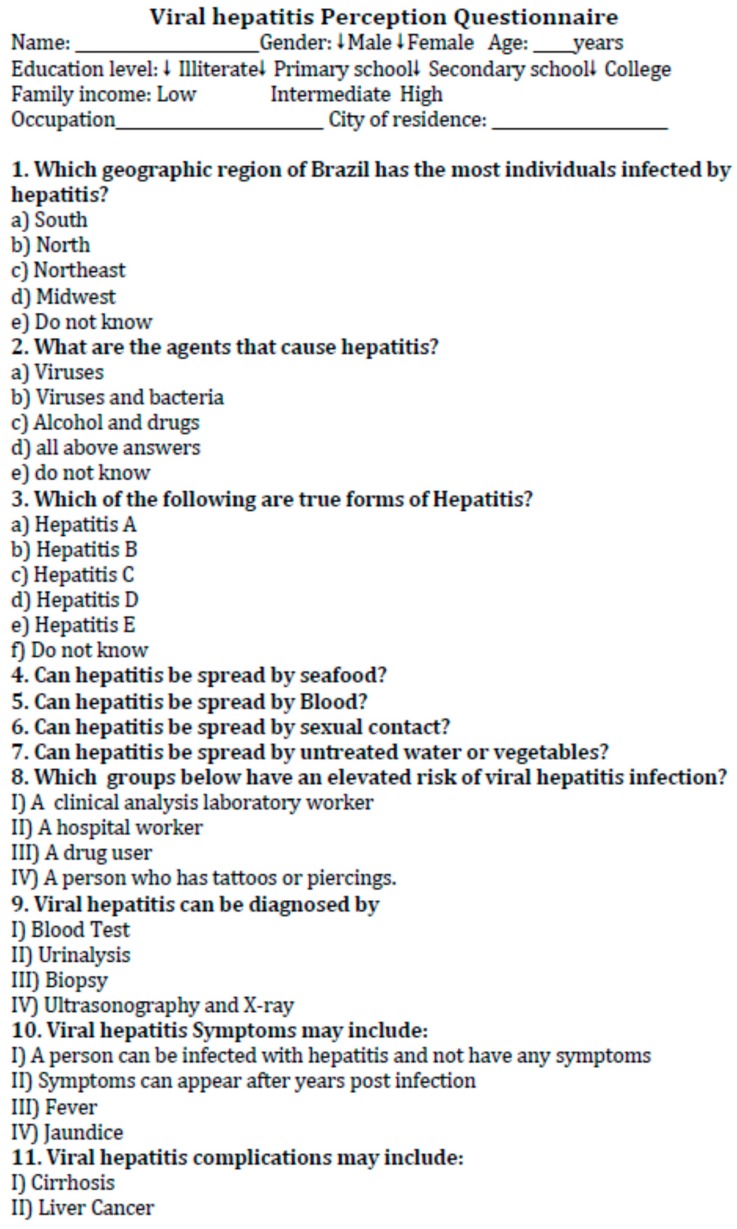
Few data are available regarding viral hepatitis perception among the general global population. The present study aims to estimate the perception of viral hepatitis in a cohort of individuals living in two geographical regions of Brazil: North (Manaus city (MA)) and Southeast (Rio de Janeiro city (RJ)). A cross-sectional, descriptive study was carried out among 287 subjects recruited in MA (134) and RJ (153). All individuals answered a questionnaire assessing socio-demographic characteristics and viral hepatitis awareness. Participants' responses were scored and divided using interquartile values. Associations between socio-demographic characteristics and knowledge were also evaluated. Interquartile analysis scored 0-21 correct answers as "Very Weak"; 22-27 as "Weak"; 28-31 as "Intermediate"; and 32-47 as "Desirable". Mean ± standard deviations (SD) of correct responses were weak in both MA (24.1 ± 7.0) and RJ (26.3 ± 7.3). Bivariate analysis showed an association between viral hepatitis awareness and both education level ( < 0.001) and family income ( < 0.01). Desirable scores were more common in female participants (61%), those aged between 21-30 years (40%), those with a secondary education (51.7%), those who received high income (31.6%), and those from RJ (70.0%). Health education campaigns in these cities are recommended to increase knowledge and reduce the transmission of these viruses.
关于普通全球人群对病毒性肝炎的认知,目前的数据很少。本研究旨在评估生活在巴西两个地区的人群对病毒性肝炎的认知:北部(马瑙斯市(MA))和东南部(里约热内卢市(RJ))。这是一项在马瑙斯(134 人)和里约热内卢(153 人)招募的 287 名个体中进行的横断面描述性研究。所有参与者均回答了一份评估社会人口统计学特征和病毒性肝炎认知的问卷。根据四分位值对参与者的回答进行评分和分类。还评估了社会人口统计学特征与知识之间的关联。四分位分析将 0-21 个正确答案评为“非常弱”;22-27 个评为“弱”;28-31 个评为“中等”;32-47 个评为“理想”。马瑙斯(24.1 ± 7.0)和里约热内卢(26.3 ± 7.3)的正确反应平均值±标准差(SD)均较弱。双变量分析显示,病毒性肝炎认知与教育水平(<0.001)和家庭收入(<0.01)有关。在女性参与者(61%)、21-30 岁的参与者(40%)、接受过中等教育的参与者(51.7%)、收入较高的参与者(31.6%)以及来自里约热内卢的参与者(70.0%)中,理想分数更为常见。建议在这些城市开展健康教育活动,以提高知识水平并减少这些病毒的传播。