Sullivan Cris M
Psychology Department, Michigan State University, 316 Physics Rd., E. Lansing, MI 48824 USA.
J Fam Violence. 2018;33(2):123-131. doi: 10.1007/s10896-017-9931-6. Epub 2017 Jul 18.
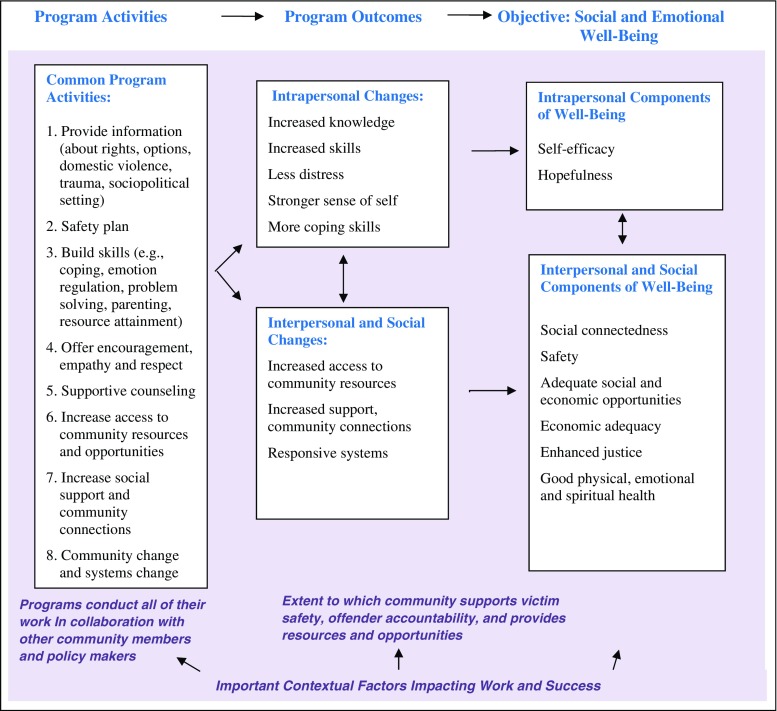
Domestic violence (DV) victim service programs have been increasingly expected by legislators and funders to demonstrate that they are making a significant difference in the lives of those using their services. Alongside this expectation, they are being asked to describe the Theory of Change guiding how they believe their practices lead to positive results for survivors and their children. Having a widely accepted conceptual model is not just potentially useful to funders and policy makers as they help shape policy and practice -- it can also help programs continually reflect upon and improve their work. This paper describes the iterative and collaborative process undertaken to generate a conceptual model describing how DV victim services are expected to improve survivors' lives. The guiding the model is an ideal structure to use to describe the goals and practices of DV programs because this framework: (1) accurately represents DV programs' goal of helping survivors and their children thrive; and (2) recognizes the importance of community, social, and societal context in influencing individuals' social and emotional well-being. The model was designed to guide practice and to generate new questions for research and evaluation that address individual, community, and systems factors that promote or hinder survivor safety and well-being.
立法者和资助者越来越期望家庭暴力(DV)受害者服务项目能够证明它们正在为使用其服务的人们的生活带来重大改变。伴随着这一期望,他们被要求描述变革理论,该理论指导着他们认为自身的做法如何为幸存者及其子女带来积极成果。拥有一个被广泛接受的概念模型不仅对资助者和政策制定者在帮助制定政策和实践时可能有用——它还可以帮助项目不断反思和改进其工作。本文描述了为生成一个描述DV受害者服务预期如何改善幸存者生活的概念模型而进行的迭代和协作过程。指导该模型的是一个理想的结构,可用于描述DV项目的目标和实践,因为这个框架:(1)准确代表了DV项目帮助幸存者及其子女茁壮成长的目标;(2)认识到社区、社会和社会背景在影响个人社会和情感福祉方面的重要性。该模型旨在指导实践,并为研究和评估提出新问题,这些问题涉及促进或阻碍幸存者安全和福祉的个人、社区和系统因素。