Balik-Meisner Michele, Truong Lisa, Scholl Elizabeth H, Tanguay Robert L, Reif David M
Bioinformatics Research Center, Center for Human Health and the Environment, Department of Biological Sciences, North Carolina State University, Ricks Hall 344, 1 Lampe Drive, Box 7566, Raleigh, NC, 27695, USA.
Sinnhuber Aquatic Research Laboratory, Department of Environmental and Molecular Toxicology, Oregon State University, Corvallis, OR, 97331, USA.
Mamm Genome. 2018 Feb;29(1-2):90-100. doi: 10.1007/s00335-018-9735-x. Epub 2018 Jan 24.
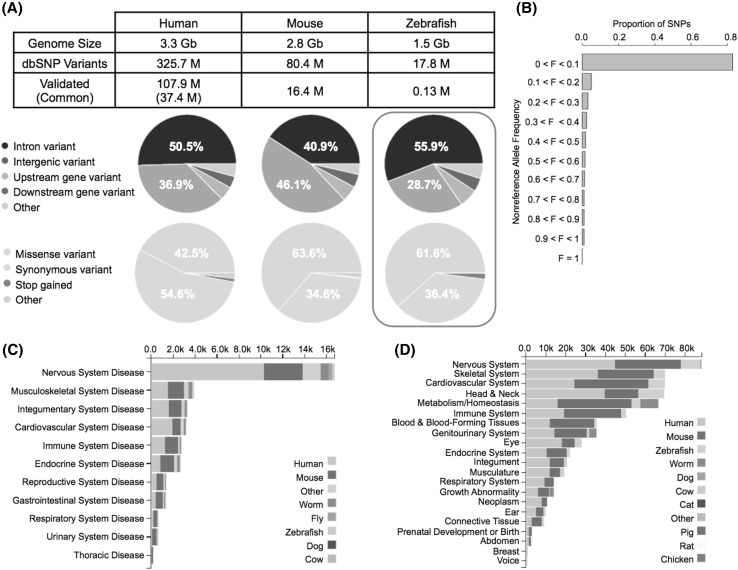
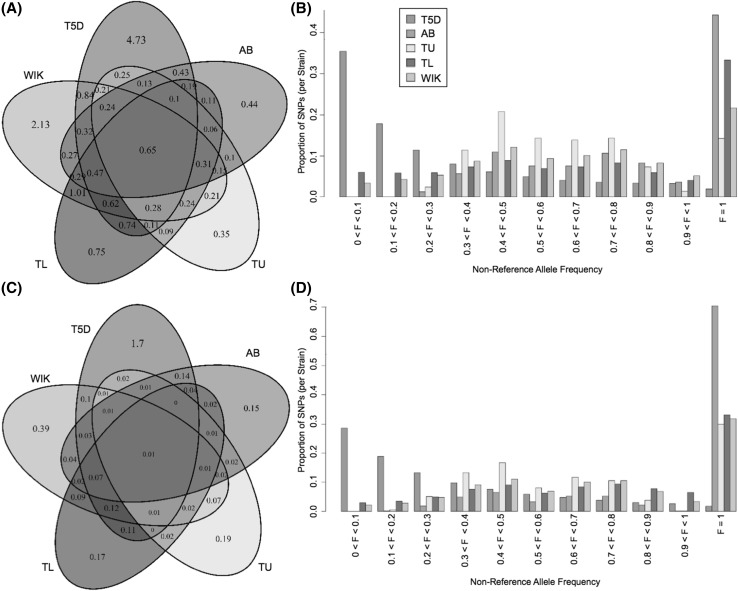
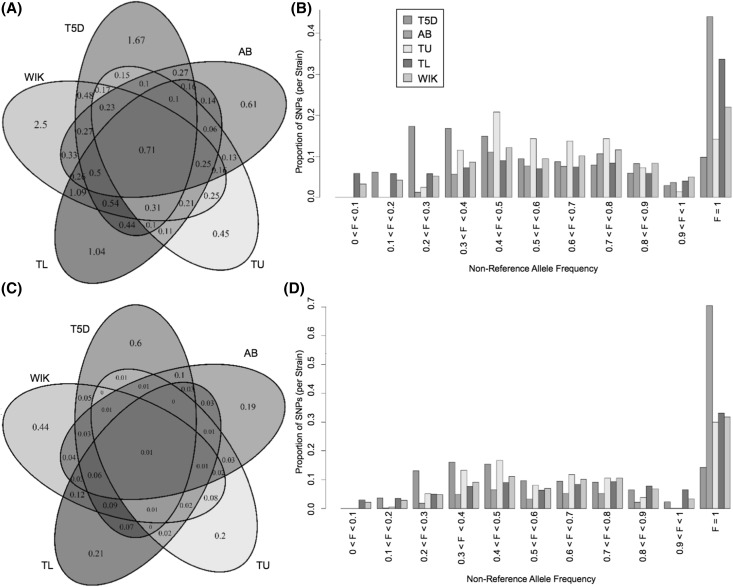
Toxicological and pharmacological researchers have seized upon the many benefits of zebrafish, including the short generation time, well-characterized development, and early maturation as clear embryos. A major difference from many model organisms is that standard husbandry practices in zebrafish are designed to maintain population diversity. While this diversity is attractive for translational applications in human and ecological health, it raises critical questions on how interindividual genetic variation might contribute to chemical exposure or disease susceptibility differences. Findings from pooled samples of zebrafish support this supposition of diversity yet cannot directly measure allele frequencies for reference versus alternate alleles. Using the Tanguay lab Tropical 5D zebrafish line (T5D), we performed whole genome sequencing on a large group (n = 276) of individual zebrafish embryos. Paired-end reads were collected on an Illumina 3000HT, then aligned to the most recent zebrafish reference genome (GRCz10). These data were used to compare observed population genetic variation across species (humans, mice, zebrafish), then across lines within zebrafish. We found more single nucleotide polymorphisms (SNPs) in T5D than have been reported in SNP databases for any of the WIK, TU, TL, or AB lines. We theorize that some subset of the novel SNPs may be shared with other zebrafish lines but have not been identified in other studies due to the limitations of capturing population diversity in pooled sequencing strategies. We establish T5D as a model that is representative of diversity levels within laboratory zebrafish lines and demonstrate that experimental design and analysis can exert major effects when characterizing genetic diversity in heterogeneous populations.
毒理学和药理学研究人员已经利用了斑马鱼的诸多优势,包括世代时间短、发育特征明确以及作为透明胚胎早期成熟。与许多模式生物的一个主要区别在于,斑马鱼的标准养殖方法旨在维持种群多样性。虽然这种多样性对于人类和生态健康的转化应用具有吸引力,但它引发了关于个体间遗传变异如何可能导致化学物质暴露或疾病易感性差异的关键问题。来自斑马鱼混合样本的研究结果支持了这种多样性的假设,但无法直接测量参考等位基因与替代等位基因的等位基因频率。我们使用坦圭实验室的热带5D斑马鱼品系(T5D),对一大组(n = 276)个体斑马鱼胚胎进行了全基因组测序。在Illumina 3000HT上收集双端读数,然后与最新的斑马鱼参考基因组(GRCz10)进行比对。这些数据用于比较不同物种(人类、小鼠、斑马鱼)之间以及斑马鱼内不同品系之间观察到的种群遗传变异。我们发现T5D中的单核苷酸多态性(SNP)比WIK、TU、TL或AB品系的任何SNP数据库中报道的都要多。我们推测,一些新的SNP子集可能与其他斑马鱼品系共享,但由于在混合测序策略中捕获种群多样性的局限性,在其他研究中尚未被识别。我们将T5D确立为一个代表实验室斑马鱼品系内多样性水平的模型,并证明在表征异质种群的遗传多样性时,实验设计和分析可以产生重大影响。